Big Data Modernization: What Changes When You Leave Hadoop

Key takeaways
- Big data modernization replaces the Hadoop operating model, not only the hardware. Storage moves to Amazon S3, compute runs per job, and catalog, lineage and access control become platform services instead of scripts.
- Hadoop isn't dead, but the self-managed cluster is retiring. The Apache project shipped Hadoop 3.5.0 in April 2026; what enterprises are switching off is the cluster that ties storage to always-on compute.
- Each Hadoop component has its own destination. HDFS goes to Amazon S3, Hive tables to Apache Iceberg, Spark to Amazon EMR or AWS Glue, Oozie to managed orchestration, and MapReduce is usually retired or rewritten.
- Hive-to-Iceberg conversion got simpler in November 2026. Amazon S3 Tables now migrates Glue-registered Hive tables stored as Parquet into Iceberg as a managed workflow, with repeated syncs and writes paused only for a few minutes at cutover.
- Retiring the old path is what pays. At AEP, HDFS was retired as the meter data pipeline moved to PySpark on Apache Iceberg, and its longest jobs went from 17 hours to 15 to 20 minutes at 35% lower cost, in 13 weeks.
Moving off Hadoop changes more than where your data lives. It changes the operating model: storage separates from compute, pipelines become governed and observable, security becomes policy-driven, and AI systems get a data foundation they can trust.
Hadoop still runs critical workloads, and for most enterprises the question is no longer whether it can process data. It's whether the cluster, its operational burden, its security model and its cost structure still fit the business. Big data modernization is the Hadoop-retirement track of a wider data modernization program, which on AWS usually lands on Amazon S3 with Apache Iceberg tables, AWS Glue, AWS Lake Formation, Amazon Athena and Amazon Redshift.
We've built data platforms on AWS since 2008, and this field note draws on two published Hadoop exits: Flipboard's Hadoop-backed database, retired under live engagement load, and AEP's interval meter pipeline, moved off HiveQL on HDFS. Apache and AWS facts were checked in November 2026.
Why Are Enterprises Moving Off Hadoop?
Because Hadoop was designed for a different era: large batch processing, storage and compute coupled on the same nodes, and infrastructure owned and run in-house. The constraints now show up in the same places across most estates.
|
Constraint |
What it costs the business |
|---|---|
|
HDFS capacity planning and node refreshes |
Engineering time spent on infrastructure instead of data products |
|
Hive, Pig, MapReduce and old Spark jobs |
Changes that are slow and risky to make |
|
Access, lineage and security in scripts |
Audit answers that depend on a few people's memory |
|
Environments and data copies on request |
Data scientists waiting days for data |
|
No governed, current context for AI |
Agents built on yet another isolated copy |
|
Clusters sized for peak |
Paying for capacity that sits idle most of the day |
Start a modernization with a workload inventory rather than "move everything to the cloud": which jobs create business value, which are redundant, which can be retired and which need rebuilding. A data migration moves data, and often its problems, onto new infrastructure; data modernization changes the architecture, pipelines, governance and cost model on the way, and it ends with the legacy system switched off.
Is Hadoop still relevant in 2026?
As software, yes. The Apache project released Hadoop 3.5.0 on April 2, 2026, the first stable release of the 3.5 line, with 485 fixes and improvements since 3.4, and Amazon EMR still runs Hadoop, Hive, HBase and Spark. What most enterprises are retiring is the self-managed cluster and the operating model around it, so the useful question is which parts of your estate still earn their place there.
What Actually Changes When You Move Off Hadoop?
The biggest change is architectural. Hadoop couples storage, compute, scheduling and often security into one managed cluster; a modern data platform separates them so each can scale, be secured and be paid for on its own.
|
Area |
Hadoop operating model |
Modern data platform on AWS |
|---|---|---|
|
Storage |
HDFS on dedicated nodes |
Amazon S3 with open table formats |
|
Compute |
Fixed YARN capacity sized for peak |
Spark, SQL and streaming that run per job |
|
Pipelines |
Scripts, Oozie, cron and manual recovery |
Managed orchestration, CDC, quality checks, observability |
|
Governance |
File permissions and custom policy tools |
Catalog, lineage, fine-grained access, audit trails |
|
AI readiness |
Extracts, stale features, unclear owners |
Governed tables and context agents can query |
|
Cost model |
Hardware, licenses, power and idle capacity |
Usage-based compute, tiered storage, cost tags |
|
Platform team |
Keeps the cluster alive |
Enables data products, models and agents |
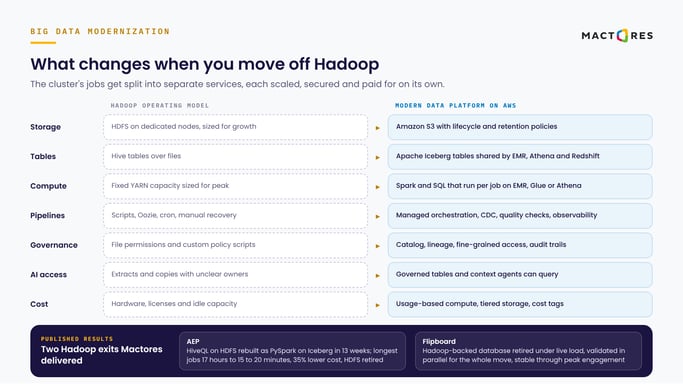
The practical result is faster change, with lower infrastructure cost as a side effect. A new data feed, an ML feature or a governed AI agent can ship without waiting for a cluster resize or a one-off integration.
What Should Replace Hadoop?
No single product replaces Hadoop, because Hadoop bundled several jobs. The right modern data platform depends on workload shape, data gravity, compliance requirements, latency needs and the skills you already have.
|
Workload |
Modern target on AWS |
Why it fits |
|---|---|---|
|
Batch ETL and scheduled transforms |
AWS Glue, Amazon EMR, Amazon Redshift |
Managed, SQL-first or Spark, runs per job |
|
Large-scale Spark |
Amazon EMR, EMR Serverless |
Keeps Spark, drops cluster administration |
|
Interactive analytics and BI |
Amazon Athena, Amazon Redshift |
Query compute separate from storage |
|
Streaming and near real time |
Amazon MSK, Amazon Kinesis, Amazon Managed Service for Apache Flink |
Event-driven instead of batch-only |
|
Machine learning |
Amazon SageMaker over governed tables |
Features that are discoverable and traceable |
|
AI agents and retrieval |
Amazon Bedrock, Amazon OpenSearch Service |
Controlled access to trusted context |
|
Cold history |
Amazon S3 with lifecycle policies |
Low-cost storage that keeps the evidence |
For many enterprises the strongest default is an open lakehouse: Amazon S3, Apache Iceberg tables, a governed catalog, fine-grained permissions, SQL analytics, and Spark where it's really needed.
What happens to HDFS, Hive, Spark, MapReduce and Oozie?
Most estates don't need a wholesale rewrite on day one; they need a disposition for each component.
|
Component |
Where it usually goes |
What to know |
|---|---|---|
|
HDFS |
Amazon S3 |
Lifecycle and retention policies replace node capacity planning |
|
Hive tables |
Apache Iceberg tables |
Schema evolution, time travel and transactional writes |
|
Spark |
Amazon EMR, EMR Serverless or AWS Glue |
Usually kept; versions and libraries retested |
|
Hive SQL |
Amazon Athena, Amazon Redshift or Spark SQL |
Rewritten where latency or concurrency demands it |
|
MapReduce |
Retired or rewritten in Spark |
Rarely worth preserving without a strong reason |
|
Oozie and cron |
Amazon MWAA, AWS Step Functions or Glue workflows |
Retries, dependencies and alerting rebuilt |
Moving Hive tables to Apache Iceberg on AWS is what lets Amazon EMR, Amazon Athena and Amazon Redshift share the same tables safely. AWS has removed much of the conversion work: as of November 2026, Amazon S3 Tables offers managed migration of Apache Hive tables to Apache Iceberg for Glue-registered Hive tables stored as Parquet, producing a compatibility report first and allowing repeated syncs while the source keeps taking writes.
Iceberg's newer table format helps after the move too. AWS added Iceberg V3 deletion vectors and row lineage to Spark on Amazon EMR 7.12, AWS Glue, Amazon S3 Tables and the AWS Glue Data Catalog in November 2025: deletion vectors speed up pipelines and cut compaction work, and row lineage makes small changes in large tables traceable with a SQL query.
Some jobs need more than a port. At AEP, HiveQL on HDFS was structurally wrong for the meter data workload; the jobs were rewritten in PySpark on Iceberg tables in Amazon S3, Amazon EMR was kept, and HDFS was retired.
Is Lift and Shift Enough to Leave Hadoop?
No, not for most estates. Lift and shift suits a narrow, healthy workload, but copying HDFS, Hive tables, scripts, undocumented dependencies and brittle orchestration into the cloud recreates the same problem on rented servers.
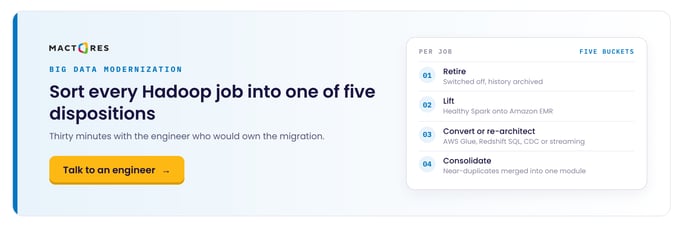
A credible plan gives every job one of five dispositions, the same buckets our data pipeline modernization services use to sort an estate.
|
Disposition |
What it means |
Good fit |
|---|---|---|
|
Retire |
Switch it off and archive its history |
Twelve months of logs show no reader |
|
Lift |
Move Spark, Hive or Hadoop jobs onto Amazon EMR with few code changes |
Healthy Spark and a deadline that won't wait |
|
Convert |
Rewrite job logic for AWS Glue or Redshift SQL, keeping the business rules |
Stable jobs with active consumers |
|
Re-architect |
Replace batch with change data capture, streaming or zero-ETL |
Feeds where freshness drives revenue or decisions |
|
Consolidate |
Merge near-duplicate jobs into shared modules |
Ten teams built ten versions of one extract |
That's why an estate register matters. Before writing migration code, record each job's owner, upstream systems, downstream consumers, service levels, data classification and business rules; without that evidence, modernization becomes guesswork at enterprise scale.
How Do You Avoid a Costly Migration Failure?
Run a phased, evidence-led program and don't repoint a consumer until the new outputs match the old ones. The failure pattern is predictable: teams copy petabytes before they understand dependencies, ownership, data quality and consumers, then reports differ after go-live, a nightly job fails and confidence collapses.
|
Phase |
What must be true to move on |
Risk it prevents |
|---|---|---|
|
Discovery |
Every workload, dataset, consumer and dependency inventoried |
Hidden dependencies, orphaned pipelines |
|
Target design |
Architecture, security, cost guardrails and operating model approved |
Cloud bill shock, architectural regret |
|
Pilot |
One bounded, valuable domain runs in parallel with reconciled outputs |
Estate-wide disruption |
|
Migration |
Data movement, conversion and validation automated where possible |
Manual errors, inconsistent results |
|
Parallel run |
New and legacy outputs compared under live conditions |
Silent data-quality regressions |
|
Cutover |
Consumers repointed only after acceptance criteria pass |
Business disruption, lost trust |
|
Decommission |
The cluster retired, not left running "just in case" |
Paying for two platforms |
Parallel-run validation is the discipline that matters most. Data landing in Amazon S3 proves nothing; the new platform has to produce the expected records, aggregates, financial figures, access behavior and downstream outputs before consumers move. The same assess, validate, cut over and retire sequence runs through any cloud data modernization program.
When Flipboard retired its Hadoop-backed database, a validation harness ran in parallel against the legacy system for the whole move, and the platform stayed stable through peak engagement periods.
How Do You Handle Compliance and Security?
Treat the Hadoop exit as a security and audit program as well as a data engineering one, and make compliance observable from the first design. A production-ready target includes these controls.
- Encryption at rest and in transit.
- Identity-based access through a central identity provider.
- Table, column, row and cell-level controls where the risk calls for them.
- Classification of personal, health, financial and confidential data.
- Lineage from source system to report, model, dashboard or agent.
- Immutable audit logs for access, schema changes, approvals and agent actions.
- Retention, residency, deletion and legal-hold policies.
- Evidence generated during the build, not reconstructed after an audit request.
This matters more once AI is involved. An agent shouldn't get open access to a data lake; it should get governed retrieval, scoped permissions, approved tools and a recorded decision trail.
What Does Hadoop Modernization Cost?
It depends on data volume, workload complexity, compliance scope and how much technical debt you choose to remove, and the business case has to cover more than infrastructure.
|
Cost category |
What to measure |
Common mistake |
|---|---|---|
|
Infrastructure |
Compute, storage, network, backup, DR, commitments |
Comparing monthly cloud spend with hardware depreciation |
|
Licenses |
Distribution, database, ETL, BI and security licensing |
Ignoring renewal escalation and support terms |
|
People |
Platform operations, security, engineering, on-call |
Treating internal labor as free |
|
Risk |
Patching gaps, outages, audit findings, key-person dependency |
Assuming quiet means stable |
|
Opportunity cost |
Delayed AI, analytics and product work |
Counting migration cost, not the cost of standing still |
|
Decommissioning |
Archival, validation, repointing, shutdown |
Leaving the cluster running indefinitely |
Cost reduction shouldn't be the whole case, though. The stronger argument is usually to retire the platform that slows change, put a governed foundation under AI, and move scarce engineering time toward products and decisions. AEP's rebuilt pipeline beat both of its targets, 35% lower cost against 30% committed and 17 times faster against 50% better committed.
How Long Does It Take to Move Off Hadoop?
A well-scoped domain can reach production in about a quarter; an estate with hundreds of jobs, custom code, regulatory controls and dozens of consumers moves in waves. Across Mactores engagements the median time to production is 12 weeks, and AEP's pipeline took 13: one week of assessment and twelve of production build.
Sequencing matters more than speed. Don't attempt a big-bang cutover; move one bounded domain, prove the control set, then repeat the pattern wave by wave.
What Changes for AI and Agentic Systems?
Leaving Hadoop is where the data platform becomes something agents can use. Legacy estates tend to give AI teams stale extracts, unclear meanings, inconsistent definitions and no reliable way to explain where a number came from, which makes pilots easy to start and hard to put into production.
|
What changes |
On a Hadoop estate |
After modernization |
|---|---|---|
|
Meaning |
Each team defines "active customer" its own way |
Business terms defined once and governed |
|
Access |
Broad access to files or extracts |
Minimum access, identity passed through |
|
Lineage |
Reconstructed by hand when asked |
Machine-readable from source to answer |
|
Quality |
Discovered when a report breaks |
Contracts, freshness thresholds and checks |
|
Actions |
Unbounded scripts and service accounts |
Approved tools inside an authority boundary |
That's why data modernization in the agentic era means rebuilding the platform so AI agents can find, understand and act on enterprise data safely, with the cloud migration as one part of the work rather than the whole of it.
What Does a Strong Modernization Roadmap Look Like?
A sequence of business outcomes, each with an owner, an acceptance test and a retirement date for the Hadoop dependency it replaces.
|
Wave |
Business outcome |
Technical scope |
Exit evidence |
|---|---|---|---|
|
1 |
Prove the platform |
One valuable domain, core ingestion, catalog, security, validation |
Reconciled outputs and signed acceptance |
|
2 |
Reduce operational drag |
High-volume batch pipelines, orchestration, observability, cost controls |
Legacy jobs retired, runbooks updated |
|
3 |
Enable self-service |
Governed semantic layer, BI migration, data products, access model |
Analysts query governed data without extracts |
|
4 |
Modernize decisions |
Streaming, feature store, ML lifecycle, real-time use cases |
Models read governed, fresh features |
|
5 |
Activate AI agents |
Retrieval, tools, permissions, evaluation, audit logging |
Agents run inside defined authority |
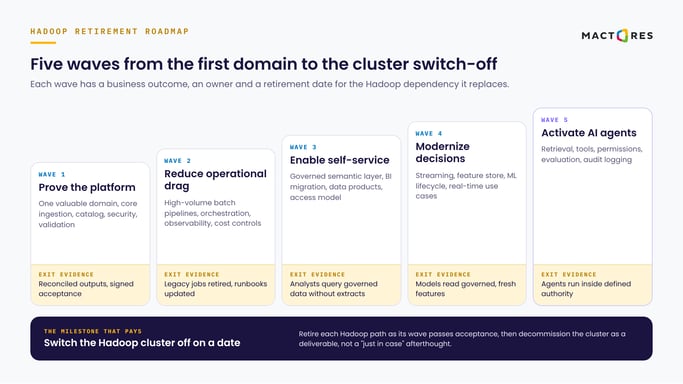
This gives the CFO a capital-allocation view and the CIO a cutover-safe plan, and it heads off the common failure where a new lakehouse goes live and the Hadoop cluster never gets switched off.
How Can Mactores Help You Move Off Hadoop?
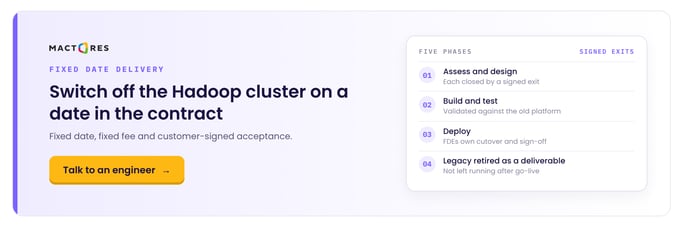
We move Hadoop estates onto governed, AI-ready data platforms on AWS with a fixed date, a fixed fee and customer-signed acceptance, starting from your estate rather than a generic proposal: the workloads that matter, the compliance obligations around them, the consumers that can't break and the systems that need a dated exit.
Our data platform modernization work splits the effort deliberately. Aedeon, the agent platform we deliver with, handles source discovery, mapping, validation and observability, which is 60 to 70% of the engagement work, while forward-deployed engineers own the architecture choices, cutover sequencing and production sign-off.
The outcome we aim for is production systems running, the Hadoop cluster retired, audit evidence in hand and a foundation that carries the next decade of analytics and AI. If you're weighing a Hadoop exit, a bounded discovery sprint on one domain is the right first step.