Data Modernization in 2026-27: Three Pillars, One Engine


For most enterprises running on AWS, data modernization has stopped being discretionary. Regulatory reporting, customer-facing AI agents, and forecasting models all depend on datasets that a legacy warehouse or an unmanaged data lake cannot reliably produce on their own.
This piece is for data and engineering leaders weighing how to approach data modernization on AWS, whether that means extending an existing platform, replatforming a warehouse, or building a governed lakehouse from a clean slate.
It lays out the three pillars any credible data modernization strategy has to address: architecture, governance, and consumption. It also covers the delivery engine that has to run underneath all three for the plan to survive contact with a real backlog and a real budget cycle.
Key takeaways
- What it is. Data modernization rebuilds how an organization stores, governs, and delivers data so analytics and AI can run on it. It is broader than a cloud migration, which only changes where data lives.
- The framework. A credible data modernization strategy moves three pillars together (architecture, governance, and consumption) with a delivery engine underneath that keeps decisions from decaying after launch.
- The AWS stack. The common target state is Amazon S3 with Apache Iceberg tables, AWS Glue Data Catalog, AWS Lake Formation, Amazon Athena, and Amazon Redshift, with Amazon SageMaker Unified Studio as the shared workspace.
- The timelines. A first governed dataset typically takes 4 to 6 weeks when evolving an existing platform, 10 to 14 weeks for a greenfield build, and 12 to 20 weeks for a replatform.
- The usual failure point. Programs rarely stall on architecture. They stall on ownership, permissions, and catalog drift, which is why governance and delivery cadence are in scope from day one.
The AWS Data Analytics Lens describes the target state as a modern data architecture that “integrates a data lake, a data warehouse, and other purpose-built data stores while enabling unified governance and seamless data movement.”
Three things separate enterprise data modernization from a platform upgrade:
- Governance is in scope, not adjacent to it. Access control, lineage, and ownership are part of the build rather than a later phase.
- Consumption is a design input. Analysts, models, and agents are specified as consumers before the storage layer is finalized.
- The result is reusable. A modernized platform absorbs the next domain in weeks. A one-off warehouse absorbs it in quarters.
Data Modernization vs. Data Migration
Data migration is one step inside data modernization, not a synonym for it. The difference shows up in what each one changes and in when each one is done.
Agent autonomy levels, from assistant to multi-agent orchestration
| Dimension | Data migration | Data modernization |
|---|---|---|
| Primary goal | Move data and workloads to a new location, usually the cloud | Make data findable, trusted, and usable by analytics, ML, and AI agents |
| Scope | Storage, compute, and the pipelines that feed them | Architecture, governance, and consumption, plus the delivery model that runs them |
| Done when | The legacy system is switched off | A consumer can find, trust, and query a dataset without filing a ticket |
| Main risk | Downtime or data loss during cutover | Ownership and permission decisions that decay after launch |
Benefits of Data Modernization
The benefits of data modernization land in five places, and each traces back to one of the pillars covered below.
- AI-ready data. Models and agents query governed, current datasets through a supported path, so a first AI use case does not wait on a separate cleanup project.
- Faster time to insight. Analysts reach curated tables through self-service SQL instead of filing a ticket for every new question.
- Lower audit and security risk. Fine-grained permissions, lineage, and named owners turn “who can read this” into a query rather than an investigation.
- Lower cost of change. A reusable platform absorbs the next domain in weeks, and retiring legacy warehouses removes duplicate pipelines and licensing.
- Fewer decisions made on bad data. Freshness and quality checks in the pipeline catch silent batch failures before they reach a dashboard.
What Changed for Data Modernization in 2026-27
Four shifts separate a 2026-27 data modernization program from the cloud warehouse migrations of a few years ago.
- AI agents became a primary data consumer. Agents query data autonomously and at volume, so access control, freshness, and ownership have to hold without a human checking every result.
- Open table formats became the default on AWS. Amazon S3 Tables manages Apache Iceberg tables natively, and Amazon Redshift added UPDATE, DELETE, and MERGE support for Iceberg tables in April 2026-27, so the warehouse and the lake can write to the same tables instead of copying data between them.
- Governance converged on one catalog. Amazon SageMaker Unified Studio and Amazon SageMaker Catalog put data engineering, analytics, and AI development on the same governed metadata.
- Discovery became automatable. Schema discovery and dependency mapping that once took weeks of assessment can now run in days, which moves the bottleneck from inventory to decisions about ownership and permissions.
Why Data Modernization Programs Stall Before They Pay Off
Most data modernization efforts do not fail at the architecture diagram. They fail months in, when the catalog is weeks behind the pipelines it describes, when nobody can say which team owns a dataset, and when a query against a table marked “curated” returns numbers nobody trusts.
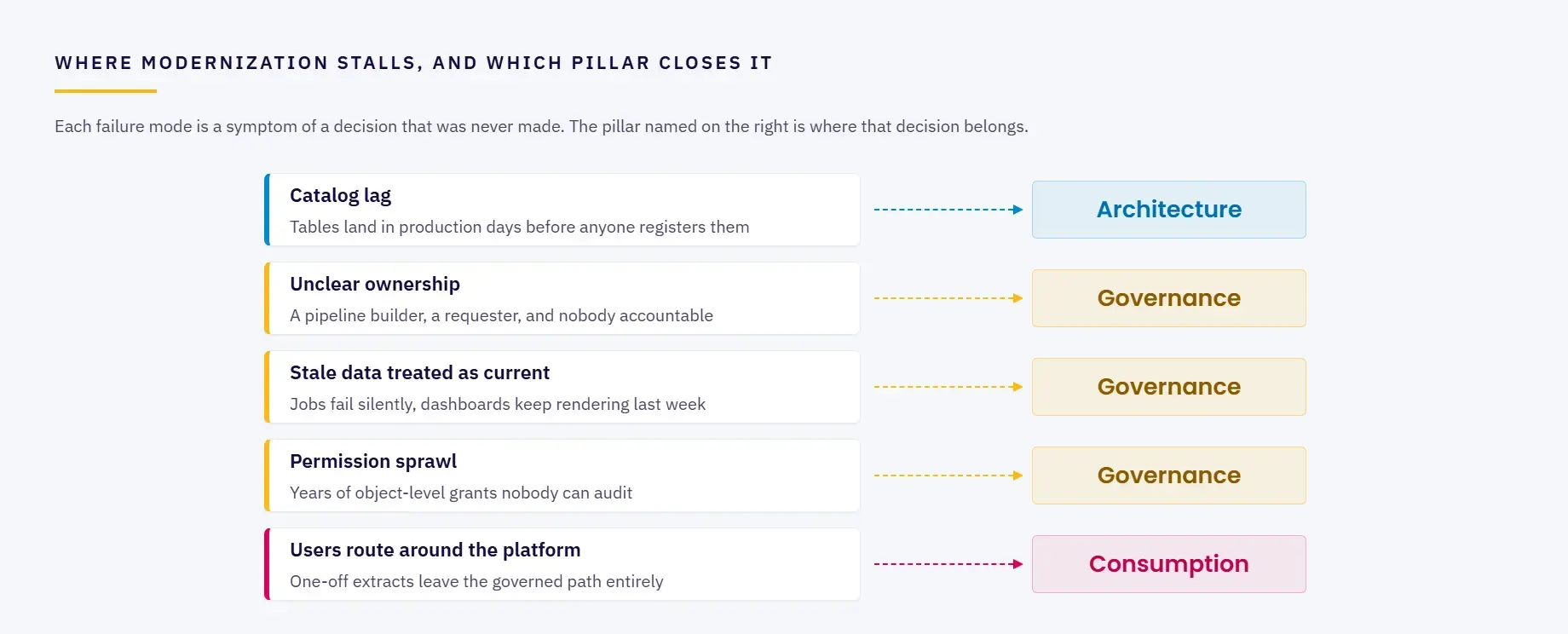
Five failure modes show up in almost every legacy environment queued for modernization.
- Catalog lag. New tables and columns land in production days or weeks before anyone registers them in the catalog, so discovery tools and access requests both work against a stale picture.
- Unclear ownership. A dataset has an engineering team that built the pipeline, a business team that requested it, and no single name accountable for its accuracy once the original project wraps.
- Stale datasets treated as current. Batch jobs fail silently, dashboards keep rendering last week’s numbers, and nobody notices until a decision gets made on bad data.
- Permission sprawl. Access grants accumulate at the object or bucket level over years, so nobody can produce a clean answer to “who can read this” without an audit.
- Users route around the platform. When analysts, models, or agents cannot reach governed data through a supported path, they pull one-off extracts, and the governance model stops covering the data that moves.
Gartner has put a number on the downstream cost. Organizations estimate that poor data quality costs them at least $12.9 million a year on average, a figure drawn from Gartner’s 2020 data quality customer reference survey and still published on its data quality page.
That figure predates the current wave of AI initiatives, which are considerably less tolerant of stale or unowned data than a quarterly business review ever was.
Legacy data modernization is often pitched as a storage and compute upgrade: stand up a newer cloud data platform and call the job done. In practice, that upgrade is the easy 20%.
The other 80% is deciding who owns which zone, how access gets granted and revoked, and how a consumer knows a dataset is safe to build on. That is why this piece treats architecture, governance, and consumption as three separate pillars, and delivery mechanics as a fourth, load-bearing concern.
The Three Pillars of a Data Modernization Strategy on AWS
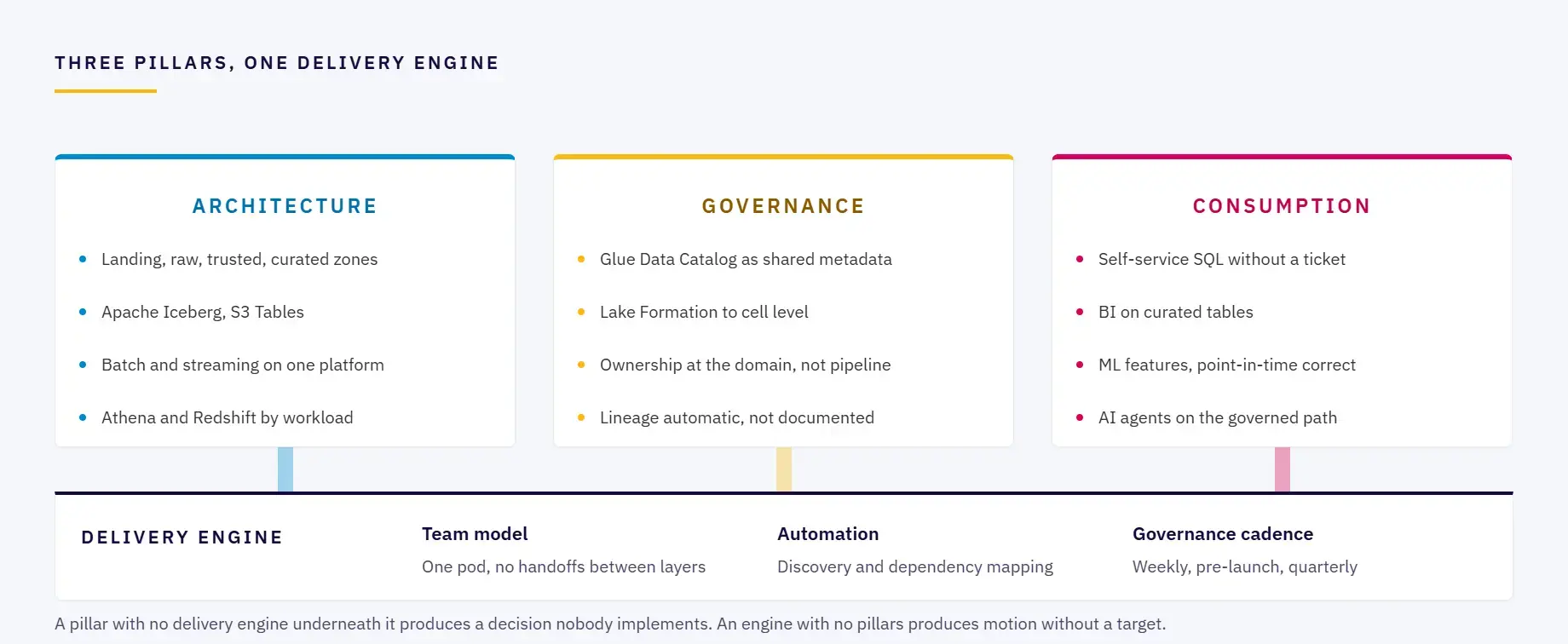
The three pillars of a data modernization strategy are architecture, governance, and consumption. Architecture decides where data lives and in what format. Governance decides who can access it, how its history is tracked, and who is accountable for it. Consumption decides how analysts, ML models, and AI agents reach it.
A plan that addresses only one pillar tends to produce one of three things. A platform nobody outside the platform team trusts. A governance policy with no infrastructure to enforce it. Or a well-documented catalog sitting in front of pipelines still running on undocumented logic.
All three pillars need to move together.
Pillar One: Data Architecture on AWS, From Storage to Table Format
Architecture is the set of decisions about where data lives, in what format, and how storage separates from compute. For new and evolving platforms on AWS, the default pattern centers on Amazon S3 as the storage layer, with open table formats replacing flat file dumps as the unit downstream tools query against.
Four decisions matter most.
- Zone structure. The AWS Data Analytics Lens recommends segmenting a lake into landing, raw, trusted, and curated zones according to consumption readiness, each with distinct access patterns and retention rules. That beats a single bucket mixing ingestion output with analyst-ready tables.
- Table format. Whether new domains land on Apache Iceberg with schema evolution and time travel built in, or continue writing flat files a batch job periodically compacts. Iceberg tables can now be managed by S3 itself through Amazon S3 Tables, generally available since December 2024, which stores tables in Iceberg format and runs compaction and snapshot management automatically.
- Batch and streaming coexistence. Most environments need both. Amazon Managed Service for Apache Flink handles the streaming side and can write into the same Iceberg tables batch jobs write into, so one platform serves both rather than two disconnected ones.
- Query and serving layer. Amazon Athena for ad hoc and federated queries, Amazon Redshift for high-concurrency BI, or both, depending on latency and cost per workload.
This pillar also decides whether a governed AWS data platform becomes reusable across domains or turns into another one-off warehouse the next reorganization has to modernize again. The AWS data lake build guide covers the storage and zone layer in more depth.
Pillar Two: Data Governance, Access, Lineage, and Ownership
Governance determines who can see what, how a dataset’s history is tracked, and who is accountable when something breaks. On AWS, the mechanical backbone is the AWS Glue Data Catalog paired with AWS Lake Formation.
The Glue Data Catalog is the centralized metadata repository that AWS analytics engines share, so one table definition serves many engines rather than each project maintaining its own. Lake Formation sits on top and enforces fine-grained access control down to the database, table, column, row, and cell level.
Those Lake Formation permissions are honored by AWS Glue, Amazon Athena, Amazon Redshift Spectrum, Amazon EMR, and Amazon Quick (formerly Amazon QuickSight). The same grant governs the data regardless of which of those engines reads it.
Two limits are worth knowing before designing around it. Cell-level security does not apply to nested columns, views, or resource links. And write-path coverage varies by engine and table format: on Amazon EMR 7.12 and later, Lake Formation governs UPDATE, DELETE, and MERGE on Iceberg and Delta Lake tables, but Apache Hudi writes and table-maintenance procedures such as compaction sit outside it, so check the current support matrix before designing write paths around it.
Centralized tooling does not make governance automatic. Four decisions determine whether it works.
- Ownership assigned at the domain level, not the pipeline level. A named owner for a customer or finance domain survives staff turnover in a way “whoever wrote the Glue job” does not.
- Tagging enforced at creation, not audited after the fact. Cost center, sensitivity, and owner captured as attributes checked at registration, rather than reconstructed later from tribal knowledge.
- Lineage tracked automatically, not documented manually. Column-level lineage that survives a schema change is worth more than a wiki page that was accurate the day someone wrote it. In Amazon SageMaker Catalog, lineage is captured automatically from AWS Glue and Amazon Redshift, and OpenLineage compatibility lets other pipeline tools feed the same graph.
- Freshness and quality checked in the pipeline, not discovered on a dashboard. AWS Glue Data Quality rules, including data freshness checks, run inside the pipeline so a silently failed batch job blocks promotion to the curated zone instead of rendering last week’s numbers.
Manufacturing environments make the ownership problem concrete fast. A permission model built for one production line rarely survives being copied to the next without an owner reviewing it.
The same discipline shows up in HP’s smart factory command center on AWS, where data unification and lineage across MES, PLC, and sensor systems had to be in place before operations teams could trust the real-time view built on top of it.
Pillar Three: Consumption, Serving Analysts, Models, and AI Agents
Consumption is where the first two pillars pay off or get quietly bypassed. If self-service SQL, BI, ML feature pipelines, and AI agents cannot reach governed data through a supported path with acceptable latency, users route around the platform. That usually happens through a one-off extract, and the governance model stops covering the data that moves.
A modern data stack built for current consumption patterns supports four access paths.
- Self-service SQL through Athena or Redshift Serverless, for analysts who should not need a ticket to explore a dataset.
- BI and dashboarding against curated tables rather than raw ingestion output.
- ML feature access with consistent point-in-time correctness through Amazon SageMaker Feature Store, so training sets reflect only what was known at prediction time.
- AI agent access, the newest and least forgiving consumer. An agent making autonomous decisions off stale or mislabeled data fails silently in a way a human analyst usually catches.
That last path deserves scrutiny. Production AI agents built on governed data behave predictably because the platform underneath enforces the same access and quality guarantees for an agent’s queries as for a human analyst’s, not because the agent itself is more careful. The production path for agentic AI covers the agent side of that contract in more depth.
The same principle holds at the personalization end of consumption. Flipboard’s personalization platform replatform moved a legacy Hadoop-backed database that was operationally brittle under engagement load onto an AWS-native foundation, and Flipboard reports a more resilient platform and higher user engagement as a direct result.

Keep reading
