Why Most Legacy Modernization Projects Never Reach Production

Key takeaways
- Cloud data modernization ends when the legacy platform is switched off. Copying data into Amazon S3 is one milestone; the program is done when the new platform carries production and the old one is retired.
- Choose the path one workload at a time. AWS's 7 Rs apply to databases, warehouses, Hadoop clusters and ETL jobs individually, so one estate often mixes retiring, replatforming and refactoring.
- Cut over on evidence of parity. Plume moved 20 Databricks workspaces to an AWS lakehouse in 18 weeks with zero rollbacks because no workspace switched until its outputs on AWS matched its outputs on Databricks.
- The biggest gains came from rebuilding the workload. AEP's interval meter pipeline went from 17-hour jobs to 15 to 20 minutes, at 35% lower cost, after HiveQL on HDFS was rewritten as PySpark on Apache Iceberg in 13 weeks.
- AI readiness depends on the data foundation. In a Gartner survey of 353 data and analytics and AI leaders, published in April 2026, organizations reporting successful AI initiatives invested up to four times more in data and analytics foundations, as a share of revenue.
Modernizing enterprise data infrastructure is rarely only a migration problem. It is a business decision that touches infrastructure economics, operational reliability, regulatory requirements, engineering capacity and whether analytics and AI teams can use the data without new bottlenecks. Moving inefficient workloads to the cloud without redesigning them keeps the same limits, adds unpredictable cloud bills and extends the life of systems the organization meant to retire.
A successful cloud data modernization program delivers a production-ready data platform, validated against business and technical requirements, with an operating model and a dated path to legacy retirement. It is the AWS delivery side of a wider data modernization program, which also changes how data is governed and how people consume it.
What follows draws on Mactores' published data platform work on AWS, where we have built since 2008: Plume's move from Databricks to an AWS lakehouse, AEP's interval meter pipeline rebuilt on Amazon EMR and Apache Iceberg, The New York Times' subscription system moved from Oracle to Amazon Aurora PostgreSQL, and the Flipboard, Poshmark and Synaptics programs. Every figure comes from those published stories or from a primary source checked in November 2026.
What Is Cloud Data Modernization?
Cloud data modernization is redesigning, migrating and consolidating an organization's data infrastructure onto cloud services, with automated pipelines, governance and validation built in. The aim is to change how the business stores, processes, governs and uses data, and moving the data is one step of that.
In practice it can mean migrating databases, rebuilding ETL pipelines, moving off Hadoop, consolidating warehouses, adopting open table formats, adding lineage or redesigning access so analytics and AI can use the same governed data.
How is cloud data modernization different from cloud data migration?
Cloud data migration moves data and workloads to the cloud, often with little change to how they run. Cloud data modernization changes the workloads as they move and retires what they replace.
|
Cloud data migration |
Cloud data modernization |
|
|---|---|---|
|
Goal |
Get data and workloads into the cloud |
Change how data is stored, processed, governed and used |
|
Typical paths |
Rehost, relocate |
Replatform, refactor, retire |
|
What changes |
Where the data lives |
Architecture, pipelines, governance and operating model |
|
Validation |
Row counts and spot checks |
Row-level parity, business totals and performance |
|
Finished when |
The data is in the cloud |
The target carries production and legacy is retired |
What changes when you modernize a data platform?
|
Legacy data environment |
Modernized data environment |
|---|---|
|
Infrastructure tied to hardware or legacy licensing |
Managed cloud services sized to the workload |
|
Fragmented databases and data marts |
Consolidated storage with shared, open table formats |
|
Hand-maintained ETL |
Automated ingestion, transformation and orchestration |
|
Little metadata or lineage |
A governed catalog with traceable lineage |
|
Fixed-capacity processing |
Compute that scales with the workload |
|
Validation by manual checks |
Automated reconciliation in a test harness |
|
Legacy systems kept indefinitely |
A dated retirement plan for each system |
|
Built mainly for reporting |
Built for analytics, operational data and AI |
When should you modernize your data platform?
Modernize when the current platform creates constraints you can measure. Common triggers, and what to measure before deciding, are below.
|
Trigger |
What to measure first |
|---|---|
|
A database or platform license renewal is coming |
Renewal cost against the cost of running the workload on AWS |
|
Hadoop or warehouse hardware is near end of life |
Cluster utilization and which jobs still need the cluster |
|
Batch jobs miss their windows or fail |
Runtime and failure history per job |
|
Pipelines need constant patching |
Engineering hours spent on fixes each month |
|
Audit or lineage gaps |
Which regulated datasets lack traceable lineage |
|
AI pilots can't reach governed data |
Which datasets the pilots need and who can approve access |
|
An earlier migration stalled |
Where it stopped and what blocked production |
Base the decision on what the existing platform costs, what it stops the business from doing and what a modernized platform can realistically improve.
Why Are Enterprises Investing in Cloud Data Modernization?
Analytics, digital products and AI now depend on data the legacy platform can't deliver fast enough, cheaply enough or under the right governance. In a Gartner survey of 353 data and analytics and AI leaders fielded from November to December 2025, organizations that reported successful AI initiatives invested up to four times more, as a share of revenue, in foundations such as data quality and governance.
The strongest business cases tie each infrastructure decision to an outcome the business already measures.
What business problems does cloud data modernization solve?
|
Problem today |
What modernization changes |
Business result |
|---|---|---|
|
Expensive database licensing |
Managed or open-source targets |
License spend reduced or reallocated |
|
Slow analytics and batch jobs |
Storage, processing and job design |
Faster reporting and analysis |
|
Fragmented data systems |
Consolidated storage and catalog |
Lower operational complexity |
|
Pipeline failures |
Rebuilt ETL with orchestration and tests |
Dependable data delivery |
|
Data that teams can't reach |
Governed, self-service access |
More data in use across the business |
|
Unpredictable cloud bills |
Workload-level cost allocation |
Spend you can explain and forecast |
|
AI pilots stuck on data access |
Metadata, quality and access controls |
Pilots that can reach production |
Is cloud data modernization a technology decision or a financial decision?
It is both, and the technology plan should serve the financial and operational goals. The financial model should separate costs that disappear (license renewals, hardware refresh, support contracts), costs that move to the cloud (compute, storage, data transfer), temporary costs (migration engineering, parallel runs, validation) and the cost of new capability such as analytics and AI workloads.
A migration that lowers licensing but raises cloud and operating costs may not pay back. A platform that costs more but materially improves performance, reliability or what the business can do may still be worth it, so evaluate the whole operating model rather than service prices one at a time.
Which AWS Services and Architecture Fit Cloud Data Modernization?
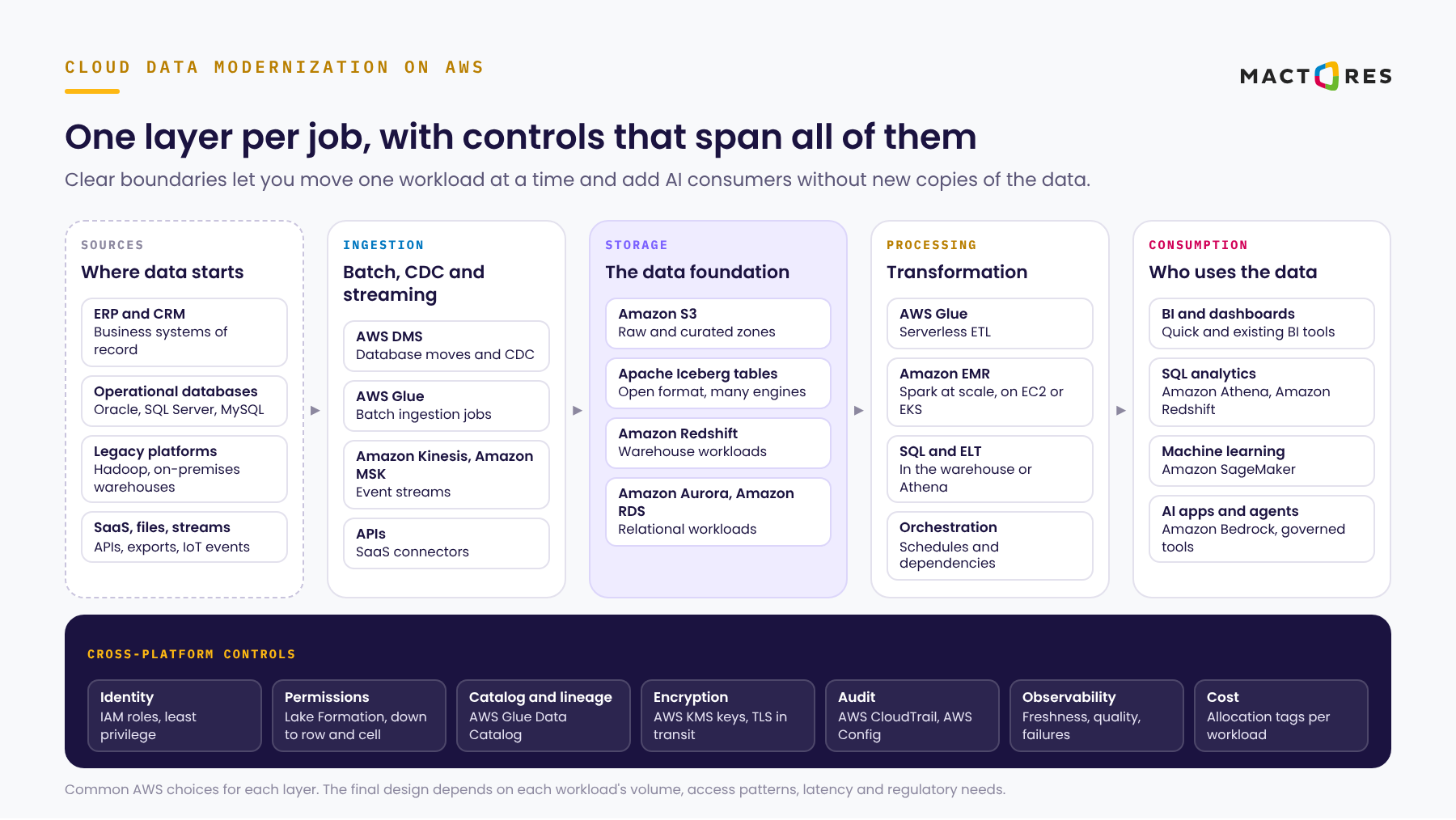
Choose services per workload. A common AWS pattern is Amazon S3 with Apache Iceberg as the storage foundation, AWS Glue or Amazon EMR for processing, Amazon Redshift or Amazon Athena for analytics, AWS DMS for database moves, and AWS Lake Formation with the AWS Glue Data Catalog for governance.
|
Layer |
AWS services |
Typical use |
|---|---|---|
|
Object storage |
Amazon S3 |
Raw and curated data, archives |
|
Open tables |
Apache Iceberg on Amazon S3 |
Transactional tables several engines can read |
|
Processing |
AWS Glue, Amazon EMR, Amazon EMR on EKS |
Spark, ETL and large-scale transformation |
|
Warehouse |
Amazon Redshift |
Structured analytics at high concurrency |
|
Interactive SQL |
Amazon Athena |
Ad hoc queries on the lake |
|
Relational |
Amazon Aurora, Amazon RDS |
Transactional and application databases |
|
Database migration |
AWS DMS, AWS Schema Conversion Tool |
Schema conversion, data movement and CDC |
|
Streaming |
Amazon Kinesis, Amazon MSK |
Event and streaming ingestion |
|
Catalog and governance |
AWS Glue Data Catalog, AWS Lake Formation |
Metadata and fine-grained access |
|
BI, ML and AI |
Quick (formerly Amazon QuickSight), Amazon SageMaker, Amazon Bedrock |
Dashboards, models and AI applications |
Check service capabilities, quotas and regional availability against current AWS documentation before the architecture is approved, because they change often.
Should you choose a data lake, data warehouse or lakehouse?
Choose by workload. A lakehouse suits mixed analytics on open tables, a warehouse suits structured SQL at high concurrency, and many estates end up with both plus transactional databases.
|
Architecture |
Best suited for |
Watch for |
|---|---|---|
|
Data lake |
Diverse and raw data, flexible processing |
Governance, quality and cataloging |
|
Data warehouse |
Structured reporting and SQL analytics |
Concurrency, modeling and cost at scale |
|
Lakehouse |
Mixed workloads on open table formats |
Table maintenance and interoperability |
|
Hybrid |
Estates with several workload types |
Clear ownership of each data flow |
The three Mactores programs cited here landed on three different targets. Plume's analytics moved to a lakehouse on Amazon EMR on EKS with Delta Lake on Amazon S3, AEP's meter data pipeline moved to Apache Iceberg tables on Amazon S3 processed by Amazon EMR, and The New York Times' subscription system moved to Amazon Aurora PostgreSQL.
What should a modern cloud data architecture look like?
A modern data architecture separates ingestion, storage, processing and consumption, with security, governance, lineage and cost controls running across all of them. Clear boundaries between layers let you migrate one workload at a time, swap a processing engine without touching storage, and add analytics or AI consumers without new copies of the data.
How Do You Assess a Data Estate Before Modernization?
Inventory what exists, how it's used, what depends on it and what it costs, then define what the target platform must deliver. This cloud readiness assessment is where most of a program's risk, unnecessary scope and hidden cost is either found or missed.
|
Assessment area |
What to examine |
Deliverable |
|---|---|---|
|
Data inventory |
Databases, warehouses, files, pipelines, schemas |
Data estate inventory |
|
Dependencies |
Upstream sources, downstream consumers, schedulers |
Dependency map |
|
Workloads |
Compute, storage, query patterns, concurrency |
Workload profile |
|
Data quality |
Completeness, duplicates, nulls, consistency |
Quality baseline |
|
Security and compliance |
Access, encryption, sensitive data, retention, residency |
Control and compliance matrix |
|
Cost |
Licenses, hardware, support, labor |
Current-state cost model |
|
Feasibility |
Compatibility, schema changes, tooling |
Path per workload |
|
Business priorities |
Critical workflows, SLAs, reporting deadlines |
Migration waves |
How do you find hidden dependencies in legacy data systems?
Combine automated inventory with observation. Stored procedures called by reports, jobs fired from external schedulers, shared files read by other applications, dashboards querying undocumented tables and business logic buried in SQL rarely appear on architecture diagrams, so discovery should pair code and schema analysis with scheduler history, query logs, lineage reconstruction and interviews with the people who run the jobs.
The output should be a dependency map that can sequence migration waves. Poshmark's internal team had concluded a clean cutover wasn't possible, and the order that worked came from a dependency analysis across every system, integration and shared resource on the platform, which then ran as a staged cutover with zero product disruption.
How should you prioritize workloads for migration?
Rank workloads by business criticality, technical complexity, dependency density and readiness of the target, then use the early waves to prove the method, tooling and cost assumptions before the hard workloads.
|
Workload |
Criticality |
Complexity |
Approach |
|---|---|---|---|
|
Standalone reporting database |
Low to moderate |
Low |
Early wave |
|
Data source with no active consumers |
Low |
Low |
Retire after a usage check |
|
Redundant data mart |
Low |
Low to moderate |
Consolidate or retire |
|
Unsupported legacy ETL platform |
Moderate to high |
Moderate to high |
Pipeline rebuild |
|
Warehouse with many dependencies |
High |
High |
Architecture-led, in waves |
|
Transactional application database |
High |
High |
Rehearsed cutover |
|
Compliance-critical platform |
High |
High |
Evidence gates per phase |
Which Cloud Data Modernization Strategy Fits Each Workload?
Decide per workload using AWS's 7 Rs: retire, retain, rehost, relocate, repurchase, replatform and refactor. They're the same seven paths used in any cloud migration to AWS, and for data workloads each one has a specific meaning.
|
Path |
What it means for a data workload |
When it fits |
Watch for |
|---|---|---|---|
|
Retire |
Switch off marts, feeds and reports nobody uses |
No active consumers after a usage check |
Consumers nobody listed |
|
Retain |
Leave the workload where it is for now |
Regulatory, contractual or technical blockers |
Ongoing license and support cost |
|
Rehost |
Move the database or cluster to Amazon EC2 unchanged |
A hard deadline such as a data center exit |
Old inefficiencies move too |
|
Relocate |
Move a VMware-hosted platform without changing it |
Data platforms running on VMware |
Little architectural gain |
|
Repurchase |
Replace with a managed or SaaS product |
Commodity functions such as BI |
Feature gaps and retraining |
|
Replatform |
Move to a managed service with targeted changes, such as Oracle to Amazon Aurora |
Cutting operational overhead |
Compatibility and configuration |
|
Refactor |
Redesign code, pipelines or models, such as HiveQL on HDFS to PySpark on Iceberg |
Performance, scale or AI readiness |
Higher engineering effort |
Consolidating redundant systems usually combines two paths: refactor the system that survives and retire the rest.
Should you lift and shift or refactor your data platform?
Decide workload by workload. Lift and shift is faster at first but keeps the existing inefficiencies, while refactoring takes longer and gives you a platform designed for how the workload runs today.
|
Factor |
Lift and shift |
Refactor |
|---|---|---|
|
Initial speed |
Usually faster |
Usually slower |
|
Architectural change |
Limited |
Significant |
|
Existing inefficiencies |
Often kept |
Can be removed |
|
Testing needed |
Compatibility and operations |
Functional, performance and integration |
|
Long-term operating model |
Resembles the legacy one |
Redesigned for the cloud |
|
Best for |
Transitional workloads |
Strategic workloads |
Rehosting makes sense when speed, continuity or an immediate infrastructure exit matters most. The mistake is treating it as the end state when the business case depends on retiring legacy operating costs or changing how the workload performs.
How do you migrate Hadoop to AWS?
Evaluate the workloads on the cluster one at a time rather than moving the cluster as a unit. Map the Hive tables and metastore, HDFS storage patterns, Spark and MapReduce jobs, HiveQL and custom SQL, schedules, security model and downstream consumers, then place each workload on Amazon EMR, AWS Glue, Amazon Redshift or Apache Iceberg tables on Amazon S3, and retire HDFS.
At AEP, the non-VEE interval meter pipeline ran 17-hour batch jobs and the weekend batches failed outright. Mactores AI agents found the root cause in under two hours: HiveQL on HDFS was structurally wrong for the workload, after some 18 months of earlier effort had not found it. Engineers kept Amazon EMR, rewrote the jobs in PySpark and moved storage to Apache Iceberg on Amazon S3, and the pipeline reached production in 13 weeks, 17 times faster and 35% cheaper against a 30% commitment.
Flipboard's legacy Hadoop-backed database was operationally brittle under engagement load. The move to an AWS-native foundation ran with a validation harness in parallel against the legacy system, and Flipboard's VP of Engineering, Greg Scallan, said: "We're more resilient, and overall user engagement has improved as a direct result of this migration."
Both programs were data platform modernization work, where the diagnosis and the rebuild are taken all the way to production on AWS.
How do you modernize legacy ETL pipelines?
Start with job discovery and dependency analysis, not code conversion. Record each job's schedule, run history, sources and targets, transformation logic, consumers, processing window and owner, then rebuild on AWS Glue, Spark on Amazon EMR or SQL-based transformations, depending on the job.
Test the rebuilt pipeline against the legacy one on the same inputs, because converted transformation logic can't be assumed equivalent. Data pipeline modernization on AWS also builds encryption, masking, lineage and access controls into the pipeline as it's rebuilt, so the new jobs don't need a separate compliance pass.
How Do You Execute Cloud Data Modernization Without Disrupting Production?
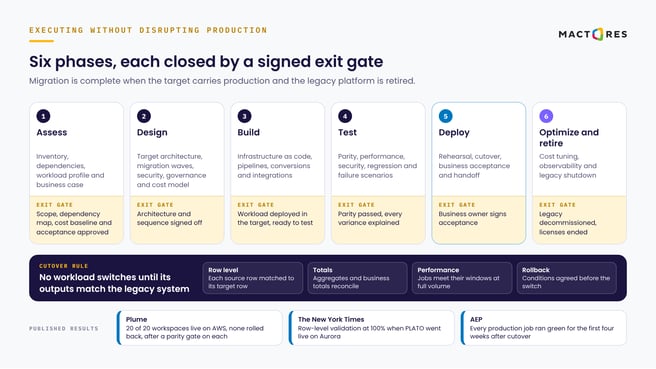
Run the program in phases with signed exit criteria, and cut over only when evidence shows the new platform matches the old one. Migration is complete when the target delivers the required data accuracy, performance, security and business acceptance, and the legacy system is retired.
|
Phase |
Main work |
Exit gate |
|---|---|---|
|
1. Assess |
Inventory, dependencies, workload profile, business case |
Scope, dependency map, cost baseline and acceptance criteria approved |
|
2. Design |
Target architecture, waves, security, governance, cost model |
Architecture and migration sequence signed off |
|
3. Build |
Infrastructure as code, pipelines, conversions, integrations |
Workload deployed in the target and ready to test |
|
4. Test |
Parity, performance, security, regression, failure scenarios |
Parity passed and variances explained |
|
5. Deploy |
Rehearsal, cutover, business acceptance, handoff |
Business owner signs acceptance |
|
6. Optimize and retire |
Cost tuning, observability, legacy shutdown |
Legacy decommissioned and licenses ended |
Automation handles the repetitive work well: schema extraction, code analysis, mapping, test generation and documentation. Engineers should own the architecture decisions, the exceptions, the security calls and the cutover decision itself.
What should you test before cutting over production?
Test whether the new platform produces the same business results as the old one, under production load, with the same controls.
|
Test |
What it proves |
|---|---|
|
Completeness |
Every required dataset, table, partition and record is present |
|
Reconciliation |
Source and target values match within agreed tolerances |
|
Transformation accuracy |
Business logic gives the expected results |
|
Schema |
Column definitions, types and constraints carried over |
|
Performance |
Queries and pipelines meet their windows at production volume |
|
Integration |
Upstream feeds and downstream consumers still work |
|
Security |
Access, encryption and permissions behave as designed |
|
Failure and recovery |
Retries, error handling, backup and restore work |
How does data migration validation work in practice?
Data migration validation compares source and target at row level, then checks aggregates and business totals, and nothing cuts over until every variance is explained. For database moves, AWS DMS data validation compares each source row with its target row and reports mismatches; it needs a primary key or unique index on each table, and validation-only tasks can check data without moving it.
Matching row counts can hide differences in individual records, so a harness for a critical workload should also compare checksums, key-level matches, null and duplicate distributions, query results, freshness and processing time. Run it in every rehearsal, not only at the end.
On Plume's move, a workspace moved only after its outputs on AWS matched its outputs on Databricks, and all 20 workspaces went live with none rolled back. The New York Times' PLATO went live on Aurora with row-level validation at 100%, every test green on PostgreSQL and rollback ready.
How should you plan a production cutover?
Write the cutover as a runbook with named decision owners, rollback conditions agreed in advance and acceptance criteria, then rehearse it at least once for any workload with material business risk.
|
Cutover step |
What happens |
|---|---|
|
Readiness check |
Testing, approvals, monitoring and recovery plans confirmed |
|
Change freeze |
Limits on source changes where needed |
|
Final sync |
Remaining changes replicated and reconciled |
|
Switch |
Consumers redirected to the target platform |
|
Watch |
Health, data quality, latency and performance monitored |
|
Business check |
Critical workflows confirmed by their owners |
|
Rollback decision |
Triggered only by the conditions agreed beforehand |
Sequence the waves so the highest-risk workloads go first, on a path you have already proven. Plume moved its 13 production workspaces in the first 14 weeks and its 7 non-production workspaces in the last 4, and its own team operated Amazon EMR from the day after cutover.
When should you retire the legacy platform?
Retire it as soon as the target has stabilized and retention rules are met, and treat retirement as a deliverable with a date. Before decommissioning, confirm these conditions.
- Every required consumer has moved and reconciliation is complete.
- Business owners have accepted the target in writing.
- Retention, archival, backup and recovery requirements are met on the new platform.
- Security and compliance controls have been validated.
- No remaining jobs, reports or applications read from the old system.
- License and infrastructure terminations are scheduled.
Without a date, organizations pay for both environments indefinitely. On PLATO, Oracle is retired, and at AEP, HDFS was retired in the rebuild. In Mactores contracts, legacy retirement is a named deliverable alongside the ship date and the fee.
If you're weighing a modernization and want a second opinion on the path for each workload, thirty minutes with the engineer who would own the build is enough to agree the paths, the parity checks and a realistic production date.
How Much Does Cloud Data Modernization Cost, and What Return Is Realistic?
Cost depends on data volume, workload complexity, testing scope, downtime tolerance and how long both platforms run in parallel, so a credible estimate starts from discovery and a current-state cost baseline. The return comes from retired licenses and hardware and from rebuilt workloads that used to run inefficiently.
|
Cost category |
What drives it |
|---|---|
|
Discovery and assessment |
Inventory, dependency analysis, architecture planning |
|
Data movement |
Transfer, replication, synchronization, tooling |
|
Engineering |
Schema conversion, pipeline rebuilds, application changes |
|
Cloud infrastructure |
Compute, storage, networking, databases |
|
Testing |
Validation, performance, security, regression |
|
Parallel operation |
Legacy and cloud platforms running at the same time |
|
Cutover |
Rehearsals, final synchronization, transition |
|
Handoff |
Runbooks, training, knowledge transfer |
|
Legacy retirement |
License termination, archival, decommissioning |
The costs most often underestimated sit in the transition rather than the cloud services: data transfer and egress, temporary duplicate storage, longer parallel runs, rewriting undocumented business logic, downstream applications that break, compliance remediation and legacy contracts that can't be ended right away. Put them in the business case before the program starts.
How do you calculate cloud data modernization ROI?
Compare the current operating model with the target over a defined period: net benefit equals avoided costs plus operational savings plus business benefits, minus total modernization cost. Count only avoided costs that will actually end, such as licenses, hardware refresh and support contracts, and include parallel running and retirement in the modernization cost.
Use your own workloads and contracts rather than generic savings percentages. For reference, these are the published results from four Mactores programs.
|
Program |
What changed |
Published result |
Time to production |
|---|---|---|---|
|
Plume |
20 Databricks workspaces to an AWS lakehouse |
58% lower analytics run-rate; $1,513K to $635K over six months |
18 weeks |
|
AEP |
HiveQL on HDFS to PySpark on Apache Iceberg |
35% lower pipeline cost against 30% committed; 17x faster |
13 weeks |
|
The New York Times |
PLATO from Oracle to Aurora PostgreSQL, 6M lines of code |
Zero revenue impact; 18.5k requests per second at go-live |
12 weeks, against 12 to 15 months by hand |
|
Synaptics |
EDA workloads on smart queues and an operational data foundation |
40% more throughput on one of its largest EDA clusters; 75% lower queue wait |
Not stated |
How do you stop cloud data modernization from raising cloud costs?
Build cost management into the migration rather than adding it after the first invoices. Oversized clusters, inefficient queries, data kept longer than needed, duplicated pipelines and ungoverned consumption can make the cloud platform cost more than the legacy one did.
The scope of cost management is widening in the same direction. In the State of FinOps 2026 survey of 1,192 practitioners, published in February 2026, 98% said they now manage AI spend, 64% manage licensing and 48% manage data centers, which is the same mix a modernization business case has to track while legacy licenses run down and cloud spend ramps up.
In practice that means sizing resources per workload, storage lifecycle and retention policies, query tuning, scheduled compute, cost allocation tags from the first deployment, budget alerts, and a commitment review once usage has settled.
How Do You Secure and Govern a Modernized Cloud Data Platform?
Design security and governance into ingestion, storage, processing and consumption from the first architecture decision, using layered controls rather than a single mechanism. Governance also has to make data usable within those controls, which depends on ownership and habits as much as tools.
|
Area |
Controls |
|---|---|
|
Identity and access |
IAM roles, least privilege, federation, MFA |
|
Encryption |
At rest with managed or customer-managed keys; TLS in transit |
|
Network |
Private connectivity, segmentation, restricted endpoints |
|
Classification |
Sensitive and regulated data tagged before it moves |
|
Data access |
Fine-grained permissions on tables, columns and rows |
|
Audit |
Access, activity, configuration and admin logs |
|
Secrets |
Central management of credentials and keys |
|
Monitoring and response |
Threat detection, alerting, escalation and recovery |
How should cloud data modernization address compliance requirements?
Design the target against the obligations that apply to your data rather than assuming a cloud service makes you compliant. The frameworks below are common examples, and which ones apply depends on your industry, data types and jurisdictions.
|
Framework |
What it changes in the modernization |
|---|---|
|
HIPAA |
PHI handling, access controls, audit trails, encryption, business associate agreements |
|
GDPR |
Lawful basis, minimization, retention, residency and cross-border transfer |
|
PCI DSS |
Cardholder data scope, segmentation, access control, logging |
|
SOC 2 |
Control design, monitoring, access governance, evidence |
|
ISO 27001 |
Risk assessment and control implementation within an ISMS |
|
Financial services rules |
Auditability, traceability and regulatory reporting |
A compliance-ready migration keeps control coverage intact during the transition. Classify data and identify sensitive fields before anything moves, mask or tokenize where appropriate, map identities and permissions to the target, keep audit logging and lineage running through cutover, and file the validation evidence with the approvals.
How do you maintain data residency and privacy requirements?
Decide residency during architecture design, not after deployment. For each dataset, record where it's stored and processed, which identities and third parties can reach it, whether cross-region replication or cross-border transfer is allowed, which retention and deletion rules apply and how audit evidence is collected. Organizations operating in both the United States and Europe often have different answers per business unit and dataset.
What does governance look like in a modern cloud data platform?
Governance gives every dataset an owner, quality rules, access policy, lineage and a lifecycle, and makes routine access fast enough that people don't route around it. The cultural side matters: Gartner predicts that by 2027, 60% of organizations that fail to address the cultural challenges of data and analytics governance will fail to govern AI successfully.
|
Area |
What it covers |
Owned by |
|---|---|---|
|
Ownership |
Owners, custodians, stewardship duties |
Business domain |
|
Quality |
Rules, thresholds, remediation |
Data stewards |
|
Access |
Permissions, approvals, audit trails |
Platform and security teams |
|
Metadata and lineage |
Catalog, source tracking, transformation history |
Data engineering |
|
Lifecycle |
Retention, archival, deletion, recovery |
Records and compliance |
On AWS, Lake Formation lets you define security policies at the database, table, column, row and cell levels, and those permissions are enforced across Amazon Athena, Amazon Redshift Spectrum, Amazon EMR and AWS Glue. Plume's lakehouse uses it to control who can read which data.
How Do You Make a Modernized Data Platform Ready for AI?
Give AI systems current, governed, well-described data they can retrieve under the right permissions, with traces and evaluation around every use. Migrating infrastructure doesn't do that by itself, so metadata, quality, access and evaluation have to be in the modernization scope.
|
Capability |
Why AI needs it |
|---|---|
|
Reliable ingestion |
Models and agents need current data |
|
Data quality |
Inconsistent data produces inconsistent outputs |
|
Metadata |
Systems need to know what a dataset means |
|
Lineage |
Outputs must trace back to sources |
|
Governed access |
AI must respect the same permissions people do |
|
Unstructured data processing |
Documents, records and logs supply context |
|
Evaluation |
Outputs are tested against defined criteria |
|
Observability |
Teams can see behavior, cost and failures |
Researchers are treating this as a maturity question too. A September 2026 paper by researchers at TU Darmstadt in the European Journal of Information Systems sets out a maturity model for scaling data management capabilities for enterprise AI, built for the banking industry.
What should you modernize before deploying AI agents?
Start with what agents will read and where they could do harm. In order, we'd put these in place before the first production agent.
- Governed interfaces, such as views, APIs or query tools, to the data agents need, instead of direct table access.
- Quality standards enforced on those datasets, with owners who fix failures.
- Metadata that says what each table and field means.
- Permissions the agent inherits from the user or its role, enforced at query time.
- Retrieval designed for both structured and unstructured data.
- Evaluation sets that test outputs against business requirements before release.
- Traces of every query, tool call and answer.
Agents also need boundaries on what they can do, not only what they can read: tool permissions, human escalation for consequential actions, failure handling and audit logging. Treat the data platform as a shared foundation that each AI initiative builds on, rather than a prerequisite project rebuilt every time one starts.
Why Do Cloud Data Modernization Projects Fail or Stall?
Mostly for reasons that have little to do with the cloud services: incomplete discovery, untested dependencies, unclear ownership, cutovers without rehearsal and legacy systems nobody switches off.
|
Risk |
Why it matters |
Mitigation |
|---|---|---|
|
Incomplete discovery |
Hidden dependencies surface mid-migration |
Automated discovery and a dependency map |
|
Unrealistic timelines |
Complex workloads need more testing |
Plans built per workload |
|
Poor data quality |
Migration copies or adds inconsistencies |
Automated validation and reconciliation |
|
Cost overruns |
Long parallel runs and oversized targets |
Cost baseline and monitoring from day one |
|
Architecture mismatch |
Services don't fit the workload pattern |
Workload-driven design |
|
Security gaps |
Permissions change during the move |
Control mapping and testing |
|
Failed cutover |
Business continuity at risk |
Rehearsal and agreed rollback conditions |
|
Legacy not retired |
Costs continue after go-live |
Retirement as a dated deliverable |
Why do modernization projects stall before production?
They make progress through assessment, architecture and pilots, then lose the path to production. Common gaps are no migration-ready dependency map, no production validation framework, architecture decisions left open, unclear ownership between the partner and internal teams, cutover plans never rehearsed and commercial terms that don't move when delays do.
Two of the programs cited here started from exactly that position. At AEP, the previous team had spent 9 to 10 months patching EMR configuration while the architecture stayed as it was, and The New York Times' Joe Cora said: "We tried this migration five times in six years and failed every time." We'd look for the same cause behind most modernization projects that never reach production: milestones that get signed off while nothing proves the platform is ready to operate.
What should you measure during cloud data modernization?
|
Metric |
What it measures |
|---|---|
|
Migration progress |
Workloads in production against the approved scope |
|
Data parity |
Validation results between source and target |
|
Pipeline and query performance |
Run times and response times against their windows |
|
Data freshness |
Time from a source update to target availability |
|
Cloud cost |
Actual operating cost against the baseline |
|
Legacy retirement |
Systems and licenses decommissioned |
|
Operational ownership |
Runbooks handed over and on-call in place |
|
Business acceptance |
Signed acceptance against agreed requirements |
Report these every week in the same format. A status dashboard should show whether the target is ready to operate, not only whether engineering tasks are closed.
What Does Cloud Data Modernization Look Like in Practice?
The published programs follow one pattern: measure the baseline, design around the real bottleneck, prove parity before each switch and retire the legacy platform. These are customer-specific outcomes, not guarantees.
|
Customer |
What the program had to solve |
Lesson for your program |
|---|---|---|
|
|
A brittle Hadoop-backed database under engagement load |
Run the validation harness in parallel against legacy |
|
Synaptics |
Weeks of queue contention on EDA infrastructure |
Find the real bottleneck before designing the target |
|
Poshmark |
A platform the internal team thought couldn't be cut over cleanly |
Let the dependency map decide the sequence |
|
Plume |
20 workspaces where every number had to survive the move |
Gate each cutover on parity |
|
AEP |
17-hour jobs after months of tuning |
Rebuild the workload instead of tuning it |
|
The New York Times |
A revenue-path system that had failed to migrate before |
Validate at row level and have rollback ready |
For Synaptics, the smart-queue architecture delivered 40% more throughput on one of its largest EDA clusters and 75% lower queue wait times. Across Mactores engagements, the median time to production is 12 weeks, and 94% of projects have been delivered on or ahead of schedule.
If you're planning a cloud data modernization, the most useful first step is agreeing the path for each workload, the parity checks and the retirement date before any build starts. We put the scope, the ship date and the fee in the statement of work, with legacy retirement as a named deliverable.