Forward-Deployed Engineer: What They Do and When to Hire


Key takeaways
- A forward-deployed engineer (FDE) is an engineer who works directly inside a customer’s environment to solve real production problems, write and deploy code, and remain accountable until the system is live and stable.
- The main difference between a forward-deployed engineer and a traditional consultant is ownership: consultants typically recommend or design solutions, while FDEs help build, deploy, troubleshoot, and stabilize the production system.
- An FDE engagement differs from staff augmentation because it is tied to a specific production outcome—such as completing a migration, launching an integration, or modernizing a platform—rather than filling an open-ended engineering capacity gap.
- Organizations typically need a forward-deployed engineer for complex, high-risk projects involving legacy systems, cloud modernization, regulated data, difficult integrations, or production environments where requirements may change during implementation.
- The biggest advantage of the forward-deployed engineering model is faster problem resolution because the engineer who discovers an issue can also make the technical decision and implement the fix without multiple handoffs.
- A strong FDE engagement should include clear production milestones, defined accountability, stabilization after go-live, and knowledge transfer so the customer’s internal team can operate and extend the system independently.
- A forward-deployed engineer is usually not necessary for low-risk, repeatable, well-documented projects that an existing in-house team can deliver within its normal roadmap.
It’s a commonly noticed pattern by experts in the industry that most enterprise software fails in the six months after the contract is signed. It happens when a beautifully architected system meets a business process nobody documented, a legacy API that lies about its own behavior, and a rollout timeline that assumed everything would work the first time. That gap between what was designed and what actually ships into production is where a forward-deployed engineer works.
FDE is not a new job title for a consultant or a rebranded solutions architect. It is a different delivery model, built around one idea: the person who understands the problem best should be the person writing the code that solves it.
For engineering leaders weighing how to close that delivery gap — hire for it, engage a systems integrator, or bring in a forward-deployed team — this piece lays out what the role actually does, where it came from, what makes someone good at it, when it earns its cost, and how to tell a real FDE engagement from a relabeled staffing contract.
Where the Forward-Deployed Engineer Model Came From, and Why It Is Spreading
The role has a specific origin. Palantir built its early delivery model around engineers it sent into customer environments rather than a professional-services arm that wrote specifications for someone else to implement.
It called them forward-deployed engineers, and the structure was a deliberate bet: the fastest way to make hard software work inside a large institution is to put the people who can change the software in the room where it breaks.
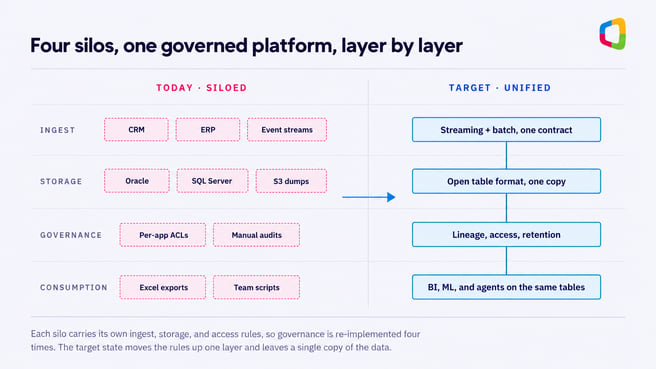
That bet has been copied because the underlying problem got worse, and the failure rate is documented rather than anecdotal: IBM’s 2025 study of core modernization programmes found that 94% of them exceed their planned timeline, with underestimated legacy complexity among the named causes. Enterprise systems now sit behind more integration surface — identity providers, warehouses, event streams, third-party APIs — than any requirements document describes accurately.
And the cost of a wrong assumption has moved earlier in the timeline. A schema mismatch found in week two is a fix. The same mismatch found after cutover is an incident, and in regulated environments it is an incident with a paper trail.
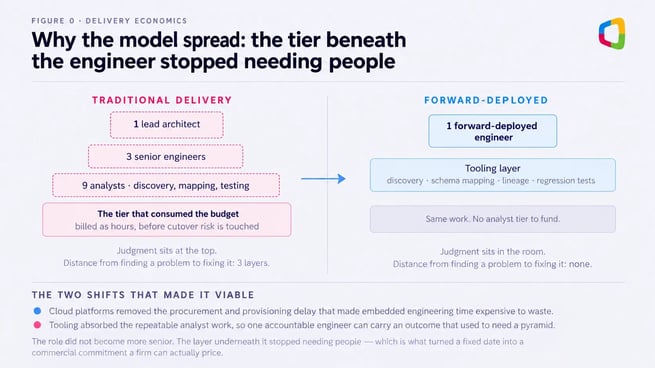
Two shifts made the model viable for firms far smaller than Palantir. The first is that cloud platforms removed the procurement and provisioning delays that used to make embedded engineering time expensive to waste.
The second is that much of what an embedded engineer once did by hand — source discovery, schema mapping, lineage extraction, regression-test generation — is now handled by tooling. That changes the arithmetic of the role: it is what allows one accountable engineer to carry an outcome that used to need a delivery pyramid beneath them, which is the operating assumption behind most current data platform modernization work.
What a Forward-Deployed Engineer Actually Is (and Isn't)
The term "forward-deployed" comes from a military metaphor: the engineer isn't in a central office building generic product for a generic customer. They're forward — on-site or embedded, virtually or physically — inside the customer's operational reality, where requirements are messy, systems are old, and the cost of being wrong is measured in downtime, not sprint velocity.
A forward-deployed engineer is, first and foremost, still an engineer. They write and ship production code. They don't hand off a design document and move to the next account; they carry the pager for what they built, at least through stabilization. That's the detail most descriptions of the role get wrong: an FDE's output is a running system, not a recommendation.
It helps to define the role by what it isn't:
- Not a traditional consultant. A consultant is typically measured on deliverables: a roadmap, an assessment, a set of recommendations. An FDE is measured on whether the system works in production, under real load, with real users.
- Not an SRE. A site reliability engineer keeps existing production systems healthy against defined service levels. An FDE is usually building or heavily modifying the system in the first place, working forward from ambiguous requirements rather than backward from an incident.
- Not generalist staff augmentation. Staff-aug fills a headcount gap on your team's existing roadmap. An FDE is deployed against a specific, bounded outcome — a workload migrated, a platform stood up, an integration live — with an end state, not just a rate card.
The common thread: an FDE's job is to compress the distance between “this should work” and “this works” by sitting close enough to the problem to see where the plan and reality diverge, and to fix it directly rather than writing a ticket about it.
The Anatomy of the Gap a Forward-Deployed Engineer Closes
The abstract version of this argument is easy to nod along to and hard to act on. Here is the concrete version, drawn from the pattern that repeats across modernization programs.
A migration is scoped to move a reporting platform off a legacy warehouse. The design is sound and the estimate is honest. In week three, discovery finds that one downstream report — the one finance closes the quarter with — reads from a view that silently coalesces two customer identifiers that were never meant to be joined.
The legacy system has been producing a subtly wrong number for years, and every reconciliation downstream of it has been quietly tuned to expect that number.
There are three ways that week ends.
- Under a deliverables contract, it becomes a change request. The finding gets documented, escalated, and scheduled. The design is still technically correct, so nobody’s deliverable is at risk, and the problem waits for a steering committee.
- Under staff augmentation, it becomes a ticket in someone else’s backlog. The engineer who found it does not own the target architecture, so the decision has to be routed to whoever does — and that person has not seen the data.
- Under an FDE engagement, the person who found it decides that day whether to preserve the legacy behavior, correct it and notify finance, or split the identifier and version the report. They make the call because they own the production outcome the report is part of, and they write the code either way.
That is the whole argument for the model. Not speed, and not seniority. It is compression of the distance between finding a problem and being permitted to fix it. It is also why the engagements that most need this structure tend to be the ones a previous vendor declined — a zero-downtime cutover on an active marketplace is a delivery-model problem before it is an engineering one.
What a Forward-Deployed Engineer Does, Week to Week
The role selects for a combination rarer than seniority. A twelve-year architect who has never been on the hook for a cutover is often worse at it than a five-year engineer who has. Six traits do most of the work:
- Willingness to be wrong quickly, in front of the customer. The value of embedding is early detection, and early detection means saying “the assumption we priced this on is wrong” in week two rather than week nine.
- The habit of distrusting systems that describe themselves. Documentation, schema comments, and API contracts are claims, not facts. Good FDEs verify behavior against real traffic before designing against it.
- Judgment about which decisions are reversible. Reversible calls get made on the spot; irreversible ones — data model, identity boundaries, retention — get escalated deliberately. Confusing the two in either direction is the most common way an embedded engagement stalls or breaks something.
- Enough political literacy to make a decision stick. A technically correct call that three teams quietly ignore has not been made. Part of the job is knowing whose sign-off converts a decision into reality.
- Genuine comfort with production. Not tolerance for it — comfort. Reading logs at volume, holding a rollback plan in mind, and knowing what the blast radius of a change actually is.
- Restraint. The most common failure mode of a strong embedded engineer is over-engineering: building the general solution when the specific one shipped this month is what the business needed. The mandate is a bounded outcome, not a platform.
When You Actually Need a Forward-Deployed Engineer
An FDE model isn't the right fit for every engagement. It earns its cost in specific situations. Watch for these signals:
- The environment is too specific to templatize — highly regulated data, custom legacy systems, or a workflow that doesn't map cleanly onto a vendor's reference architecture.
- "Time to value" is being measured in a single migration or launch, not a multi-year roadmap; you need a defined outcome shipped, not an ongoing team.
- Previous engagements produced excellent documents and disappointing systems. If your last modernization effort left you with a beautiful architecture diagram and a system that still isn't in production, that's a delivery-model problem, not a design problem — and the reason fixed-date application modernization exists as a commercial structure rather than a delivery preference. The pattern is common enough to be diagnostic: two pilots that reached a demo and stalled at the audit step usually indicate nobody owned the path from working prototype to signed-off production system.
- Your internal team has the platform expertise but not the bandwidth — or has the bandwidth but not the specific integration or migration experience the project demands.
- The risk of getting it wrong in production is high: regulated financial workloads where a pricing or reporting error is an examinable event, clinical and PHI-bearing systems where the validation burden is a design input, and customer-facing infrastructure where "we'll fix it in the next sprint" isn't an acceptable answer.
- Cross-functional friction is the actual blocker, not a lack of technical options; someone needs to sit between data, platform, and business teams and make decisions stick.
If none of those apply — the work is well-templated, low-risk, and fits neatly inside your team's existing roadmap — a traditional project team or your own engineers are probably the more efficient choice. Part of evaluating this model honestly is knowing when not to use it.
03
Delivery Models Compared: FDE vs. Traditional Consulting vs. In-House Team
| Dimension | Forward-Deployed Engineer | Traditional Consulting | In-House Team |
|---|---|---|---|
| Primary output |
Working production system |
Deliverables: assessments, roadmaps, designs |
Working system, scoped by internal prioritie |
| Where the work happens | Embedded in your environment, with your data | Largely off-site, workshops and reviews |
On your team, inside your existing environment |
| Accountability after go-live | Owns stabilization through defined production milestones |
Typically ends at handoff or sign-off |
Owns it indefinitely, competing with other priorities |
| Speed to first production result | Fast, usually weeks, scoped to one outcome |
Slower: discovery and design phases precede build |
Variable — depends on existing backlog and bandwidth |
| Best suited for |
A specific, high-stakes, non-templated system or migration |
Strategy, assessment, and planning work |
Ongoing platform ownership and steady-state roadmap |
| Institutional knowledge retained | Transferred to your team as a deliberate exit condition |
Limited — knowledge often leaves with the consultants |
Full — the team that builds it is the team that keeps it |
| Typical engagement length | Weeks to a few months, bounded by outcome | Weeks to months, bounded by deliverable | Ongoing |
None of these models is universally "better." They answer different questions. Consulting answers "what should we do?" An in-house team answers "who runs this forever?" An FDE answers "who makes sure this specific, hard thing actually ships?"
04
How to Tell a Real FDE Engagement From a Relabeled Staffing Contract
“Forward-deployed” has become a label worth applying, which means it now gets applied to work that is not it. Seven questions separate the two, and the tell is always whether the answer is an outcome or a resource.
- What is the named production outcome? A real answer is a system, a workload, or an integration, in production. A staffing answer is a number of engineers and a start date.
- Who signs that it is done, and when? A real answer names a customer-side signatory and a phase exit. A staffing answer is a sprint cadence.
- Does the engineer who runs discovery also do the build? If discovery is a separate team and a separate document, you are buying an assessment with an implementation attached, and the handoff you are trying to avoid is still in the contract.
- What happens on the committed date if it slips? Almost every vendor will commit to a date. The useful version of the answer names who absorbs the cost when the date moves and which party caused it — the clause that carries the date is a different artifact from a project plan.
- Is stabilization in scope, or does the engagement end at go-live? Go-live is the moment the real requirements arrive. An engagement that closes there has handed you the hardest part.
- Is knowledge transfer a dated deliverable or a closing promise? Runbooks, architecture documentation, and a scheduled handover session are deliverables. “We will make sure your team is comfortable” is not.
- What has this specific engineer shipped into production, and where? Not the firm’s portfolio — the individual’s. The whole premise of the model is that judgment sits with the person in the room.
If four of those seven come back as rate cards, roles, or hours, the engagement is staff augmentation with better branding. That is not a bad thing to buy — it is just priced and managed differently, and it will not close the gap described at the top of this piece.
Outcomes to Expect
Engineering leaders who bring in a forward-deployed team for the right kind of problem tend to see a consistent pattern of results:
- A shorter gap between "approved" and "in production." Fewer handoffs between the people who designed the system and the people who build it means fewer places for intent to get lost in translation.
- Fewer surprises after go-live, because the discovery work was done by the same people accountable for what happens next, not a separate team that moved on after the design phase.
- Legacy behavior preserved deliberately rather than by accident. The difference shows up most clearly in systems where the old logic is the product — a pricing engine moved without rewriting its valuation logic is a decision someone has to be present to make.
- Documented, transferable systems, not tribal knowledge that leaves when the engagement ends.
- Faster resolution of the "unknown unknowns" that only surface once real data and real users hit the system, because the person who hits that problem can fix it directly, same day.
- A clearer signal on what to build next, since field-level learnings feed back into the roadmap instead of staying trapped in a project retrospective nobody reads.
- Lower coordination overhead for your own team, who get a single accountable engineering counterpart instead of managing a chain of vendors, architects, and delivery managers.
How Mactores Runs Forward-Deployed Engagements