.svg)
.svg)
.svg)
Every click tells you what your users want, if you know how to use it. Personalized recommendations are now essential for driving engagement and retention. Behind the scenes, this relies on well-structured data and scalable systems. Services like Amazon RDS from Amazon Web Services provide a strong foundation to store and query that data efficiently.
In this blog, we’ll walk through how to build a simple, scalable recommendation system using RDS, and where partners like Mactores fit in to help take it further.
Understanding Personalization & Recommendation Systems
Content personalization is the process of tailoring experiences based on user behavior, preferences, or context, helping applications deliver more relevant and engaging interactions. At its core, recommendation systems power this by using approaches such as content-based filtering, which suggests items similar to those a user has interacted with, and collaborative filtering, which identifies patterns among users with similar behavior. While the algorithms often get the spotlight, the real foundation lies in how data is stored, accessed, structured, and made queryable; this enables both real-time and batch recommendations at scale. This is why relational databases continue to play a key role, especially when combined with well-designed data platforms, often architected with guidance from experts like Mactores, to ensure performance, scalability, and adaptability as systems grow.
Why Choose Amazon RDS for Recommendation Systems?
When building recommendation systems, especially in the early to mid stages, having a reliable and scalable relational database is often more practical than jumping straight into complex distributed or NoSQL architectures. Amazon RDS, offered by Amazon Web Services, simplifies database management by handling backups, patching, scaling, and high availability out of the box. This allows teams to focus on building recommendation logic rather than managing infrastructure. RDS works particularly well for structured datasets such as user profiles, item catalogs, and interaction logs, making it a strong foundation for content-based and collaborative filtering approaches.
Key advantages:
- Managed service with automated maintenance and backups
- Supports popular engines like MySQL and PostgreSQL
- Read replicas for scaling read-heavy recommendation queries
- Seamless integration with the AWS ecosystem
- Strong fit for structured, relational data workloads
Architecture of a Personalized Recommendation System Using RDS
A personalized recommendation system built on Amazon RDS is typically designed as a modular, layered architecture that separates concerns across data ingestion, data storage, processing, and delivery. This approach ensures scalability, flexibility, and maintainability as data volumes and user expectations grow. By leveraging managed services from Amazon Web Services, teams can focus more on recommendation logic and less on infrastructure overhead, while also enabling future integration with AI-driven enhancements.
1. High-Level System Design
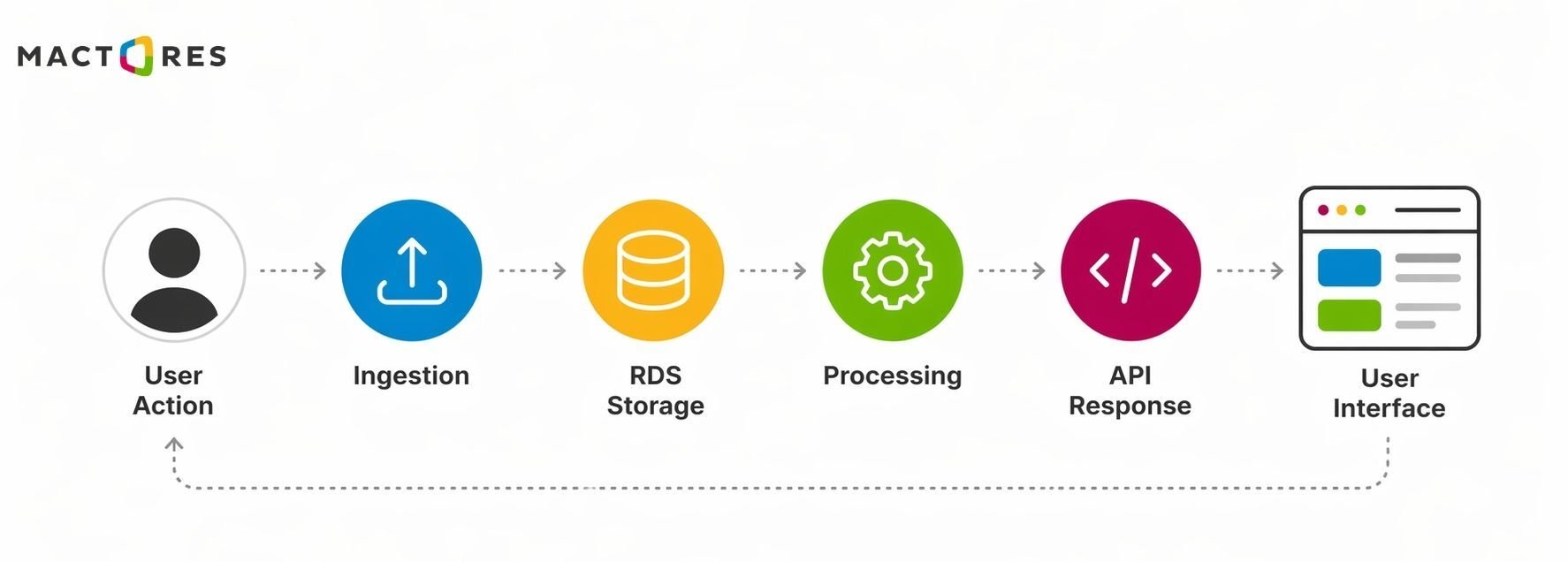
At a high level, the system flows from capturing user activity to serving personalized recommendations in real time:
 2. Core Components
These foundational datasets power the recommendation engine and determine its effectiveness:
Core components:
- User profile store: Stores user attributes, preferences, and history
- Content/item catalog: Contains metadata about products, articles, or media
- Interaction/event logs: Tracks behavioral data used for generating recommendations
3. AWS-Based Reference Architecture
In a typical AWS setup, multiple services work together to support scalability and performance:
Architecture elements:
- Compute layer: EC2 or Lambda for processing recommendation logic
- API layer: API Gateway for routing and exposing endpoints
- Caching layer: Redis/ElastiCache for faster response times
- Database layer: Amazon RDS as the central structured data store
Design considerations:
- Separate read/write workloads using replicas
- Optimize for low latency with caching and efficient queries
- Enable horizontal scaling for high-traffic applications
- Incorporate AI-driven optimization patterns (often implemented by Mactores) for continuous improvement
Designing the Database Schema in Amazon RDS
A well-designed schema is the backbone of any recommendation system. In Amazon RDS, structuring your data correctly ensures efficient queries, faster recommendations, and easier scaling as user activity grows. The goal is to balance simplicity (for maintainability) with performance (for real-time recommendations), something often refined in production environments.
1. Key Tables and Relationships
At a minimum, your schema should capture users, content, and interactions between them.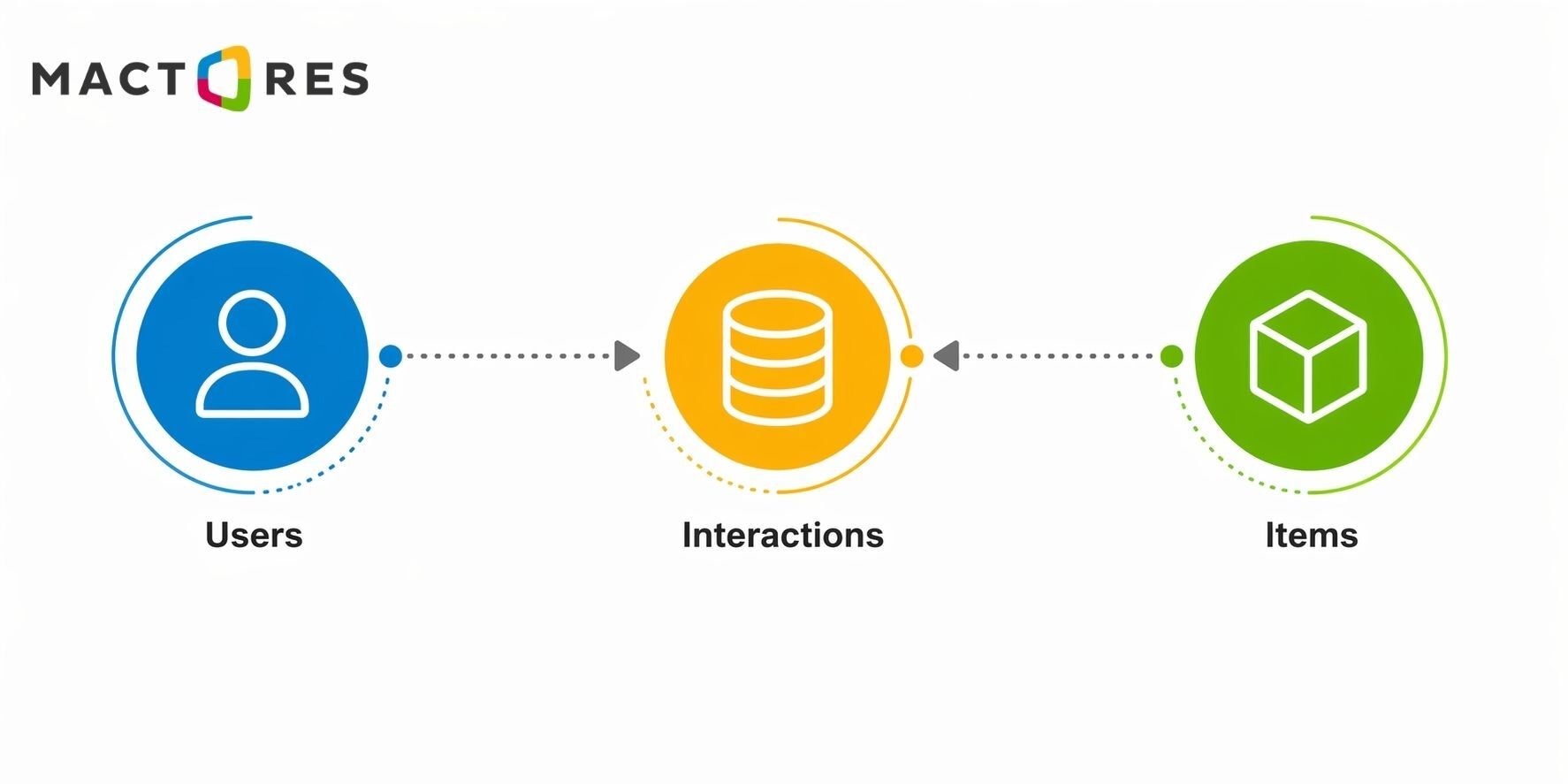 Core tables:
- Users table: Stores user details (user_id, preferences, demographics)
- Items/Content table: Stores metadata (item_id, category, attributes)
- User interactions/events table: Tracks actions (user_id, item_id, event_type, timestamp)
Relationship overview:
- One user → many interactions
- One item → many interactions
- Interactions act as the bridge between users and items
2. Schema Design Best Practices
Design choices directly impact the performance and flexibility of your recommendation queries.
Best practices:
- Normalization vs denormalization: Normalize for data integrity early on; selectively denormalize for faster reads at scale
- Primary & foreign keys: Ensure strong relationships and data consistency
- Indexing strategies: Index frequently queried columns (user_id, item_id, timestamps) to speed up lookups
3. Optimization Techniques
As data grows, optimization becomes critical to maintain performance.
Techniques:
- Query optimization: Use efficient joins, avoid unnecessary scans, and analyze queries with EXPLAIN
- Partitioning & sharding: Split large interaction tables by time or user segments for better performance
- Handling high-volume data: Archive old data, batch process logs, and offload heavy workloads when needed
- Modernization insights: Evolving schemas, workload-aware indexing, and scalable data patterns are commonly implemented in large-scale systems with support from Mactores.
Building a Basic Recommendation Engine
With your data structured in Amazon RDS, you can start generating recommendations directly using SQL. While advanced systems use machine learning, many practical use cases begin with simple, explainable approaches that leverage relational queries. This makes it easier to iterate quickly and build a strong foundation before scaling into more complex models.
1. Content-Based Filtering with SQL
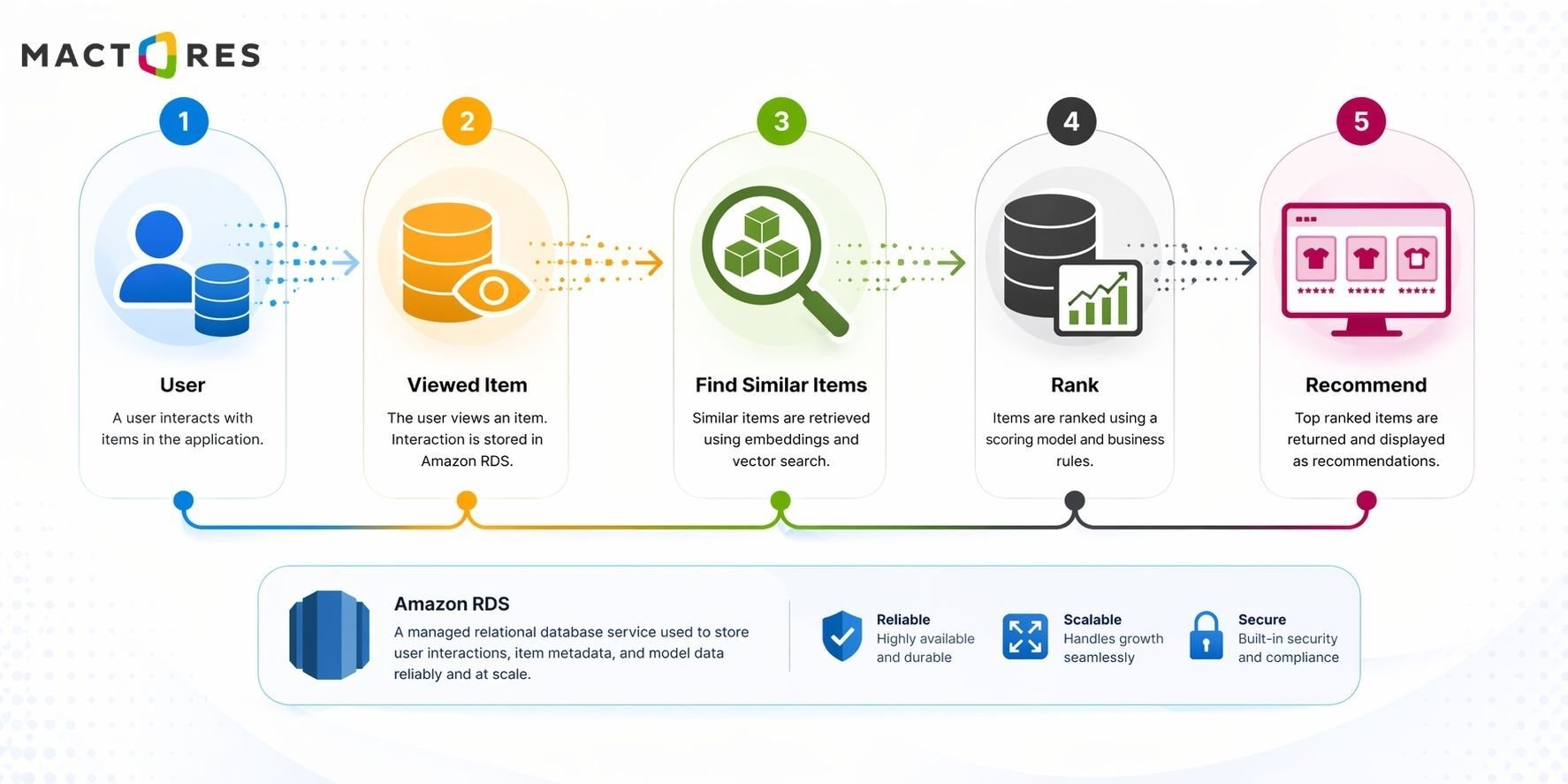
Content-based filtering recommends items similar to what a user has interacted with, based on attributes like category, tags, or features.
How it works:
2. Collaborative Filtering Concepts
Collaborative filtering uses patterns across users or items to generate recommendations.
Approaches:
- User-user similarity: Recommend items liked by similar users
- Item-item similarity: Recommend items frequently interacted with together
3. Example SQL Queries
SQL can be used to generate recommendations by combining joins, aggregations, and ranking logic.
Common patterns:
- Join interactions with items to find similar content
- Aggregate interactions (COUNT, SUM) to compute popularity or similarity
- Rank results using ORDER BY and LIMIT
Example logic:
- Find items in the same category as previously viewed items
- Rank by frequency or relevance score
- Filter out already seen items
This approach provides a simple yet effective way to generate recommendations directly within your database, making it a practical starting point before introducing more advanced AI-driven techniques.
Performance Optimization in Amazon RDS
As recommendation workloads grow, performance becomes critical to maintain low latency and a smooth user experience. Amazon RDS provides several built-in capabilities to optimize performance, but effective tuning comes down to how well your schema, queries, and scaling strategy are designed. In production environments, this often involves continuous monitoring and iterative improvements, an area where experienced teams like Mactores help fine-tune systems for efficiency at scale. Choosing the right indexes is key for fast recommendation queries. Index frequently accessed columns such as user_id, item_id, and timestamps, and avoid over-indexing, which can slow down writes. Focus on indexes that align with your most common query patterns.
Scaling in RDS can be achieved vertically by upgrading instance types or horizontally using read replicas to handle read-heavy workloads like recommendation queries. Load balancing across replicas helps distribute traffic and improve response times as usage grows. Optimizing queries ensures efficient execution. Use EXPLAIN plans to understand query behavior, avoid full table scans where possible, and refine joins and filters. Performance tuning is an ongoing process, requiring regular monitoring and adjustments as data and traffic increase.
How We Built a Scalable Recommendation Engine on Amazon RDS
A fast-growing e-commerce company partnered with Mactores to solve a key problem: despite strong traffic, their platform lacked personalization, resulting in low conversions and poor user engagement. Their data existed across systems but wasn’t structured for real-time recommendations. The goal was to quickly design a scalable, cost-efficient solution using Amazon RDS on Amazon Web Services without introducing unnecessary complexity.
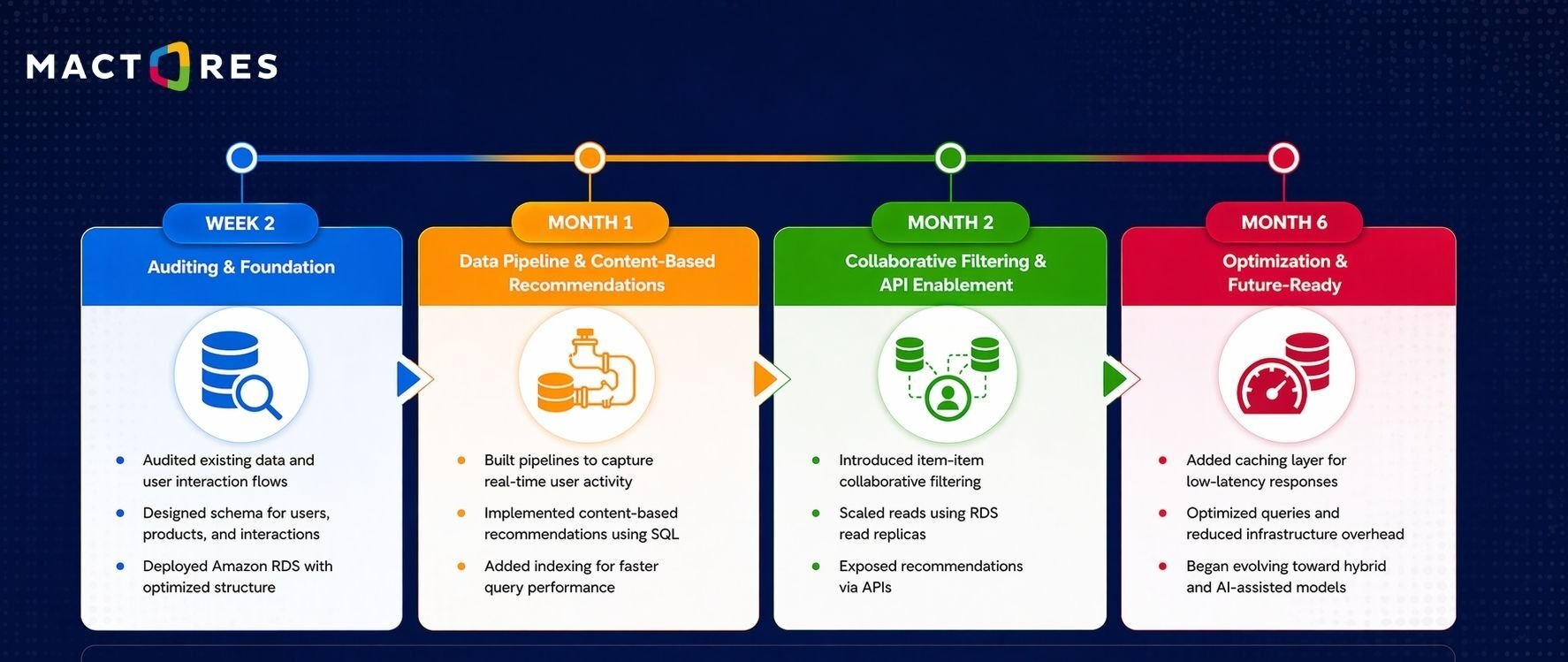
A. Transformation Timeline
B. Key Strategies Used
To ensure a balance between speed, scalability, and long-term flexibility, the implementation focused on a few core architectural and operational principles:
- Clean relational schema for structured data
- SQL-driven recommendations for faster iteration
- Incremental scaling with replicas and caching
- Continuous performance tuning based on usage patterns
C. Business Outcomes
These architectural and engineering decisions translated into measurable business and technical impact within a short timeframe:
- 28% increase in conversions
- 35% longer user sessions
- 40% lower infrastructure costs
- Sub-100ms response time for recommendations
- Scaled to millions of daily interactions
This case shows how a practical, phased approach can turn existing data into a working recommendation engine without overengineering. With support from Mactores, the client was able to move quickly from basic data structuring to delivering real-time personalized experiences.
Next Steps
Personalization has become a core capability for modern applications, but it doesn’t have to start with complex machine learning. As shown throughout this guide, a strong foundation using Amazon RDS within Amazon Web Services allows teams to build effective, scalable recommendation systems using simple, explainable approaches. The real value comes from structuring your data well, optimizing queries, and evolving incrementally as your needs grow.
To move forward, start by assessing whether your current system is capturing and organizing user interaction data effectively. From there, build a basic SQL-driven recommendation layer, optimize it with indexing and query tuning, and introduce scaling strategies like read replicas and caching as usage increases. As your system matures, you can gradually incorporate AI and hybrid recommendation models to improve accuracy and personalization.
For organizations looking to accelerate this journey, working with experienced partners like Mactores can help bridge the gap between foundational systems and advanced, intelligent platforms, ensuring your personalization efforts are not only scalable but also aligned with measurable business outcomes.