.svg)
.svg)
.svg)
Enterprise databases rarely change overnight. They evolve layer by layer until they become the foundation for hundreds of applications, integrations, and operational processes. That is exactly what has happened with Oracle in many organizations.
But the economics and innovation dynamics of enterprise technology have shifted dramatically. CIOs today face pressure to reduce infrastructure costs, accelerate AI initiatives, and modernize data platforms. Legacy Oracle environments that are often built around RAC clusters, Exadata infrastructure, and tightly coupled applications make that transformation difficult.
This is why many organizations are now designing deliberate Oracle exit strategies rather than incremental optimizations. The goal is not simply to migrate a database but to transition toward cloud-native database platforms such as Amazon Aurora and Amazon RDS.
At Mactores, we work with enterprises that want to modernize data platforms without disrupting mission-critical operations. A successful exit from Oracle requires careful planning, architectural alignment, and controlled migration execution. When done correctly, it reduces licensing overhead, improves scalability, and unlocks the ability to support AI workloads.
This guide outlines a structured, low-risk approach to exiting Oracle environments using AWS-native services, ensuring that enterprises maintain operational continuity while modernizing their database architecture.
Why Enterprises Struggle to Exit Oracle?
An Oracle environment often becomes deeply embedded within enterprise systems over time. Applications rely on Oracle-specific features, data pipelines depend on Oracle schemas, and downstream analytics systems pull data directly from Oracle databases. Exiting such an environment requires a carefully orchestrated transformation rather than a simple migration project.
Deep Application Coupling
Many enterprise applications rely on Oracle-specific capabilities such as PL/SQL packages, proprietary indexing strategies, or Real Application Clusters (RAC). These dependencies create migration barriers because alternative database engines do not always support these features directly.
Oracle-centered ERP and financial systems are especially vulnerable to this form of coupling. Tightly bound database architectures often prevent organizations from evolving toward modern data platforms.
Data Migration at Enterprise Scale
Oracle databases in large organizations often store tens or hundreds of terabytes of operational data accumulated over years of transactions. Migrating this data safely requires maintaining integrity, minimizing downtime, and validating replication accuracy.
Without controlled migration pipelines, enterprises risk data inconsistencies that could affect billing systems, reporting pipelines, or regulatory compliance.
This is why most modern Oracle migrations rely on replication-driven tools such as AWS Database Migration Service, which enables continuous data synchronization during the migration process.
Hidden Dependencies Across Systems
Oracle databases often function as central hubs in enterprise architectures. Over time, hundreds of services and integrations begin relying on them. These dependencies include analytics pipelines, reporting dashboards, ETL processes, and partner integrations.
Identifying these relationships is critical before migration begins. Discovery tools such as AWS Application Discovery Service and AWS Migration Hub help map these dependencies and prevent unexpected disruptions during database transitions.
Fear of Performance Regression
Mission-critical systems frequently run on highly optimized Oracle environments supported by specialized infrastructure such as Exadata clusters. Enterprise teams worry that migrating these workloads could introduce performance issues or reduce transaction throughput.
Modern cloud-native databases address these concerns through distributed storage, automatic scaling, and read replicas. For example, Amazon Aurora separates compute from storage and replicates data across multiple availability zones, providing high performance and resilience.
Organizational Risk Aversion
Even when technical solutions exist, organizations hesitate to migrate core databases due to perceived risk. Database failures can disrupt operations, affect financial systems, or impact customer-facing applications.
Because of this, many enterprises continue paying rising licensing costs rather than committing to modernization.
Defining the Target Architecture: Aurora vs RDS
Before designing a migration strategy, enterprises must determine the appropriate target database platform. AWS provides two primary options for Oracle modernization: Amazon Aurora and Amazon RDS.
While both services remove infrastructure management overhead, they serve different modernization goals.
|
Feature |
Amazon Aurora |
Amazon RDS |
|
Architecture |
Distributed storage layer |
EBS-backed storage |
|
Performance |
High throughput, cloud-native |
Engine dependent |
|
Scalability |
Reader replicas and serverless options |
Vertical scaling |
|
Availability |
Multi-AZ storage replication |
Multi-AZ standby |
|
Best Use Case |
Modernized applications |
Minimal application change |
Organizations seeking minimal disruption often migrate first to Amazon RDS for compatibility. Enterprises pursuing deeper modernization typically adopt Amazon Aurora, which provides a distributed architecture optimized for cloud-scale workloads.
The Four-Phase Oracle Exit Strategy
Successful Oracle exits rarely occur in a single step. Instead, they follow a structured migration lifecycle designed to reduce operational risk and ensure data consistency.
.jpg?width=4800&height=1425&name=Oracle%20Exit%20Strategy%20Phases%20(2).jpg)
Phase 1: Discovery and Dependency Mapping
The first step involves building a complete inventory of existing Oracle environments and understanding how they interact with applications and data pipelines. Key activities include:
-
database inventory and classification
-
workload analysis
-
schema dependency mapping
-
application integration assessment
Tools such as AWS Application Discovery Service and AWS Migration Hub help capture system metadata and identify cross-system dependencies. This visibility is essential for designing a migration strategy that avoids operational disruptions.
Phase 2: Schema and Code Conversion
After the environment is mapped, the next step involves converting database schemas and stored procedures to formats compatible with the target database engine.
This process is typically automated using the AWS Schema Conversion Tool, which analyzes Oracle schemas and generates compatible structures for Aurora or PostgreSQL-based environments.
The tool converts:
- tables and indexes
- views and constraints
- stored procedures and functions
However, Oracle-specific features such as complex PL/SQL packages may require manual refactoring.
Phase 3: Continuous Data Migration
With the schema in place, the next step is moving the data while minimizing downtime. AWS Database Migration Service enables this through a replication pipeline that supports two key modes:
- Full load migration, which transfers historical data to the target database
- Change Data Capture (CDC), which continuously replicates new transactions
This architecture allows the Oracle database to remain operational while data is synchronized with the new database environment.
Phase 4: Validation and Production Cutover
Before switching production workloads, enterprises must validate the migrated environment. Typical validation processes include:
- row-level data consistency checks
- query performance benchmarking
- application regression testing
Operational monitoring tools such as Amazon CloudWatch help teams track performance metrics and detect anomalies during testing. Once validation is complete, the organization performs a controlled application cutover to the new database platform.
Advanced Migration Patterns for Complex Environments
Some enterprise environments require more sophisticated migration approaches.
-
Strangler Migration Pattern: In this model, workloads are gradually moved from Oracle to Aurora. New services connect to the modern database while legacy services continue using Oracle until they are refactored. Over time, the Oracle footprint shrinks until it can be fully decommissioned.
-
Dual-Write Architecture: Certain mission-critical systems require zero downtime. In these cases, applications temporarily write data to both the Oracle and Aurora databases simultaneously. Once consistency and stability are confirmed, Oracle can be retired.
-
Data Domain Decomposition: Monolithic Oracle databases combine operational, reporting, and analytics workloads in a single system. Modern architectures separate these domains. Transactional workloads move to Aurora, while analytical data is streamed to platforms such as Amazon Redshift or Amazon S3.
Post-Migration Optimization and Cloud-Native Advantages
Moving to Aurora or RDS provides opportunities to optimize performance and scalability. Cloud-native capabilities include:
-
automatic storage scaling
-
read replicas for query scaling
-
rapid failover across availability zones
-
serverless compute models
Features such as Amazon Aurora Global Database enable multi-region replication, allowing organizations to support global applications with low-latency data access.
How Oracle Exit Enables AI and Modern Data Platforms?
Exiting Oracle environments does more than reduce licensing costs. It enables enterprises to adopt modern data architectures that support AI and analytics.
AWS-native databases integrate seamlessly with services such as:
- Amazon Redshift for large-scale analytics
- Amazon S3 for data lakes
- Amazon Bedrock for generative AI applications
These integrations allow enterprises to build data pipelines and AI workflows that would be difficult to support in traditional database environments.
Oracle Exit in Post-Merger Integration
Database consolidation is also a critical part of post-merger integration strategies. When organizations merge, they often inherit multiple legacy databases with incompatible architectures.
Migrating to AWS-native databases allows enterprises to standardize infrastructure and reduce operational complexity. This approach can significantly accelerate integration timelines, a strategy explored in How AWS-Native Databases De-Risk Post-Merger Integration.
Execution Timeline: A 90–180 Day Oracle Exit Plan
While timelines vary depending on database size and application complexity, most Oracle modernization projects follow a similar execution model.
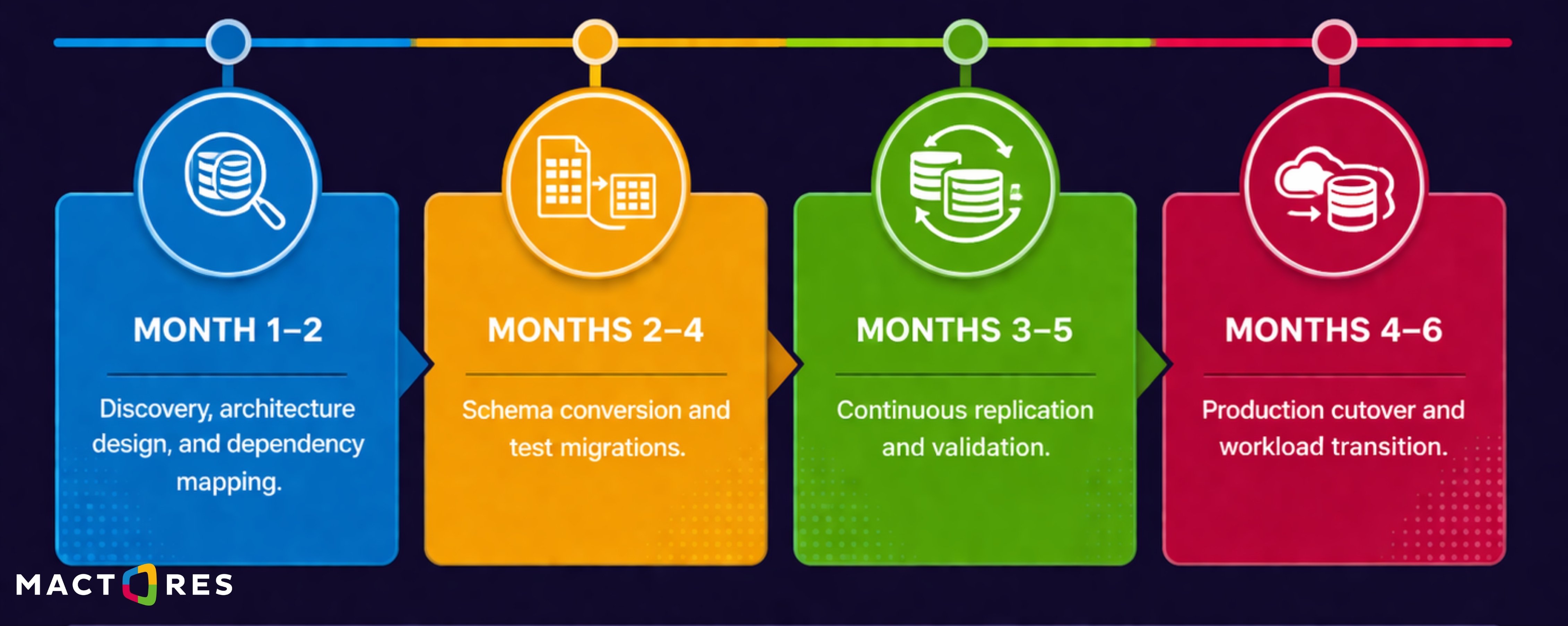
This structured approach ensures that migration risks are gradually reduced rather than concentrated during a single cutover event.
How Mactores Supports Oracle Modernization?
Designing and executing an Oracle exit strategy requires expertise across database architecture, cloud migration, and application modernization. Mactores helps enterprises plan and implement these transformations by combining migration frameworks, automation tools, and AWS-native architectures.
Our teams support organizations through every stage of the journey—from migration strategy and architecture design to execution and optimization—ensuring that database modernization delivers both operational stability and long-term cost efficiency.
Read: How Mactores Automates Oracle to Amazon RDS Migration for Synaptics?
Conclusion
Leaving Oracle is no longer just a cost optimization initiative. It is a strategic transformation to enable AI adoption and scalable analytics platforms. However, for a successful Oracle exit, enterprises must address application dependencies, data migration complexity, and operational risk through a structured modernization strategy.
By adopting AWS-native databases, organizations can reduce infrastructure overhead, improve scalability, and unlock innovation opportunities. For enterprises ready to modernize database platforms, the key is to approach the transition with a clear architecture, a phased migration plan, and the right technical partner.