Enterprise AI Strategy for 2027: Why the Context Layer Belongs on the Roadmap

Key Takeaways
- An enterprise AI strategy for 2027 needs a context layer next to data, models and agents, because most 2026 programs stalled on business meaning rather than model quality.
- The retailer in this guide ran three agent pilots in 2026, and the two that stalled failed on definitions, not technology.
- Five questions turn a list of use cases into a 2027 AI roadmap, covering decisions, definitions, sources of truth, agent authority and testing.
- Context sits between your data and your agents, and it needs business owners who sign each definition, not just engineers who model it.
- The first 90 days should put one decision into production, with 15 to 20 test questions answered correctly before release.
Most companies will finalize their enterprise AI strategy for 2027 in the next few weeks, and many will start from a familiar list: a data platform upgrade, a model choice and a set of agent use cases. That list leaves out the thing that stopped most 2026 programs. The agents worked, the models were fine, and the answers were still wrong, because nobody had told the agent what the business meant by the words in the question.
Our running example is a specialty home-improvement retailer with about 600 stores, made up but typical. In 2026 it ran three agent pilots, and its CIO spent October writing the 2027 plan. This guide follows that plan through five roadmap questions and a 90-day start. A sound enterprise AI strategy is an architecture decision as much as a business one, and the 2027 version adds a layer most plans still leave out.
What Changed in Enterprise AI in 2026?
Agents moved from demos into real workflows, and the bottleneck moved with them. In McKinsey's 2026 State of AI survey, the share of respondents at companies with more than $1 billion in revenue who said they were scaling AI agents rose from 27% to 40%, while 37% of all respondents attributed at least some EBIT impact to AI, about the same as a year earlier. More agents reached production, and the business results didn't grow at the same pace.
The vendors noticed. Through 2026, AWS announced AWS Context and released the open-source Context Ontology Accelerator, Databricks announced Genie Ontology, Microsoft extended Fabric IQ and Snowflake introduced Horizon Context. Each one is an answer to the same problem: agents that can reach the data but don't understand it.
The retailer's year looked like that in miniature. Its store associate assistant, which answered "is this item in stock at a nearby store?", went to production in May. Its returns agent for customer service and its margin assistant for finance both stalled by August, and neither problem was the model.
Why Is Context the Missing Layer in Most Enterprise AI Strategies?
Because strategies are usually organized around technology, while the failures happen in meaning. The retailer's returns agent read the policy documents, the point-of-sale codes and the order system, and it still approved returns it shouldn't have. "Returnable" depended on rules spread across all three.
Special-order items couldn't come back, contractor accounts had 90 days instead of 30, and major appliances needed a manager. No single source held the full definition, so the agent improvised one.
The margin assistant had the opposite problem. "Store margin" had three definitions in use. Merchandising measured it before shrink, finance measured it after shrink and freight, and regional operations subtracted store labor. The assistant picked whichever table it found first, and the CFO stopped trusting it within two weeks.
This is the most common reason AI projects fail, and it's measurable. VentureBeat's August 2026 poll found that 64% of organizations had traced a confidently wrong agent answer to missing or inconsistent business context in the previous six months. Gartner expects more than 40% of agentic AI projects to be canceled by the end of 2027, with unclear business value and inadequate risk controls among the reasons. Both are harder to fix after an agent ships than before.
A context layer is where those definitions live once they're agreed. It records what each business term means, the rules and consequences that go with it, which system holds the truth for each fact, and what an agent may do without asking. An ontology in AI is the usual way to model it, so the meaning can be read by software rather than buried in prompts.
Five Questions Your 2027 Enterprise AI Roadmap Has to Answer
The retailer's first draft of the 2027 plan listed nine use cases. Its CIO replaced the list with five questions, asked of every decision an agent would touch. The answers became the roadmap.
|
Roadmap question |
What the retailer found in 2026 |
What went on the 2027 roadmap |
|---|---|---|
|
1. Which decisions will agents make or support, and who owns each one? |
The pilots were framed as tools, so nobody owned the returns decision end to end |
Three decisions with named owners: returns approval, store margin reporting, and replenishment exceptions |
|
2. What do the words in those decisions mean, and who signs each definition? |
"Returnable" and "store margin" each had several working definitions |
Signed definitions, with the VP of customer service and the CFO as owners |
|
3. Which system is the source of truth for each fact? |
The order system and the point-of-sale system disagreed on special orders |
A source-of-truth map for every fact the three decisions use |
|
4. What may each agent do without asking, and who approves the rest? |
The returns agent had no limit, so it approved a $2,400 appliance return on its own |
Approval limits per agent, written into the context layer the agent reads |
|
5. How will you know an answer is right before and after release? |
Pilots were judged on demos and user feedback |
15 to 20 questions with known answers per decision, run before every release |
None of the five is about a model or a platform, and that's deliberate. The retailer's platform and model choices for 2027 stayed close to 2026's. What changed was that every decision on the roadmap now had an owner, a set of signed definitions and a test set before any engineering started. That turned the plan from an AI adoption roadmap, focused on how many teams were using AI, into an implementation roadmap built around decisions.
Where Does Context Ontology Sit Next to Data, Models and Agents?
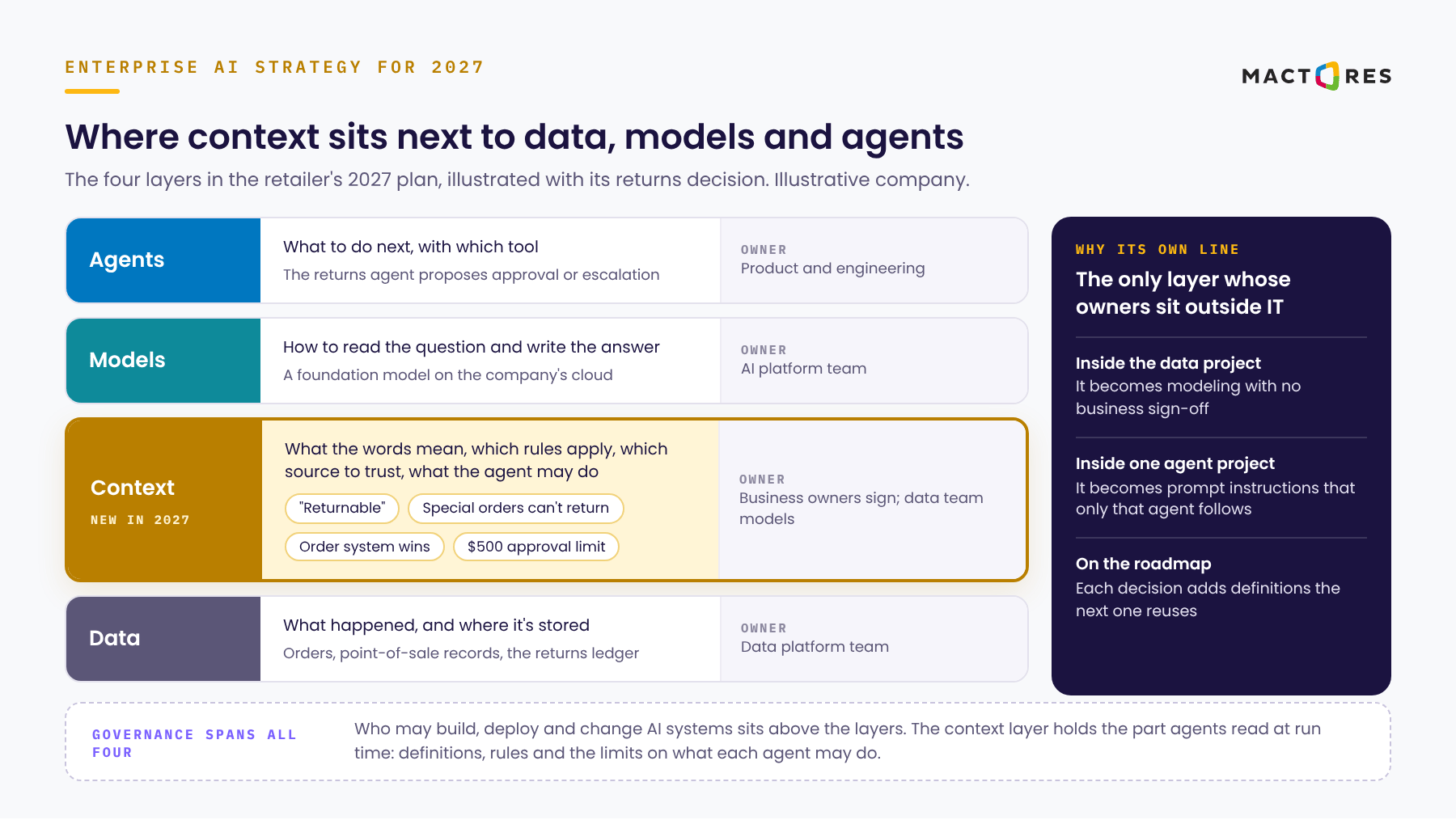
Between the data and the agents, with its own owners. The retailer's 2027 architecture had four layers, and each one answered a different question for the agent.
|
Layer |
What it answers for the agent |
Who owns it at the retailer |
Example from returns |
|---|---|---|---|
|
Agents |
What to do next, using which tool |
Product and engineering |
The returns agent proposes approval or escalation |
|
Models |
How to read the question and write the answer |
AI platform team |
A foundation model on the company's cloud |
|
Context |
What the words mean, which rules apply, which source to trust, and what the agent may do |
Business owners, with the data team |
"Returnable," the special-order rule, the $500 approval limit |
|
Data |
What happened, and where it's stored |
Data platform team |
Orders, point-of-sale records and the returns ledger |
The context layer is the one most 2026 architectures were missing, and it's the one whose owners sit outside IT. That's why it needs its own line on the roadmap. Left inside the data platform project, it becomes a modeling exercise with no business sign-off. Left inside an agent project, it becomes a set of prompt instructions that only work for one agent.
It also depends on AI-ready data underneath it, since a definition can't be enforced on data that isn't governed. Where the context lives is a platform choice. Teams on AWS can build on the Context Ontology Accelerator today, and others can hold the same model in a Databricks ontology, Microsoft Fabric IQ or Snowflake Horizon Context. The definitions and owners are the same work on every platform.
What Should the First 90 Days of a 2027 AI Roadmap Look Like?
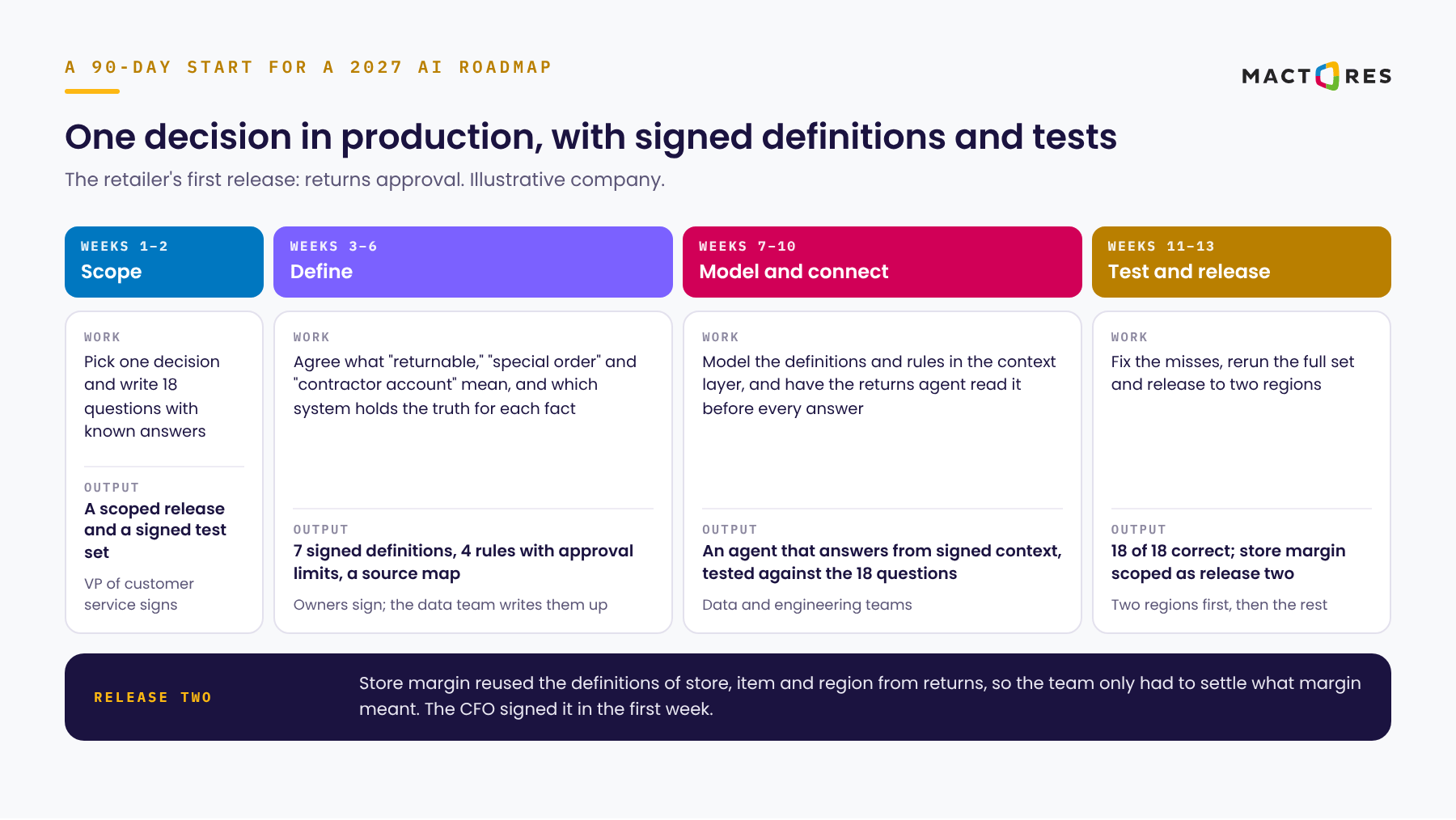
One decision in production, with signed definitions and tests, by the end of the first quarter. The retailer chose returns approval, because it had the clearest owner and the most visible mistakes in 2026.
|
Weeks |
What the retailer did |
What it had at the end |
|---|---|---|
|
1 to 2 |
Picked the returns decision and wrote 18 questions with known answers, such as whether a special-order vanity bought 20 days ago can come back |
A scoped first release and a test set signed by the VP of customer service |
|
3 to 6 |
Agreed definitions for returnable, special order and contractor account, and mapped each fact to its source of truth |
Seven signed definitions, four rules with approval limits and a source map |
|
7 to 10 |
Modeled the definitions and rules in the context layer and connected the returns agent to it |
An agent that read the context before answering, tested against the 18 questions |
|
11 to 13 |
Fixed the misses, ran all 18 questions again and released the agent to two regions |
18 of 18 correct, and a plan for store margin as the second release |
The second release went faster than the first. Store margin reused the definitions of store, item and region from the returns work, so the team only had to settle what margin itself meant, which the CFO signed in the first week. That reuse is the reason to treat context as a roadmap layer rather than a project. Each decision added to it makes the next one quicker to build and easier to trust.
Shipping that first release is where most of the effort goes, and it's what separates AI agents in production from another year of pilots.
That's the work our context ontology services are built for. Forward-deployed engineers sit with the people who own your definitions, while agents handle the profiling, drafting and test generation. Within a week of the first working session, you get a diagnosis, a draft first-release scope and a target production date to put on the 2027 roadmap.