AI Transaction Monitoring: How a Transaction Ontology Gives Banking AI the Context Behind Every Payment

Key Takeaways
- AI transaction monitoring scores payments without the relationships behind them, so alerts are noisy and hard to explain. Shared owners, merchant hierarchies and product rules sit in KYC files, acquirer data and product terms that the monitoring model never reads.
- A transaction ontology links each payment to its accounts, parties, beneficial owners, merchants, counterparties, products and rules. Public standards such as FIBO, the Legal Entity Identifier and ISO 20022 supply much of the shared vocabulary.
- Network context finds what single-account scoring misses. In the BIS Innovation Hub's Project Hertha, published in June 2025, payment system analytics helped banks find 12% more illicit accounts and improved detection of previously unseen behavior by 26%.
- Examiners need to retrace why an alert was raised or closed. SR 26-2, issued in April 2026, leaves generative and agentic AI models to each bank's own governance, so the trace has to be built into the system.
- Start with one alert type on one product line. A first release of 10 to 20 questions, tested against cases the bank has already closed, usually takes 8 to 12 weeks.
Most banks already run transaction monitoring, and many are adding machine learning or AI agents on top of it. The complaint from compliance teams stays the same: too many alerts close as false positives, and the ones that matter are hard to explain. The facts an investigator needs usually exist somewhere in the bank, spread across systems the monitoring model doesn't read.
Mactores has built data platforms and AI agents on AWS since 2008, much of it for regulated companies, including a real-time MBS pricing platform that records its own lineage and a payments platform cut over without an audit incident. This guide draws on that work and on the delivery method we use for transaction ontologies.
What Is AI Transaction Monitoring?
AI transaction monitoring is the use of machine learning, and increasingly AI agents, to review payments and account activity for signs of money laundering, fraud or sanctions evasion, alongside or in place of fixed rules. AML transaction monitoring is its regulatory core: a bank has to detect suspicious activity and, under 31 CFR 1020.320, generally file a suspicious activity report within 30 calendar days of first detecting it.
It's already widespread. In the Cambridge Centre for Alternative Finance's 2026 global survey of 628 organizations in 151 jurisdictions, AML/CFT and KYC was among the most widely adopted AI uses in risk and compliance, cited by 52% of the industry firms surveyed, behind fraud detection at 57%. Regulators are encouraging it too. FinCEN's proposed AML/CFT program rule of April 2026 encourages institutions to evaluate whether new technology might help and names machine learning and generative AI as examples.
|
Approach |
What it looks at |
What it can explain |
|---|---|---|
|
Rules and thresholds |
One account's activity against fixed scenarios |
Which scenario fired and which threshold was crossed |
|
Machine learning scoring |
Patterns across many features, usually per account or customer |
A risk score and the features that moved it |
|
AI agents on the monitoring data |
Whatever the agent can retrieve from the systems it's connected to |
A written rationale, as good as the context it found |
|
AI with a transaction ontology |
The payment plus its owners, merchants, counterparties, products and rules |
The parties, links, rule and sources behind the alert |
Why Do Transaction Monitoring Models Flag the Wrong Things and Struggle to Explain Why?
Because they score each transaction with the data in the monitoring feed, and the facts that decide what a payment means sit somewhere else. Who controls an account is in KYC and beneficial ownership records. What a merchant really sells is in acquirer data. Which volumes are normal depends on the product terms. A model that can't see those links raises alerts on activity that's routine for the customer and misses activity spread across accounts that look unrelated.
Each system also names the same thing its own way. Core banking knows an account holder, the CRM knows a party under another ID, and the beneficial ownership file knows the person behind both. In our context ontology for financial services work, the failures that show up at almost every institution start there: AML alerts close as unrelated when one person sits behind several accounts, fraud agents misjudge merchants whose descriptors and category codes disagree, and alert rationales fall apart in review because nothing recorded which data and rules produced them.
|
What goes wrong with the alert |
The fact the model didn't have |
Where that fact usually lives |
|---|---|---|
|
A cash-heavy business alerts every week |
Its account type carries higher expected cash volumes |
Product terms and the KYC profile |
|
Deposits split across several accounts never alert |
One person owns or controls all of the account holders |
Beneficial ownership records collected at account opening |
|
A card merchant is scored as low risk |
It has changed what it sells while keeping its category code |
Acquirer data and merchant onboarding files |
|
An outbound wire to a known party is missed |
The beneficiary is linked to a customer the bank exited |
Payment messages and customer exit records |
|
A closed alert can't be defended in review |
Which data, rule and threshold version led to the decision |
Nowhere, unless the system records it |
Relationships across accounts are where the extra detection comes from. In Project Hertha, the BIS Innovation Hub and the Bank of England tested analytics on payment system data covering 1.8 million synthetic accounts and 308 million transactions. Banks and payment providers using it found 12% more illicit accounts than they would have alone, with a 26% improvement when the criminal behavior was a pattern they hadn't seen before. The project framed the analytics as a supplement to each bank's own monitoring and named explainable AI among the things that make it effective.
Explanation is the other half of the problem. In the same Cambridge survey, 79% of the 130 regulators who took part rated explainability as critical or important to their regulatory objectives. An alert that can only say "unusual amount" gives an investigator nowhere to start and an examiner nothing to test.
What a Transaction Ontology Captures: Accounts, Parties, Merchants, Counterparties, Products, Rules
A transaction ontology is a governed, machine-readable model of each payment and everything that gives it meaning. It names the things a bank deals with, how they connect and which rules apply, and it ties every local identifier for a customer, account or merchant to one shared record. Filled in with the bank's actual records, it becomes a financial knowledge graph that monitoring systems and agents can follow from one alert to every related party.
|
What it captures |
What the monitoring feed usually has |
What the ontology adds |
A standard to start from |
|---|---|---|---|
|
Accounts |
An account number, balance and transaction history |
The product, owners, signatories, limits and the ledger it posts to |
FIBO clients and accounts |
|
Parties and beneficial owners |
A customer ID per system |
One party across core, CRM and KYC, plus who owns or controls each legal entity |
FIBO ownership and control, the LEI |
|
Merchants |
A card descriptor and a category code |
One merchant identity behind its descriptors, merchant IDs and category history |
ISO 18245 merchant category codes |
|
Counterparties |
Free-text name and account fields in a payment message |
The other side of a wire, ACH entry or trade, resolved to a known party where possible |
ISO 20022 fields, the LEI |
|
Products and channels |
A product code |
The terms that change what a payment means: card, ACH, wire, RTP, FedNow, branch or mobile |
FIBO financial products and services |
|
Rules |
Scenario thresholds inside the monitoring engine |
Monitoring, sanctions and access rules written as checks, each with an owner and a version |
Your own policies, written in SHACL |
The ontology connects the nouns of banking, such as customers, accounts, payments and cases, with its verbs, such as hold, escalate, reverse and report. It also keeps provenance: which source system supplied each fact, when it changed and which rule relied on it. That's what separates it from a data catalog, and it's the idea of an ontology in AI applied to payments.
Much of the vocabulary already exists. FIBO, the Financial Industry Business Ontology, is maintained by the EDM Council through an open community process, standardized by the Object Management Group and published with formal updates every quarter, most recently in its third-quarter 2026 release on October 20. Its Business Entities domain includes modules for ownership parties, control parties and corporate ownership, and its Financial Business and Commerce domain covers clients, accounts and financial products. For legal entities on either side of a payment, the Legal Entity Identifier system reached 3.19 million active LEIs at the end of the third quarter of 2026.
What no standard holds is the bank's own meaning: its products, its scenarios, its thresholds and the definition of a related party its BSA officer will sign. Those come from the people who own them. For US banks, the beneficial ownership facts usually come from the customer due diligence rule at 31 CFR 1010.230, which has a bank identify, when an account is opened, each individual who owns 25 percent or more of a legal entity customer and one individual with significant responsibility to control it.
The ontology doesn't replace core banking, the card processor, the monitoring engine or the warehouse. On the open-source Context Ontology Accelerator, it reads those systems in place through a virtual knowledge graph and serves the result to agents through an MCP server, inside the bank's own AWS account.
How Context Changes an AML or Fraud Alert
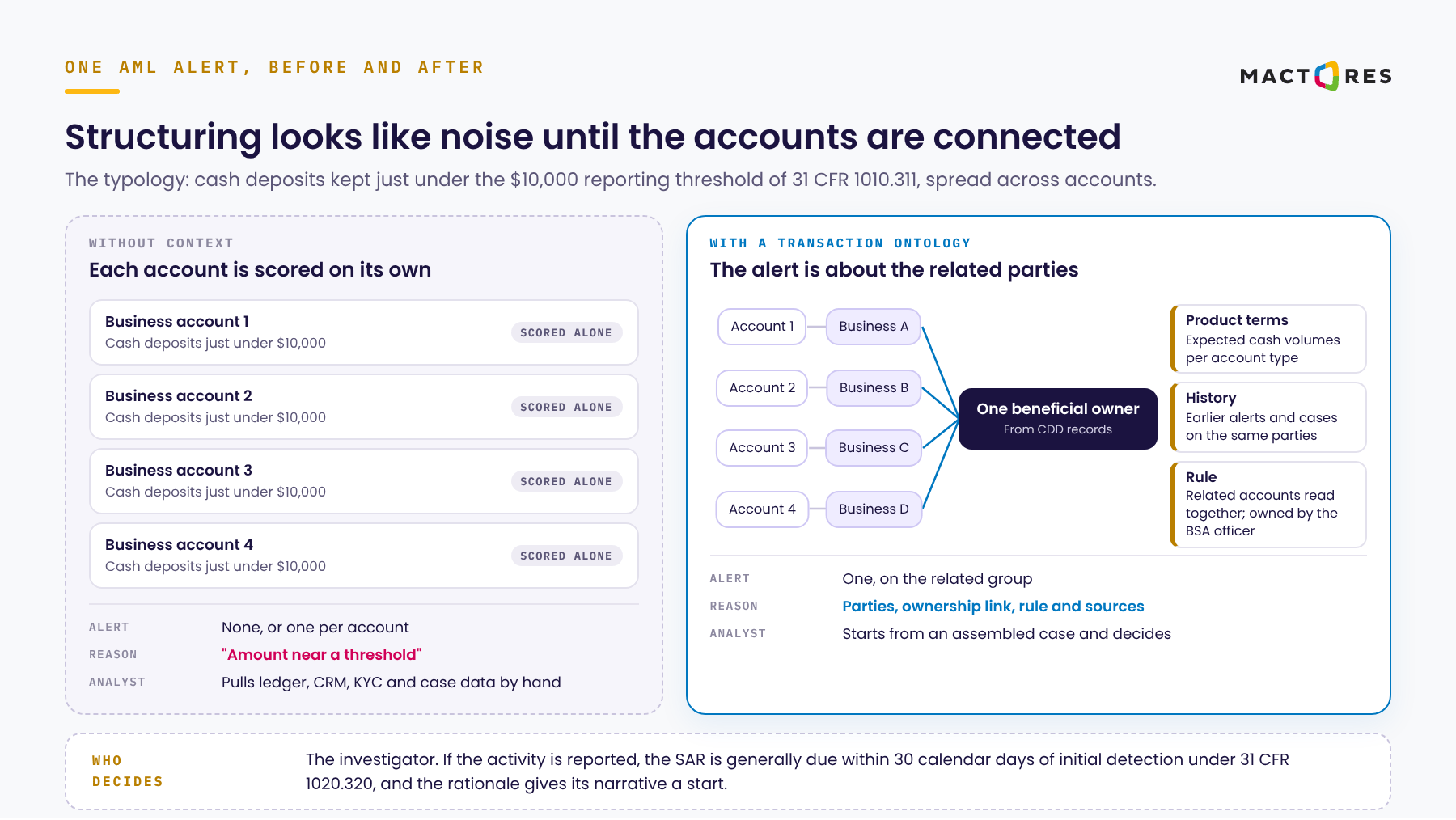
It changes what the alert is about. Without context, the system alerts on transactions. With a transaction ontology, the alert is about a set of related parties, the rule they may have broken and the evidence for it.
Take structuring, one of the oldest patterns in AML: cash deposits kept just under the $10,000 currency transaction report threshold of 31 CFR 1010.311, spread across branches and accounts so no single deposit triggers the report. A monitoring system that scores each account alone sees deposits on accounts held by different small businesses. Each may sit below the scenario threshold, or each may raise its own alert. Either way, the investigator starts by pulling the core ledger, the CRM, the KYC files and past cases into one place, and the alert's stated reason is an amount near a threshold.
With a transaction ontology, the same deposits resolve to their legal entity customers, and the beneficial ownership records the bank collected at account opening show whether one person owns or controls them. The product terms show whether any account is a cash-intensive business with its own expected volumes, and earlier alerts and case outcomes for the same parties come linked. The aggregation rule the BSA officer signed then runs over the whole group, and the investigator receives one alert naming the parties, the ownership link, the rule and the sources behind each.
|
For one structuring alert |
Without context |
With a transaction ontology |
|---|---|---|
|
What raises the alert |
Each account's deposits against a threshold |
The related parties' deposits, aggregated under the signed rule |
|
Where the investigator starts |
Pulling ledger, CRM, KYC and case data by hand |
A case with the parties, links and history already assembled |
|
What the rationale says |
Amount near a threshold |
Who is connected, how, under which rule, from which sources |
|
What an examiner can retrace |
The alert and the analyst's notes |
Every fact, rule version and access decision behind the outcome |
The decision stays with the investigator. If the activity is reported, the SAR narrative starts from that rationale, and the 30-day clock in 31 CFR 1020.320 is easier to meet when the evidence is already assembled. The same rule set also protects what the bank must keep quiet: a SAR and any information that would reveal one are confidential, so the ontology's access policies keep SAR-related data out of reach for every role and agent that shouldn't see it, which is the core of agentic AI governance in a bank.
Fraud alerts change the same way. A card fraud model that knows one merchant identity behind its descriptors, merchant IDs and category history can tell a merchant that changed its business from one that was always risky. ACH monitoring needs the history of originators and receivers. Nacha's 2026 risk management rules, which took effect in phases on March 20 and June 19, 2026, require risk-based processes reasonably intended to identify ACH entries initiated due to fraud, and receiving banks must look for fraudulent credits. Instant payments on RTP and FedNow add urgency, because the context has to be there before the money moves.
Making Each Alert Traceable for Examiners
Store the explanation with the alert. Each alert, and each step an agent takes on it, should keep the data it read, the definitions and rules it applied, what each role was allowed to see and the ontology version in force, so an examiner can replay the conclusion months later.
Supervisory guidance now makes that the bank's job. On April 17, 2026, the Federal Reserve, OCC and FDIC issued SR 26-2, which supersedes SR 11-7 and SR 21-8, the 2021 interagency statement on model risk management for systems supporting BSA/AML compliance. Its definition of a model leaves out deterministic rule-based processes with no statistical theory behind them, and a footnote places generative and agentic AI models outside its scope, leaving their controls to each bank's own risk management and governance. A monitoring stack can therefore hold three kinds of component under three sets of expectations: threshold rules, machine learning scores and agents. A trace that covers all three is the simplest way to answer an examiner about any of them.
We've built this kind of evidence into regulated systems before. On the real-time MBS pricing platform we delivered for a capital markets customer, every signal, model invocation and trading decision is traced and logged as the system runs, so audit evidence aligned to FFIEC, SEC and FINRA expectations is captured at the moment of decision. The same principle runs through our financial services data modernization work, where the evidence an examiner will ask for is generated while the system is being built.
|
What an examiner asks about an alert |
Where the answer comes from |
|---|---|
|
"Why was this alert closed without escalation?" |
The stored rationale: the parties resolved, the links followed, the rule and threshold applied |
|
"Which definition of a related party applied that month?" |
The definition's version history and the steward who approved each change |
|
"Could the analyst or the agent see SAR-related information?" |
Entitlement test results for each role and the query log |
|
"Which sources did the rationale rely on, and how fresh were they?" |
Source lineage and refresh times recorded with the answer |
|
"Which ontology release produced this alert?" |
The release history linked to the alert trace |
Recording those decisions as they happen, with the sources and rules behind each one, is what a context graph is for. The same habit carries into cutovers: on the branded-payments platform we moved to AWS, agents instrumented the parallel run, our engineers sequenced the cutover by risk, and production sign-off came with zero audit incidents.
Where to Start: One Alert Type, One Product Line
Pick the alert type that wastes the most investigator time on one product line, write down the 10 to 20 questions investigators ask about it, and build only the ontology those questions need. We don't ask a bank to model the whole enterprise before proving value.
|
Alert type |
Product line |
Why it makes a good first scope |
|---|---|---|
|
Cash structuring and aggregation |
Small-business deposit accounts |
Beneficial ownership links decide most outcomes, and the rule is easy to state and sign |
|
ACH credit-push fraud |
Business ACH origination or receipt |
Nacha's 2026 rules already require risk-based monitoring, and originator history is the missing context |
|
Card fraud and disputes |
Consumer cards |
One merchant identity across descriptors and category history fixes a large share of misreads |
|
Rapid movement of funds |
Instant payments on RTP or FedNow |
There's no recall window, so context has to arrive before release |
From there, our delivery runs in five phases, each closed by a signed exit: frame the questions, resolve parties and sources, agree meaning and rules with the risk and compliance owners, test against known outcomes, then go live in stages under parallel running. A first release usually takes 8 to 12 weeks and covers a few source systems. Testing uses questions whose answers are already settled, such as cases the bank has closed, and every role is checked against its entitlements, including refusals for SAR-related data and information barriers.
|
What derails a first release |
What we'd do instead |
|---|---|
|
Modeling every product and alert type before proving one |
Scope to one alert type and one product line, and let the second release reuse the parties and owners the first one resolved |
|
Party and account data that disagree across systems |
Make party resolution the first phase, with match rules the data owners sign |
|
Rules the business has never written down |
Hold definition sessions with the BSA officer and fraud lead before encoding anything |
|
Agents allowed to close alerts or move money |
Let agents assemble and draft, and keep every closing, filing and blocking decision with a named person |
|
Controls described in documents but not enforced |
Run entitlement and known-outcome tests before every release, and keep the results |
Measure the release on the alerts it changes: the share of alerts that close as false positives, the time it takes to assemble a case, how often a rationale is complete enough to stand on its own and whether every entitlement test passes. The ontology, its mappings, rules and tests stay in the bank's AWS account in open W3C formats, so the bank's own stewards can extend it.
Our context ontology services start from one question your agents or analysts keep getting wrong. Bring an alert your team closed and shouldn't have, the accounts behind it and the rationale, and within a week you get our findings, a proposed first-release scope and the date we would commit to.