Agentic AI in Telecom: How a Network-to-Customer Ontology Connects an Alarm to the SLA It Puts at Risk

Key Takeaways
- Agentic AI in telecom stalls on one gap: the agent can't see which customers an alarm affects. Fault management names a network element, inventory knows the services on it, billing knows the subscriber and the contract repository holds the SLA, each under its own identifiers.
- OSS and BSS mean different things by "service". The network side means a circuit or a bearer in inventory, while the business side means a product someone bought and is billed for, so the chain between them has to be modeled.
- A network-to-customer ontology links element, service, product, customer and SLA in one queryable chain. It reuses TM Forum SID names where they fit and writes SLA, outage and CPNI rules as checks agents run before they answer.
- Operators are betting on autonomy anyway. In TM Forum research presented at DTW Ignite 2026, 81% of 80 operators were targeting Level 4 autonomous networks or above by 2030, and 20% expected to get there by 2027.
- Start with one alarm family and one enterprise product. A first release built on 10 to 20 business questions usually takes 8 to 12 weeks, and it isn't done until replayed incidents name the same customers your service desk confirmed.
Telcos are putting agents into network operations, care and enterprise service, and many of those agents hit the same wall the first night a real outage happens. The care agent sees subscribers calling about dropped calls, the network agent sees a resource ID, and neither can say which enterprise customers sit behind the failed element or what their contracts promise.
Mactores has built data platforms and AI agents on AWS since 2008, including Safaricom's intent-based care agents and a churn and intervention platform that scores more than 10 million subscribers. This guide draws on that work and on the context ontology method we publish for telecom and media. The regulations and research it cites were checked on November 17, 2026.
What Is Agentic AI in Telecom?
Agentic AI in telecom is the use of AI agents that pursue a goal across network and business systems, such as investigating an alarm or troubleshooting a customer's line, by deciding their next step, calling tools and acting within limits the operator sets. An assistant answers a question, while an agent runs a closed loop of observe, decide, act and observe again inside an enforced envelope, and that loop is what makes agentic AI different from earlier automation.
Operators are heading that way at the network level too. TM Forum's autonomous networks research, presented at DTW Ignite 2026 and based on a survey of 80 operators, found that 81% are targeting Level 4 or above by 2030, while 20% expect to reach it by 2027. Level 4 means the network acts on faults without waiting for a person, which only works when the automation knows what a fault means for customers and contracts.
|
Where agents work |
Questions they get |
What they need to know |
|---|---|---|
|
Network operations center |
"Which enterprise customers sit behind this alarm cluster, and when do their restoration clocks run out?" |
Elements linked to circuits, services, sites, customers and SLA terms |
|
Customer care |
"This caller reports dropped calls. Is there an open incident on their serving cells?" |
Subscriber linked to line, device, serving cells and open incidents |
|
Enterprise service desk |
"Which of our contracts does this outage touch, and what do we owe?" |
Contracts tied to the circuits and sites they cover, with credit terms |
|
Field service |
"Which job goes first?" |
Work orders linked to the customers and SLA clocks each one protects |
|
Retention and marketing |
"Should this household get the bundle offer this week?" |
Offers, households and incidents on one timeline, with CPNI approval status |
Why Can't a Telco Agent Tell Which Customers an Alarm Affects?
Because no single system holds the chain, and the two halves of the stack don't agree on what a service is. Fault management knows the network element, inventory knows which services ride on it, billing knows the subscriber and the contract repository holds the SLA, each under its own identifiers, so an agent sees one link at a time.
The word "service" is where the gap starts. In the OSS, a service is a technical construct in inventory, such as a circuit, a bearer or a VPN that rides on specific elements. In the BSS, a service is the product a customer bought and is billed for, such as a dedicated internet access plan or a mobile subscription. An agent that reads one side can't translate to the other unless something records how one maps to the other, for every customer and every product.
|
What goes wrong |
Why it happens |
What the agent is missing |
|---|---|---|
|
Care blames the handset during a known outage |
Incident data never reaches the care channel |
The link from incident to serving cells to subscribers |
|
Enterprise SLA credits are missed, or paid twice |
Contracts sit apart from the circuits and sites they cover |
Each SLA tied to the services and sites it promises |
|
A retention discount reaches a customer mid-outage |
Churn models and offer engines can't see network events |
Offers checked against open incidents and recent service quality |
|
Field crews go to the wrong site first |
Work orders carry element IDs, not customer impact |
Which jobs protect which customers and restoration targets |
Most operators already align parts of their data with the TM Forum Information Framework, known as SID, which names customer, product, service and resource entities. SID helps, but it's published as a UML model rather than in a form agents can reason over, and every operator implements it a little differently.
Network to Service to Product to Customer: The Ontology Chain
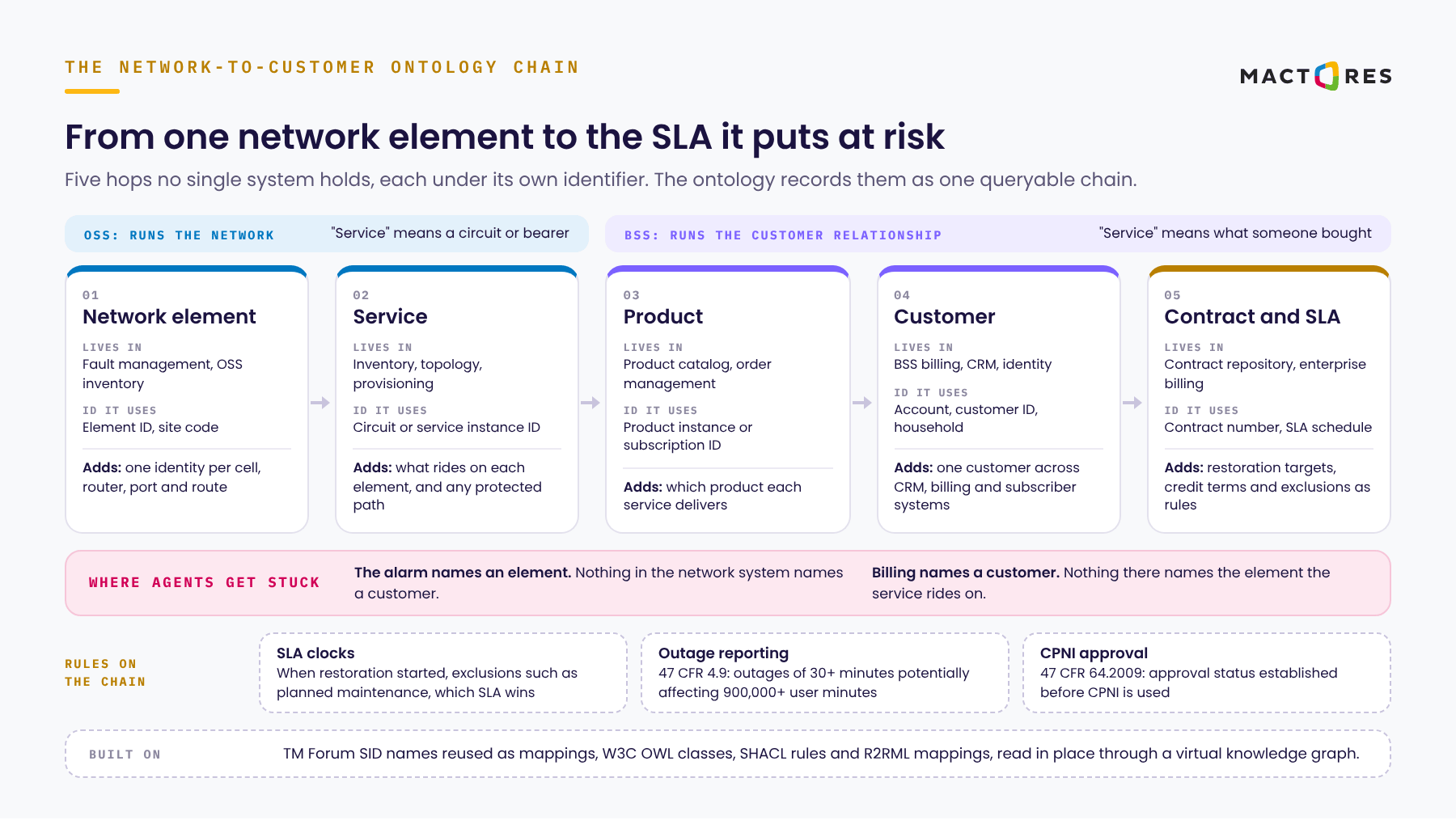
A network-to-customer ontology models five hops, from network element to service, product, customer and SLA, and the identity rules that connect each hop across systems. Once those links exist, an agent can follow one alarm to every customer and contract behind it in a single query instead of asking five teams.
|
Hop |
Where it lives today |
Identifier it uses |
What the ontology adds |
|---|---|---|---|
|
Network element |
Fault management, OSS inventory |
Resource or element ID, site code |
One identity per cell, router, port and route, refreshed as topology changes |
|
Service |
Inventory, topology, provisioning |
Circuit ID, service instance ID |
Which services ride on each element, and whether a protected path exists |
|
Product |
Product catalog, order management |
Product instance or subscription ID |
Which product each service delivers, so a circuit becomes "dedicated internet access" or "mobile line" |
|
Customer |
BSS billing, CRM, identity |
Account number, customer ID, household |
One customer and account across CRM, billing and subscriber management |
|
Contract and SLA |
Contract repository, enterprise billing |
Contract number, SLA schedule |
Availability and restoration targets, credit terms and exclusions such as planned maintenance, as checkable rules |
Identity is most of the work. Matches between inventory IDs and service and billing records are drafted by agents, each scored for confidence, then reviewed by the system owners. Your network, care and billing leads decide the definitions no tool can settle, such as whether "customer" means the account, the line or the household for each question, and what counts as an affected customer during a partial outage.
The model itself uses open standards. Each concept becomes a W3C OWL class, SLA and availability logic is expressed in SHACL, and R2RML maps every class to the source tables that hold it, so a virtual knowledge graph can read OSS inventory and BSS billing in place. Telecom already has a head start here: TM Forum's intent common model vocabulary (TR290V, version 3.2.0) is anchored in RDF and the TM Forum intent management ontology, so network intents can be linked to the services and customers they protect.
That's the same structure as ontology in AI anywhere else, applied to a domain where the identifiers multiply fastest. On the open-source Context Ontology Accelerator, agents draft the classes and matches from OSS, BSS and CRM schemas, and people approve every element before it reaches the graph.
Adding SLAs, CPNI Rules and Content Rights
The chain tells an agent who is affected. The rules attached to it tell the agent what that means: which SLA clocks are running, which regulatory notices may be due, which customer data it may read for this purpose and, for operators with a TV service, which titles may play where.
SLAs and restoration clocks
Enterprise contracts carry availability and restoration targets, credit terms and exclusions, and they rarely live next to the circuits they cover. Modeled as rules on the contract node, they let an agent say when a restoration clock started, whether planned maintenance excludes the event and which SLA wins when a contract and a standard plan disagree, a call your owners make once and sign.
Outage reporting
Regulators ask the same question the chain answers. Under the FCC's outage reporting rule, wireless and wireline providers must notify the Commission within 120 minutes of discovering an outage of at least 30 minutes that potentially affects at least 900,000 user minutes of telephony, among other triggers. When a switch fails, a wireless provider counts potentially affected users by multiplying the macro cell sites disabled by the average number of users served per site. An ontology that already links sites to subscribers turns that count into a query.
What is CPNI?
CPNI, customer proprietary network information, is what a carrier knows because it provides the service: who a customer calls, when, for how long, from where and what they subscribe to. The FCC's CPNI rules limit its use beyond the service relationship without the customer's approval, and 47 CFR 64.2009 says carriers "must implement a system by which the status of a customer's CPNI approval can be clearly established prior to the use of CPNI." An officer must also sign an annual compliance certificate.
For agents, that rule is a design requirement. CPNI fields and each subscriber's approval status are modeled in the ontology, every tool declares its purpose, such as troubleshooting, restoration or marketing, and policies admit CPNI only to purposes the approval covers. A care agent may use call records to troubleshoot a line, while a marketing agent never sees them unless the customer has opted in, and each answer records what was withheld and why. That's agentic AI governance written where the agent reads, rather than in a policy manual.
Content rights
Operators that resell TV and streaming add one more chain: titles, territories, platforms, tiers and windows, with holdbacks and blackouts from licence agreements. Our context ontology for telecom and media models those with EIDR identifiers and MovieLabs avails, so a storefront or scheduling agent checks a window before promoting a title.
What Agents Can Answer With That Context
With the chain and its rules in place, agents can answer the questions that cross teams: which enterprise customers sit behind an alarm and when their clocks run out, whether a caller's problem is a known outage, which field job goes first and whether an offer should wait until service is restored. They can also show the trace behind each answer.
Here is one alarm traced hop by hop, the way a network agent would query it on your own estate. No customer or count below is invented; each step names what the ontology resolves and where the answer comes from.
|
# |
Step |
What the ontology resolves |
Who uses the answer |
|---|---|---|---|
|
1 |
A fault alarm fires on a network element |
The element's single identity across fault management and inventory |
NOC agent |
|
2 |
Follow the element to its services |
Every circuit and service instance riding on it, and whether each has a protected path |
NOC agent, field service |
|
3 |
Follow services to products and customers |
The product each service delivers and the accounts behind it, enterprise and consumer |
Care, enterprise desk |
|
4 |
Follow customers to contracts and SLAs |
Restoration targets, when each clock started, exclusions and credit terms |
Enterprise desk, account team |
|
5 |
Check the duties |
Whether outage-reporting thresholds may be met, and which customers' CPNI approvals allow outreach that uses call data |
Compliance, care |
|
6 |
Hold or act |
Which retention offers to pause, which notices to draft and which actions wait for a person |
Retention, care, account team |
The answer comes back in three tiers, the same way the accelerator answers any question. The count of affected subscribers comes from a governed figure, the path from cell site to enterprise customer and SLA comes from the graph, and the credit wording comes from the contract.
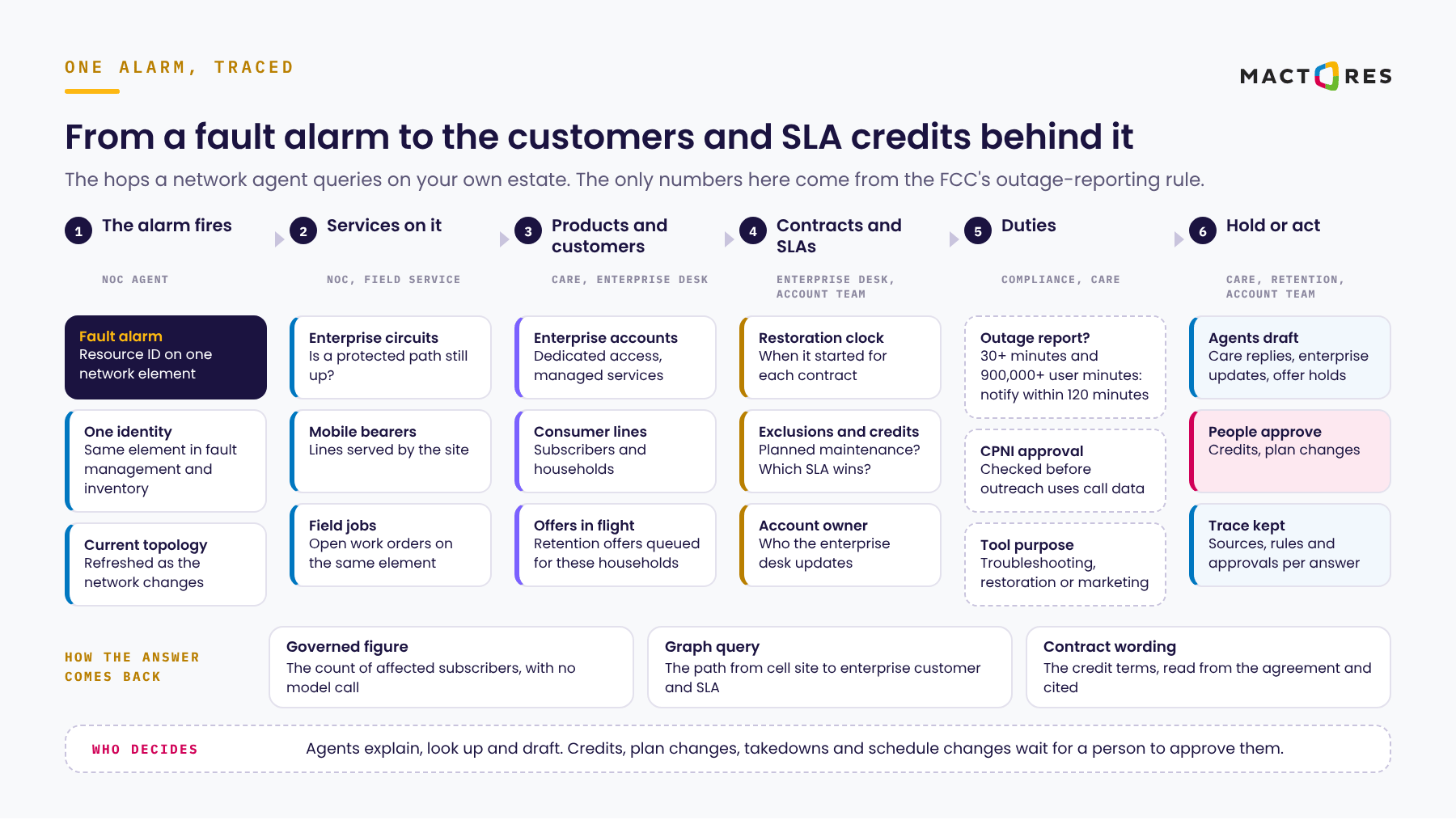
What agents may do with that answer is a separate decision. Agents can explain, look up and draft, while credits, plan changes, takedowns and schedule changes wait for a person to approve them. That boundary is written into the tools, not the prompt.
Safaricom's care agents were built with the same kind of limits. The Safaricom agentic customer experience, at Africa's largest telco, split work across billing, account, product and troubleshooting agents, with forward-deployed engineers setting the agent authority boundary for a regulated telco, guardrails for billing, identity and account-change risk, and handover to a person designed as a planned route. The agents were delivering value within 12 weeks, and human agents moved from routine intents to the cases that need judgment.
The same context makes other models safer. A churn and intervention platform scoring more than 10 million subscribers is only as good as what its offers can see, and once offers can check open incidents and recent service quality, a retention discount stops landing on a customer whose real complaint is the network.
Where to Start
Start with one alarm family, one region and one enterprise product, where a wrong answer shows up within hours as missed credits, repeat calls or crews at the wrong site. Name 10 to 20 questions your NOC, care and enterprise desk should be able to ask, give each one an owner and an expected answer, and build only the hops those questions need.
|
Starting point |
Why it pays back first |
First questions |
|---|---|---|
|
Enterprise circuits in one region |
SLA terms are explicit, and missed or duplicate credits show up quickly |
Which customers sit behind this element, and when do their clocks run out? |
|
Care during outages |
Repeat calls and wrong troubleshooting start within minutes |
Is there an open incident on this caller's serving cells? |
|
Retention offers |
Discounts sent mid-outage are visible to customers and finance |
Did this household have an incident in the last week? |
|
Field dispatch |
Crews sent to the wrong site first delay every customer behind the right one |
Which open job protects the most restoration targets? |
A first release built around 10 to 20 business questions on a small set of sources usually takes 8 to 12 weeks from discovery to production. For telcos, the work also has to respect the calendar: definition sessions stay clear of network change freezes, and ontology changes pass through your change advisory process like any other release.
Our context ontology services run in five phases, each ending with a signed exit. Before any care, network or enterprise agent relies on the release, it has to pass a gate: links from element to service to customer match inventory for the regions in scope, replayed incidents name the same enterprise customers your service desk confirmed at the time, and CPNI, consent and kids-profile probes are refused by every tool agents can call.
Ownership decides whether the chain stays true after go-live. We'd give each definition a named owner on the network, care or billing side, rerun the test questions whenever a mapping changes and keep the trace for each answer. Our checklist for AI agents in production adds a human-in-the-loop threshold for each action type and an eval suite that gates every release.
If your NOC can see the alarm but not the customers behind it, bring one alarm and the answers your agents gave. In one working session we find the missing links, outline a first release and name a ship date you can plan around.