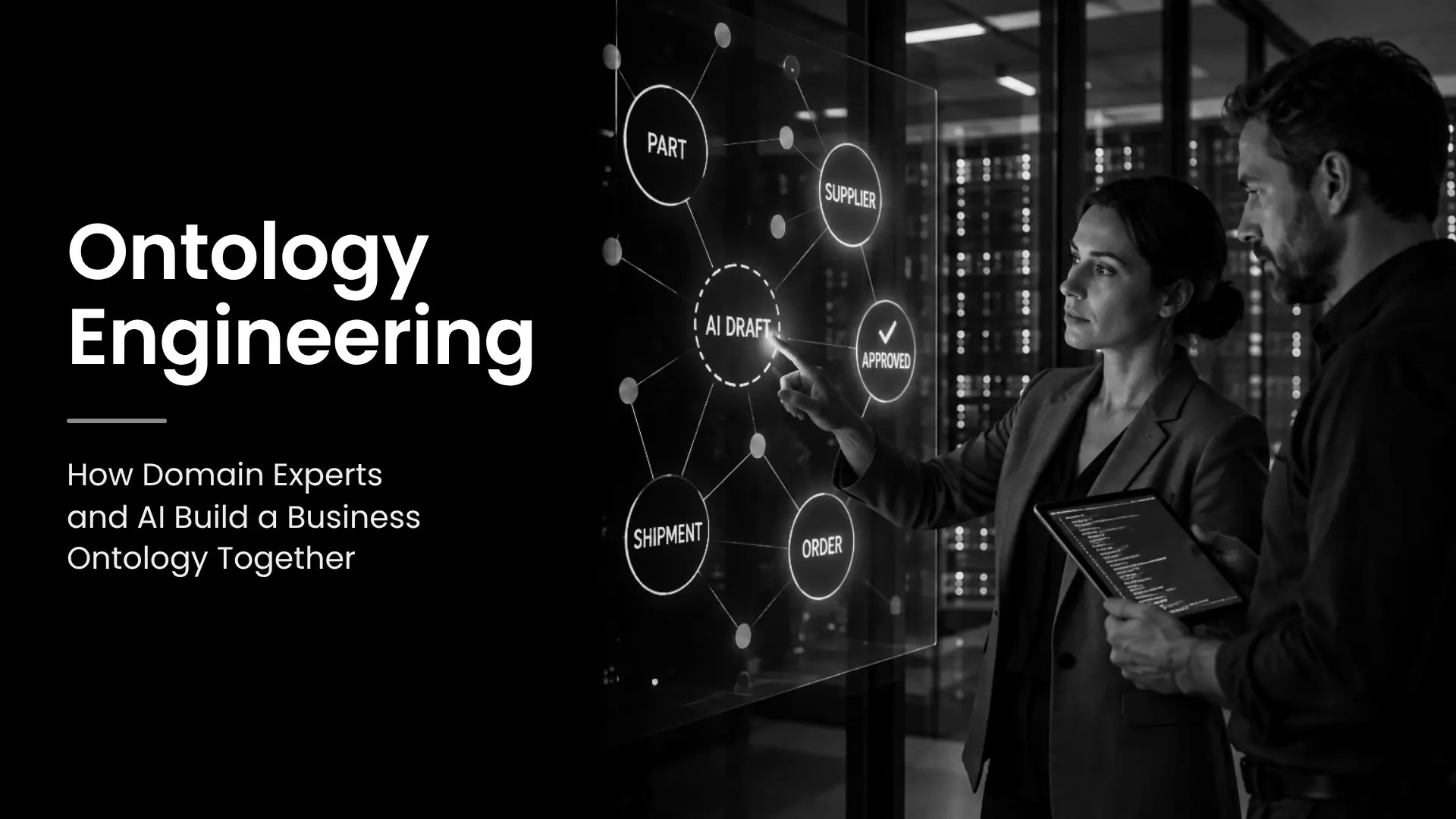
Ontology Engineering: How Domain Experts and AI Build a Business Ontology Together

Key Takeaways
- Ontology engineering is the work of building a machine-readable model of a business and keeping it current. The model covers the things the business deals with, how they relate, what its terms mean and which rules apply.
- AI now drafts the ontology, and domain experts decide what it means. AWS says its open-source Context Ontology Accelerator turns months of manual ontology authoring into days, with experts reviewing, editing and approving every element.
- A draft is a starting point. In a 2025 study, knowledge engineers judged the best model's drafts adequate for 96% to 100% of test questions, and the same model's drafts still contained wrong inverse relationships and cycles in the class hierarchy.
- The work runs in six steps: scope, sources, standards, review, rules and publish. A first release usually covers 10 to 20 business questions and takes 8 to 12 weeks.
- Long-lived ontologies are managed like software. SNOMED CT ships monthly, FIBO ships quarterly through GitHub, and a business ontology needs the same named owners, versioned releases and tests on every change.
Ontology engineering was slow, specialist work for a long time, and most companies skipped it. That has changed for two reasons. AI agents need a model of the business to answer correctly, and AI can now draft most of that model.
Mactores has built data and AI systems on AWS since 2008, and this guide draws on that work. For The New York Times, a knowledge graph built from roughly 6 million lines of code surfaced subscription rules the team didn't know existed. For a global aerospace manufacturer, we're building a supply chain ontology with the client's own supply chain experts. The public ontologies named below have been maintained for years, and their figures were checked on November 16, 2026.
What Is Ontology Engineering?
Ontology engineering is the discipline of designing, building, testing and maintaining an ontology: a formal, machine-readable model of the things a business deals with, how they relate, what its terms mean and which rules apply. Its output is a set of files and tests that a team can version and software can query.
It differs from data modeling in what it describes. A data model says how one system stores its records. An ontology says what those records mean across systems, so an agent reading an ERP, a CRM and a contract folder treats "customer" as one thing. That shared meaning is what an ontology in AI gives an agent. A taxonomy stops at arranging terms in a hierarchy, which is the heart of the ontology vs taxonomy difference.
|
What gets built |
What it holds |
Common open standard |
|---|---|---|
|
Classes and relationships |
The kinds of things in the business and how they connect |
OWL |
|
Rules and constraints |
Conditions the data must meet, written as checks |
SHACL |
|
Mappings |
Which table and column each class reads from |
R2RML |
|
Governed metrics |
One signed formula per figure, with a named owner |
Stored with the ontology |
|
Test questions |
Questions with known answers that every release has to pass |
Kept in the same repository |
Who Builds an Ontology: AI Drafts, Experts Decide
AI does the drafting, and the people who own each term do the deciding. An ontology engineer sits between the two and turns those decisions into the model. In our engagements that person is a forward-deployed engineer working inside the client's team.
AWS describes the same split for its open-source Context Ontology Accelerator, which it released on July 31, 2026: the tool "uses AI to draft an ontology; your domain experts review, edit, and approve every element of it." AWS says this "reduces what would take months of manual ontology authoring into days."
Research backs the division of labor. In a March 2025 study from the University of Bologna, Italy's National Research Council and Linköping University, two experienced knowledge engineers judged the best model's draft ontologies adequate for 96% to 100% of the competency questions across three test stories. The same model's drafts still contained wrong inverse relationships and cycles in the class hierarchy, and the authors describe their approach as one that "aims to assist rather than replace ontology engineers."
|
What AI drafts |
What experts decide |
|---|---|
|
Entities and relationships proposed from schemas, code and documents |
What each term means, and who owns it |
|
Candidate matches for the same customer, part or account across systems |
Which system is authoritative when two disagree |
|
Draft metric formulas read back from existing models and spreadsheets |
Which formula the business reports on |
|
Rules extracted from contracts, policies and procedures |
Which rules apply, and what an agent may see and do |
|
Regression runs against the test questions on every change |
When the answers are good enough to release |
We've seen the same division hold at scale. On The New York Times program, agents carried the codebase assessment, schema conversion, SQL remediation and validation across about 8,400 files, and engineers owned the complex logic and the cutover. On the aerospace program, the materials, warehouse and logistics specialists who own each definition sign it off.
The Steps: Scope, Sources, Standards, Review, Rules, Publish
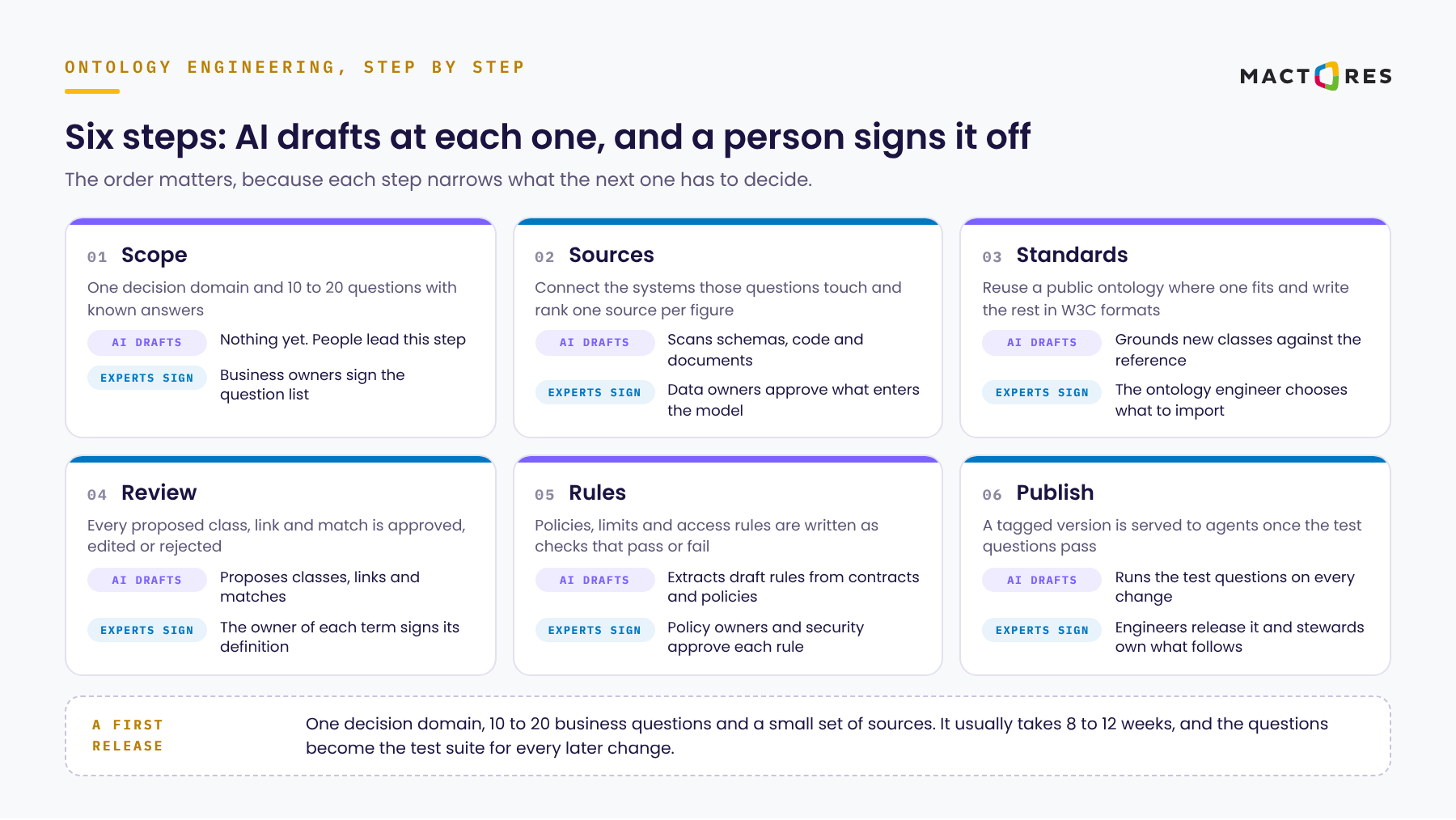
Ontology engineering runs in six steps, and the order matters because each step narrows what the next one has to decide. AI carries most of the volume in steps two, four and five, and a person signs the end of every step.
|
Step |
What happens |
Who leads |
Done when |
|---|---|---|---|
|
1. Scope |
Pick one decision domain and write down 10 to 20 questions with known answers |
Business owners, with an engineer |
The question list is signed |
|
2. Sources |
Connect the systems those questions touch, and decide which one is authoritative for each figure |
AI scans; data owners approve |
Each figure has one ranked source |
|
3. Standards |
Reuse a published ontology where one fits, and write the rest in open W3C formats |
The ontology engineer |
Each class maps to a public reference or is marked as your own |
|
4. Review |
AI proposes classes, links and matches; the owner of each term approves, edits or rejects it |
Term owners |
Every term has one definition and a named owner |
|
5. Rules |
Write policies, limits and access rules as checks |
Owners and security, from AI-extracted drafts |
Every rule returns a clear pass or fail, with the reason |
|
6. Publish |
Release a version to agents once the test questions pass |
Engineers |
Test questions pass at the agreed threshold and the version is tagged |
We treat scope as the step that removes the most risk. We don't ask a client to model the whole enterprise before proving value. A first release built around 10 to 20 business questions on a small set of sources usually takes 8 to 12 weeks, and the questions double as the test suite for everything that follows.
For sources, start with what actually runs. On The New York Times program, the legacy modernization with AI began from stored procedures, application code, configuration and infrastructure code, and the knowledge graph built from them traced each business rule from the user interface to the database tables it touches.
Reusing a standard removes modeling work the team would otherwise repeat. The Context Ontology Accelerator can load public reference ontologies such as FIBO or schema.org and ground new classes against them, so the team defines only what is specific to the company. Review is the step nobody can automate: on the accelerator, nothing enters the knowledge graph until a person approves it.
Rules and publishing are what turn a model into something an agent can be trusted with. A rule written as a check gives the same verdict every time, where a rule left in a prompt is only a suggestion. A published version is served to agents through an MCP server, a REST API or a SPARQL endpoint, and each answer records the version it came from.
Ontology Examples by Industry
The best-known ontologies are public, and most business ontologies start by importing one. A company's own ontology then adds what no public standard knows: its customers, its products and its rules.
|
Industry |
A public ontology or standard to start from |
What your own ontology adds first |
|---|---|---|
|
Financial services |
FIBO, the Financial Industry Business Ontology: OWL definitions for parties, accounts, contracts, loans and securities, standardized by the Object Management Group |
Transactions, accounts, parties, beneficial owners and the monitoring rules around them |
|
Healthcare |
SNOMED CT: more than 360,000 clinical concepts, released monthly |
Patients and members, coverage, encounters, care teams and attribution, and quality measures |
|
Manufacturing and supply chain |
The Industrial Ontologies Foundry's Core and Supply Chain ontologies, built on the Basic Formal Ontology |
Materials and parts, lots, locations, shipments, suppliers, orders and quality events |
|
Software and commerce |
schema.org: shared terms for products, offers, organizations and orders |
Customers, tenants, plans and entitlements, subscriptions, usage and governed metrics |
|
Telecom and media |
TM Forum's Information Framework for operators and the EBU's EBUCorePlus for media assets |
Customers and households, services and devices, network elements, contracts and SLAs, content rights and windows |
SNOMED CT shows the scale a mature ontology reaches. SNOMED International calls it "the most comprehensive, multilingual clinical healthcare terminology in the world," used in more than eighty countries, and its relationships logically define the meaning of a concept so a computer can process it. No health system rebuilds that. It adds its own patients, providers, networks and attribution rules on top.
Manufacturing shows the opposite case, where the standard exists and the ontology doesn't. ISA-95 describes the hierarchy from enterprise to site, line and work center, and it has no official OWL version, so our engineers translate the parts a client's questions need with its plant specialists. For a global aerospace manufacturer, we're building a supply chain ontology from three datasets, warehousing, shipping and materials, and the agentic AI supply chain work starts by reconciling the identifiers each system gives the same part, location and shipment.
Managing the Ontology After Go-Live
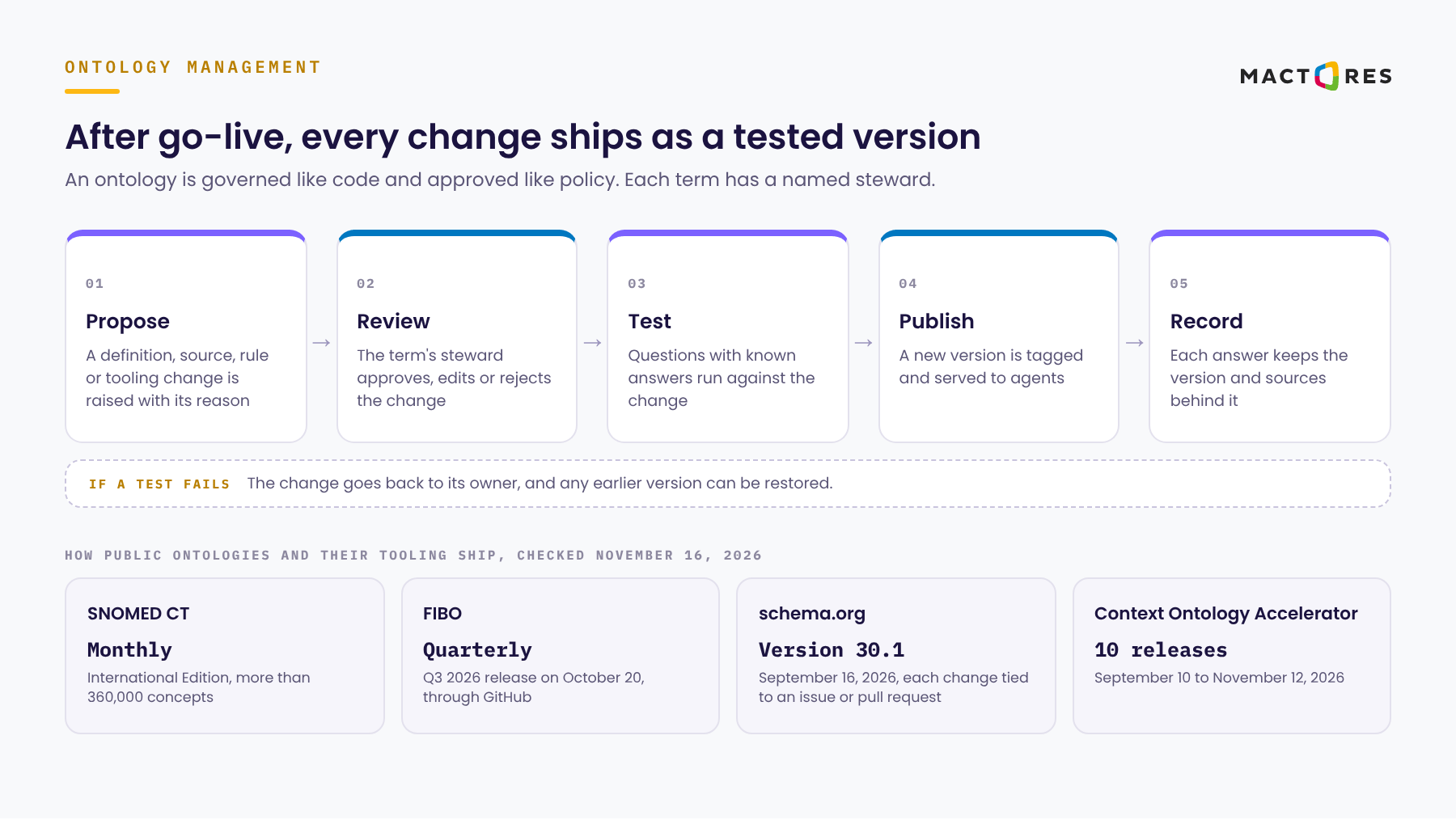
An ontology is governed like code and approved like policy. Every change is proposed, reviewed, tested and published as a new version, and each term has a named steward who approves changes to it.
What is ontology management?
Ontology management is the ongoing work that keeps an ontology correct once agents rely on it. It has four parts: ownership of each term, change control for every edit, access policies on every query path and evidence of which version produced which answer. This is where an ontology program meets agentic AI governance, because the same record that proves a definition was approved also proves what an agent was allowed to read.
The public ontologies are the best evidence that this works. SNOMED International publishes its International Edition every month with reviewed release notes. FIBO ships a production release each quarter, and its third-quarter 2026 release on October 20 merged nine pull requests. schema.org reached version 30.1 on September 16, 2026, with every change tied to a GitHub issue or pull request.
|
What changes |
Who approves it |
What runs before release |
|---|---|---|
|
A definition or metric formula |
The steward for that term |
The test questions, with results compared against the report of record |
|
A new source or mapping |
The data owner for that system |
Reconciliation against the current source |
|
A rule or access policy |
The policy owner and security |
Pass and fail cases, including requests that must be refused |
|
The platform or tooling version |
The engineering owner |
A rehearsed upgrade in staging, with rollback to the earlier version |
Tooling moves as quickly as the model does. The accelerator itself shipped ten releases between September 10 and November 12, 2026, so we pin a release and rehearse each upgrade in staging before it reaches production.
Ownership settles who does this work after we leave. In our context ontology services, the ontology lives in the client's own AWS account in open W3C formats, every definition has a named steward before go-live, and the client's people are trained to extend it. The first working session takes one question your AI keeps getting wrong and shows which definitions and rules it was missing.