.svg)
.svg)
.svg)
In our previous blog, we explored the architecture and mechanics of single-agent AI systems. For many everyday tasks, this architecture works remarkably well. A single agent answering a customer query, summarizing a document, or writing a draft operates efficiently within its boundaries.
But what happens when the task grows beyond those boundaries?
In the real world, production systems face demands that a single agent simply cannot handle gracefully. When the task is too long, too complex, too multi-domain, or too time-sensitive for one agent to process end-to-end, the cracks begin to show. For the use cases where single-agent design reaches its structural limits, you need multi-agent AI systems.
Before we dive in, if you'd prefer to watch rather than read, we've put together a video walkthrough — you can check it out here.
What are the Limitations of Single-Agent Architecture
Before we build upward, it's worth being precise about where single-agent systems break down:
-
Context window saturation: Every model has a finite context window. Once the accumulation of instructions, history, tool results, and intermediate reasoning fills that window, the agent begins losing earlier context. Long-horizon tasks become unreliable, and the model starts "forgetting" what it was trying to do.
-
Sequential reasoning bottlenecks: A single agent processes one step at a time. Complex tasks that require multiple domains of analysis, legal review, financial modeling, and risk assessment to run simultaneously, for example, are forced through a serial pipeline. There is no parallelism. The agent finishes one thing before it can start another, and the user waits.
-
Latency amplification: In real-time applications, this sequential execution compounds. Each tool call, each reasoning step, each retrieval adds to end-to-end latency. Tasks that could theoretically be parallelized are instead processed one after another, turning seconds into minutes.
-
Tool orchestration overload: As systems integrate more tools, web search, database queries, code execution, APIs, the cognitive load on a single agent managing all of them simultaneously becomes unwieldy. It must reason about when to call which tool, track results from all of them, and integrate everything into a coherent response. Beyond a certain threshold, this management overhead degrades the quality of the core reasoning.
-
Limited specialization: A general-purpose agent is a generalist. It can do many things adequately, but cannot match the depth of a purpose-built model fine-tuned for a specific domain like legal text, medical literature, financial data, or systems code. A single model trying to excel at all domains at once is attempting the impossible.
-
Rising token cost: Long reasoning chains, large tool outputs, and extended conversation histories translate directly into token consumption. In a single-agent system, every step in the chain accumulates in a single context, and that cost grows with every interaction, particularly painful at scale.
The Real Solution Is Architectural
The instinct at this point is often to reach for a more powerful model. If one model can't handle the task, surely a smarter, larger one can?
Sometimes. But this is a band-aid on a structural problem. The real solution is not "a smarter model." It is architectural decomposition, breaking complex work into components that can be handled by multiple specialized agents working in coordination.
This is the core premise of multi-agent systems: rather than asking one agent to carry the entire cognitive load, you distribute that load across a team of agents, each operating within its area of competence.
But as soon as you introduce multiple agents, a fundamental architectural question arises, one that defines how your system behaves at every level:
Should intelligence remain centralized under coordination or distributed across autonomous peers?
This is the central tension of this blog. We will explore it thoroughly.
Why Multi-Agent Systems Exist?
Multi-agent systems are not just a clever engineering pattern. They exist because they solve concrete problems that single-agent systems cannot address structurally.
Performance
When tasks can be decomposed into independent subtasks, multiple agents can work on them simultaneously rather than sequentially. A research task that requires pulling financial data, analyzing regulatory filings, and summarizing news — three separate jobs — can be dispatched to three specialized agents in parallel, with results aggregated at the end. The wall-clock time drops dramatically.
Beyond parallelism, specialized agents perform better on domain-specific tasks. A model fine-tuned for legal contract analysis will consistently outperform a general-purpose model on the same task. Multi-agent architectures allow you to route tasks to the right specialist, improving quality at the component level.
Scalability
Horizontal scaling of cognitive work becomes possible. Rather than upgrading to a more powerful single model, you add more agents. The system scales outward, not upward. Individual agents remain focused on bounded tasks, which means their contexts stay manageable and their failure modes stay isolated — a malfunctioning agent does not necessarily bring down the whole pipeline.
Parallel task pipelines become a first-class architectural feature rather than an afterthought.
Model Efficiency
Not every subtask requires your most expensive, most capable model. A task that involves retrieving structured data from a database does not need the same model as one generating a nuanced executive summary. Multi-agent systems allow you to right-size each component, small, efficient models where appropriate; powerful frontier models where necessary. Context stays local to each agent, which means token accumulation is bounded per agent rather than growing unboundedly in a single chain.
Single Agent vs. Multi-Agent AI Architecture
 This shift from a single loop to a coordinated network is the architectural foundation of everything that follows.
What is the Centralized Intelligence Model?
The first major category in multi-agent models is centralized intelligence. These are the models where systems with coordination and reasoning authority reside in a central controller. A single entity makes decisions about task decomposition, agent assignment, and output aggregation. Agents in the system are subordinate to this central authority.
Under this umbrella sit two primary patterns: the Pure Orchestrator and the Hierarchical Orchestrator.
What is the Orchestrator Pattern (Pure Centralization)?
The Orchestrator pattern is the most direct implementation of centralized intelligence. The orchestrator sits at the top of the system and owns the entire reasoning process:
-
It receives the user's request
-
It decomposes the task into subtasks
-
It assigns subtasks to specialized agents
-
It receives their outputs
-
It aggregates results, resolves conflicts, and produces the final response
All communication flows through the orchestrator. Agents do not communicate with each other. They receive instructions from the orchestrator and return results to it. Nothing happens without the orchestrator's knowledge.
Pure Orchestrator Architecture

Why is Orchestrator the Most Common Enterprise Model?
The orchestrator pattern has become the default architecture in enterprise AI deployments for good reason. It is easy to monitor because all activity passes through a single point. Accountability is clear — if something goes wrong, the orchestrator's decision log tells you exactly what happened and why. Coordination is deterministic; there is no ambiguity about which agent is responsible for what at any moment.
For organizations that need strong governance, auditability, and predictable behavior, this clarity is invaluable. A centralized architecture maps naturally onto existing enterprise governance structures.
Production Limitations
But pure centralization comes with serious production limitations that become acute at scale.
The orchestrator becomes a reasoning bottleneck. As the number of agents increases, the orchestrator must manage more assignments, track more intermediate states, and integrate more outputs. Its context grows with every agent response it must process.
-
Context aggregation overload is a direct consequence. When ten specialist agents return outputs, the orchestrator must hold all of them in memory simultaneously to produce a coherent synthesis. This is exactly the context saturation problem we identified for single-agent systems — it has simply been moved one level up.
-
Latency increases as agents scale. Even if agents execute in parallel, the orchestrator's synthesis step is sequential. The more agents there are, the more work the orchestrator must do before a response can be returned.
-
Single point of failure. If the orchestrator crashes, hallucinates, or gets stuck in a loop, the entire system fails. There is no redundancy built into the architecture.
-
Supervisor hallucination risk. The orchestrator itself is a language model. Under high cognitive load — managing many agents, synthesizing complex outputs — it can make reasoning errors that propagate to every downstream agent.
-
Coordination cost grows quadratically. In the limit, an orchestrator managing N agents must reason about N outputs, N potential conflicts, and N × N possible interactions. The coordination overhead grows faster than the intelligence gain.
Consider a concrete example: a large-scale financial document analysis system where an orchestrator must read and synthesize outputs from twelve specialist agents — each analyzing a different section of a regulatory filing. The orchestrator's context window fills rapidly. Latency spikes as the synthesis step grows. The bottleneck that the multi-agent architecture was supposed to eliminate has simply been re-created at the coordination layer.
What is the Hierarchical Intelligence Model( Structured Centralization)?
Hierarchical architecture is the natural evolution of the orchestrator pattern. It preserves centralized control while distributing the coordination load across multiple layers.
Rather than a single orchestrator managing all agents directly, hierarchical systems introduce layers of management:
-
Top-level supervisor sets overall strategy and monitors outcomes
-
Mid-level coordinators manage specific domains or workstreams
-
Specialist agents execute bounded tasks within their domains
Each layer only communicates with the layers directly above and below it. Complexity is partitioned by design.
Hierarchical Agent Tree

How Does it Reduce Bottlenecks?
Hierarchical systems address the orchestrator's core limitations through structural partitioning. Context partitioning ensures that no single agent must hold the entire system state in memory. Each coordinator is responsible for their subdomain only. Scoped reasoning keeps each agent's cognitive load bounded. Delegated aggregation distributes the synthesis work across coordinators, so the chief agent only receives high-level summaries rather than raw agent outputs.
Parallel subdomain reasoning becomes possible: Domain Manager A and Domain Manager B can execute their entire subtrees simultaneously, with the chief agent only waiting for both to complete before synthesizing at the top level.
Benefits
Hierarchical systems offer meaningfully improved scalability over flat orchestration. The system can grow — more worker agents, more domain coordinators — without overloading the top-level supervisor. State boundaries are cleaner, which makes reasoning within each layer more reliable. Specialization is deeper because each domain coordinator understands its subdomain context.
Tradeoffs
Hierarchical architectures introduce new forms of complexity in exchange for the scalability gains.
-
Increased coordination complexity: Multiple layers of agents must communicate and stay aligned, introducing more overhead compared to a single decision layer. This increases the risk of misalignment across the system.
-
Latency accumulation: Each layer adds delay. Outputs from worker agents must pass through supervisors before reaching the top-level agent, causing latency to build up across the hierarchy.
-
Error propagation: Failures at mid-level coordinators can impact all downstream agents. These errors may not always be visible to the top-level agent, making them harder to detect.
-
Debugging complexity: Tracing incorrect outputs requires following the full decision chain across multiple layers, making troubleshooting slower and more complex.
Distributed Intelligence Models
Distributed intelligence is the alternative paradigm where agents coordinate without a single central reasoning authority. There is no orchestrator telling agents what to do. Coordination is emergent, protocol-driven, or peer-negotiated.
This paradigm encompasses three distinct patterns: Peer-to-Peer, Swarm, and Debate.
Peer-to-Peer Variant
In a peer-to-peer architecture, agents communicate directly with each other. There is no permanent central supervisor. An agent can send a request to any other agent in the network, receive a response, and act on it — all without routing through a coordinator.
Coordination emerges from protocols: agents follow defined rules about when to request help, how to share intermediate results, and how to resolve conflicts. The system as a whole achieves coherence through these local interactions rather than through top-down direction.
Peer-to-Peer Mesh

Benefits
Peer-to-peer architectures offer genuine fault tolerance — there is no single point of failure. If one agent fails, others can continue without it. True parallel reasoning is achieved at the network level because agents are not waiting for a central coordinator to assign their next task. Horizontal scalability is natural: adding more agents adds more capacity without creating new bottlenecks. Reduced bottleneck risk is the structural consequence of removing the central node.
Challenges
The benefits come at a steep coordination cost. Deadlocks can emerge when two agents are each waiting for the other to respond. Infinite delegation loops occur when agents pass tasks to each other without a clear termination condition. An inconsistent global state is a fundamental challenge. When agents update shared memory concurrently, the system can reach states that no individual agent intended. In addition to that, conflict resolution overhead is high because there is no authority to adjudicate when agents disagree. Moreover, observability is genuinely hard — tracing the full execution path of a task across a mesh of communicating agents requires sophisticated distributed tracing infrastructure.
Swarm Pattern
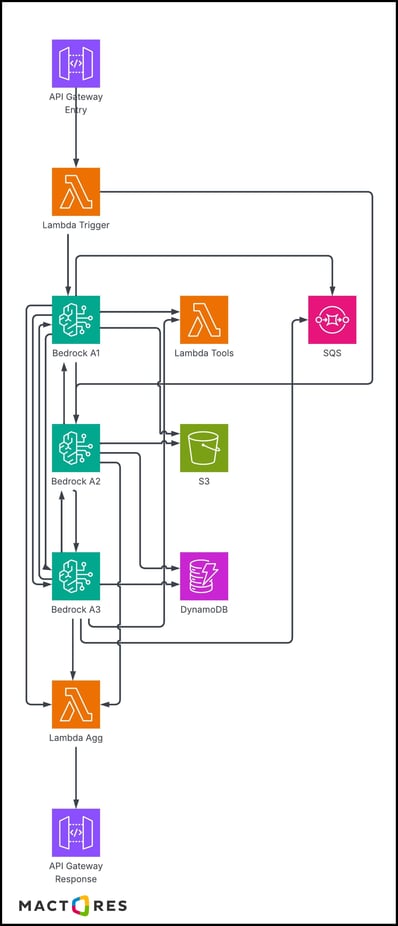
A swarm consists of many autonomous agents, each following local rules in pursuit of a shared objective. No individual agent has global knowledge or global authority. Coordination is emergent — coherent system-level behavior arises from the sum of individual interactions, not from any central plan.
The pattern is directly inspired by biological systems. Ant colonies, bird murmurations, bee swarms. No individual ant knows the full map of the colony. No individual bird knows the shape of the flock. Yet the system as a whole exhibits remarkable intelligence.
Diagram: Swarm Intelligence Model
How Does it Work?
Tasks are broadcast to the swarm rather than assigned to specific agents. Agents pick up tasks based on their current state and local rules. As agents complete subtasks, they deposit partial results into a shared state pool. Other agents read from this pool, build on existing results, and deposit further refinements. The cycle continues — iterative refinement — until a convergence mechanism (a threshold of agreement, a time limit, or a quality metric) signals that the system has reached a satisfactory answer.
Benefits
Swarms achieve extreme parallelism, potentially hundreds of agents working simultaneously on different facets of a problem. High fault tolerance is structural. Losing a few agents barely affects aggregate behavior. Moreover, emergent creativity can produce novel solutions that no individual agent would have generated alone, because the interaction between agents creates combinations that a linear pipeline never would. The architecture scales horizontally almost without limit.
Risks
The same properties that make swarm systems powerful also introduce serious challenges in production environments.
-
Message explosion is a common issue. When multiple agents continuously share intermediate results with each other, communication can grow exponentially. This creates network overhead and slows down the system instead of speeding it up.
-
Resource overuse is another concern. Swarm agents often operate with a degree of autonomy, and without strict guardrails, they may trigger additional tasks or spawn more agents. This can quickly lead to excessive consumption of compute and infrastructure resources.
-
Convergence uncertainty is the most critical risk. Unlike structured systems, swarms do not guarantee that they will arrive at a correct or even useful outcome within a defined timeframe. The system may keep iterating without producing a clear result.
-
Cost unpredictability is a direct consequence of this behavior. Since execution paths are dynamic and not predefined, it becomes difficult to estimate how much compute—and therefore cost—the system will consume before it finishes.
Debate Pattern
The Debate pattern is structured distributed intelligence, a formalization of adversarial reasoning.
Multiple agents are assigned opposing or distinct positions on a problem. Each agent constructs and presents an argument for its position. Agents may challenge each other's reasoning, identify weaknesses, and refine their own arguments in response. After a defined number of rounds, a judge agent, which may be a separate model or one of the debaters in a final role, evaluates the arguments and produces a final synthesis.
Debate Architecture
.jpg?width=14765&height=7584&name=Untitled%20design%20(3).jpg)
Benefits
The debate structure provides genuine reasoning robustness — by forcing agents to actively challenge each other's assumptions, the system surfaces logical flaws that a single agent's internal reasoning would likely miss. Reduced hallucination risk is a meaningful benefit: when an agent knows its output will be challenged by a peer, it has an implicit incentive toward precision. Balanced outputs emerge naturally from adversarial synthesis — extreme positions tend to be challenged and moderated.
Tradeoffs
The debate pattern doubles or triples token consumption by design. Latency increases because the pattern is inherently sequential — argue, respond, argue again, judge. Strong arbitration is required; a weak or biased judge agent can negate the entire reasoning benefit. Perhaps most critically, debates may not converge — if both agents hold equally strong positions, the judge may produce an inconclusive result or an arbitrary tiebreak.
Centralized vs Distributed: Comparative Analysis
|
Dimension |
Orchestrator |
Hierarchical |
Peer-to-Peer |
Swarm |
Debate |
|
Control |
High |
High |
Medium |
Low |
Medium |
|
Scalability |
Medium |
High |
High |
Very High |
Medium |
|
Execution Model |
Sequential |
Layered |
Parallel |
Parallel |
Sequential |
|
Observability |
Easy |
Moderate |
Hard |
Very Hard |
Moderate |
|
Cost Predictability |
High |
Moderate |
Low |
Very Low |
Low |
|
Fault Tolerance |
Low |
Moderate |
High |
Very High |
Moderate |
A few observations are worth drawing out from this matrix.
-
Control and fault tolerance move in opposite directions — as you gain one, you lose the other. Orchestrator systems are maximally controllable and minimally resilient. Swarms are maximally resilient and minimally controllable. This is not a solvable engineering problem; it is a fundamental architectural tradeoff.
-
Scalability correlates with distribution. The more distributed the architecture, the more it can scale horizontally. But horizontal scaling comes with coordination cost, and that cost appears as reduced observability and cost predictability.
-
Sequential execution models (Orchestrator, Debate) offer easier monitoring but are bounded by the sequential bottleneck. Parallel models (Peer-to-Peer, Swarm) unlock throughput but introduce consistency and convergence challenges.
Choosing the Right Architecture
Given the tradeoffs above, the choice of architecture should be driven by the specific demands of your use case.
-
Use an Orchestrator when your domain requires strict governance, auditability, and deterministic behavior. Regulated enterprise workflows are natural fits. The centralized control model maps cleanly onto organizational accountability structures.
-
Use a Hierarchical architecture when your task is genuinely multi-domain, and the orchestrator pattern is showing latency or context overflow at scale. Hierarchical systems let you preserve central governance while distributing coordination load across domain managers.
-
Use Peer-to-Peer or Swarm when the task requires maximum parallelism and the highest priority is throughput rather than strict controllability. Research-heavy distributed cognition, large-scale content generation, or exploratory analysis problems are candidates.
-
Use Debate when the priority is reasoning quality on high-stakes decisions where hallucination or bias is a significant risk, and you can absorb the additional token cost and latency.
The Hidden Engineering Challenges
Most architectural discussions stop at the pattern level. The real production complexity lives in the engineering layers beneath, the infrastructure that must exist for any multi-agent system to function reliably at scale.
-
State synchronization: One of the hardest problems in multi-agent systems. When multiple agents read from and write to shared memory concurrently, you need mechanisms to prevent race conditions, ensure consistency, and handle partial writes gracefully. This requires careful design of the shared state model and synchronization primitives.
-
Memory partitioning: The practice of scoping each agent's accessible memory to what it actually needs. Without it, agents accumulate irrelevant context, context windows fill unnecessarily, and reasoning quality degrades. Good memory partitioning is a deliberate design act.
-
Event sourcing: Treating state changes as an immutable log of events rather than direct mutations. It provides an audit trail, enables replay for debugging, and supports recovery from partial failures — making it increasingly common in production multi-agent systems.
-
Agent identity management: Non-trivial at scale. Agents need stable identities, capability registries, and permission models. Which agents can call which other agents? Which agents can access which tools? Governance of these questions requires explicit system design.
-
Cost guardrails: Essential in architectures like swarms and peer-to-peer systems that can consume compute aggressively. Hard limits on token consumption, agent spawning rates, and total task budget must be enforced at the infrastructure level, not just the application level.
-
SLA monitoring: Requires dedicated tooling across a distributed agent network. You need to track not just whether a final output was produced, but the latency and quality of every agent's contribution to understand where the system is bottlenecked or degrading.
-
Distributed tracing: The observability layer that makes all of the above visible. A task that flows through an orchestrator, dispatches to four agents, and aggregates results has a complex execution graph. Reconstructing that graph for debugging or performance analysis requires trace IDs that propagate across every hop and a tracing infrastructure that collects them.
-
Conflict resolution strategies: Must be defined explicitly. When two agents produce contradictory outputs, what happens? Does the orchestrator pick one? Does a debate agent adjudicate? Does the conflict propagate to the user? This must be a designed decision, not an emergent one.
These engineering challenges are not afterthoughts. They are first-class architectural requirements. Systems that are designed around patterns without addressing these layers will fail in production.
The Real Scaling Problem: Coordination Cost
As multi-agent systems grow, a pattern emerges that deserves to be stated plainly.
Adding more agents increases intelligence capacity, specialization, parallelism, and throughput. But it also increases the coordination overhead required to direct that intelligence toward a coherent goal. These two forces scale at different rates.
Intelligence scales roughly linearly with agents added. Coordination cost, the communication, synchronization, conflict resolution, and state management required to keep agents working toward a shared objective, scales superlinearly. In dense network architectures, it approaches quadratic growth: each new agent must potentially communicate with every existing agent.
The consequence is a fundamental tension:
- As agents increase, communication channels multiply
- Synchronization cost rises with every shared state update
- Observability decreases because the execution graph becomes harder to trace
- Latency unpredictability increases because more coordination steps introduce more variance
This is not an argument against multi-agent systems. It is an argument for being precise about architecture. The goal is not to maximize the number of agents. It is to find the minimum coordination structure that achieves the required capability, and to design that structure deliberately, not organically.
Conclusion
Multi-agent AI systems are not inherently superior to single-agent systems. They are architecturally demanding. They introduce coordination problems that single-agent systems avoid by design. They require engineering infrastructure that most teams underestimate. They can fail in ways that are subtle and difficult to diagnose.
But for the class of problems that genuinely exceed the structural limits of single-agent architecture — complex, multi-domain, long-horizon, high-throughput tasks, they are the only path forward. The question is not whether to use multi-agent systems, but how to architect them with the discipline the problem demands.
This blog is part of an ongoing series on AI systems architecture. In our next piece, we'll explore one of the most critical challenges in production agentic systems: Controlling Non-Determinism in Agentic AI Systems.
When agents make decisions, call tools, and coordinate with each other, the same input rarely produces the exact same output twice. Understanding how to manage, constrain, and design around that unpredictability is what separates reliable agentic systems from brittle ones. Stay tuned.