.svg)
.svg)
.svg)
Enterprise AI has entered a new phase. We are no longer experimenting with large language models that generate text on demand; we are deploying AI agents that plan, retrieve information, make decisions, and execute actions across real systems.
These agents migrate code, query production databases, generate reports, and trigger workflows with minimal human supervision. As discussed in the previous post, Controlling Non-Determinism in Agentic AI Systems, this shift from passive generation to autonomous execution fundamentally changes the risk profile of AI in production.
In most organizations, they’re deployed with a familiar mindset: If the output looks good enough, ship it. We’ll handle edge cases later.
That mindset barely worked when AI was limited to chat interfaces and non-actionable outputs. It breaks down in agentic architectures, where mistakes compound over time and translate directly into operational risk.
The core problem isn’t that AI agents are inaccurate.
It’s that most enterprise deployments lack a safety layer designed for agentic behavior.
Before we dive in, if you'd prefer to watch rather than read, we've put together a video walkthrough — you can check it out here.
Why “Ship It Anyway” Is Failing Enterprise AI?
The “ship it anyway” mindset comes from traditional software engineering, where systems are deterministic, test cases are enumerable, and failures are usually reproducible. If something breaks, you patch it, redeploy, and move on.
AI agents don’t behave that way.
Agentic systems are probabilistic, iterative, and context-dependent. The same input can produce different behaviors depending on state, memory, retrieved data, or prior actions. As a result, issues don’t always surface immediately, and when they do, the root cause is often hard to trace.
In enterprise environments, this leads to a dangerous gap between perceived correctness and actual reliability.
The “Looks Good” Fallacy
Most AI agents fail in subtle ways:
- Outputs look plausible
- Logs show no hard errors
- Tasks complete end-to-end
But beneath the surface:
- Edge cases are mishandled
- Assumptions go unchallenged
- Partial context leads to silent inaccuracies
A single successful run creates false confidence, encouraging teams to promote proofs-of-concept into production without addressing systemic risk.
Why This Approach Doesn’t Scale for Agents
When agents are deployed without a safety-oriented architecture, small issues compound quickly:
- Errors propagate across steps: One incorrect assumption early in a plan can affect every downstream action.
- Retries amplify mistakes: Blind retries often reinforce the same flawed reasoning instead of correcting it.
- Autonomy increases blast radius: An agent with tool access doesn’t just fail; it can execute the failure.
- Failures are discovered late: Problems are often detected only after data corruption, bad decisions, or customer impact.
The Core Misalignment
The failure isn’t due to bad models or insufficient prompts. It’s architectural.
Most enterprise systems are built assuming:
- One-shot correctness
- Static inputs
- Predictable execution paths
AI agents violate all three assumptions. Without mechanisms to evaluate outcomes, reflect on mistakes, and intervene at the right moments, “shipping anyway” turns into a liability, especially as agents take on higher-stakes responsibilities.
This is why enterprise AI needs to move beyond optimism-driven deployment and toward architectures that expect imperfection and are designed to correct it.
What AI Agent Safety Means in Enterprise Systems?
When most teams talk about “AI safety,” they are usually talking about constraints, what the system should not do such as blocking certain outputs, restricting tool access, and adding filters to catch obvious failures. These controls are necessary. But for AI agents, they are foundational, not sufficient.
AI agents fail not because they violate rules, but because they confidently do the wrong thing while staying within the rules. That distinction is where most enterprise safety strategies collapse.
Why Guardrails Are Necessary, but Incomplete
Guardrails are designed around a static interaction model:
- A prompt goes in
- A response comes out
- The response is validated against predefined rules
This model works reasonably well for chatbots and one-shot generation systems. It breaks down the moment you introduce autonomy, iteration, and action.
Agentic systems do not operate in single steps. They:
- Plan across multiple stages
- Carry forward assumptions
- Chain tool calls
- Make decisions based on intermediate results
An agent can comply with every rule at every step and still produce an unsafe or incorrect outcome at the task level.
How Agents Fail Without Breaking Rules?
In production systems, the most dangerous failures look like this:
- Correct-looking intermediate steps: Each step appears reasonable, but the outcome is wrong due to compounding assumptions.
- Legitimate actions based on flawed context: Tool calls are authorized, APIs respond successfully, but the underlying premise is incorrect.
- Overconfident execution on partial information: The agent never pauses to ask whether it has enough context to proceed.
Nothing here triggers a guardrail. Nothing is “illegal.” And yet the system fails.
This is why many enterprise incidents involving AI agents are postmortem discoveries, not real-time interventions.
What AI Agent Safety Actually Means in Enterprise Systems?
For enterprises, agent safety is not about stopping agents from acting; it’s about ensuring they act appropriately given uncertainty, impact, and context.
Practically, this means agents must be able to:
- Evaluate their own outputs, not just generate them
- Recognize incomplete, low-confidence, or risky results
- Retry with intent, using feedback instead of repetition
- Escalate to humans when the cost of being wrong is high
- Avoid irreversible actions without explicit validation
Safety, in this framing, is about behavior over time, not correctness at a single step.
From Prevention to Correction
Traditional safety systems are prevention-oriented:
- Don’t allow bad outputs
- Don’t allow restricted actions
- Don’t cross predefined boundaries
Agentic systems require correction-oriented safety:
- Expect the first attempt to be imperfect
- Detect deviation from intended outcomes
- Apply feedback to improve subsequent behavior
- Contain failures before they propagate
This shift is subtle but critical. Enterprise-grade systems are not defined by never failing. They are defined by:
- Failing detectably
- Recovering predictably
- Limiting blast radius
- Leaving auditable traces
The Missing Layer in Most Agent Architectures
Most enterprise agent architectures stop at:
- A reasoning model
- Tool integrations
- Execution logic
What’s missing is a dedicated safety and evaluation layer that sits inside the execution loop, responsible for:
- Reflection and critique of outputs
- Confidence estimation and uncertainty handling
- Decision checkpoints for high-impact actions
- Escalation and override logic
- Preventing silent failure accumulation
Without this layer, agents often look impressive in demos and pilots, but degrade rapidly under real-world complexity, scale, and ambiguity.
The rest of this blog focuses on how this missing layer is built in practice, starting with reflection as a first-class safety primitive, not an afterthought bolted on after deployment.
Reflection as a Safety Primitive
In most enterprise AI systems, safety mechanisms focus on what an agent is allowed to do. Reflection focuses on something more important: whether the agent actually did the right thing.
This distinction matters because the majority of failures in agentic systems are not caused by forbidden actions; they’re caused by unexamined assumptions and partially correct outputs that look reasonable enough to pass unnoticed.
Reflection turns evaluation into a first-class architectural concern, rather than an external monitoring afterthought.
Why Enterprise Agents Fail Without Reflection?
Enterprise tasks rarely have clean success criteria. Consider common agent workloads:
- Migrating SQL logic across engines
- Refactoring legacy codebases
- Generating operational or compliance reports
- Reconciling data across systems
In these scenarios:
- Outputs can be syntactically valid but semantically wrong
- Tests may pass while business logic is subtly broken
- Errors appear only under specific edge conditions
Without reflection, agents behave optimistically:
- They assume the first attempt is sufficient
- They propagate hidden flaws downstream
- They take action without revalidating outcomes
This is where safety breaks down, not because the agent acted maliciously, but because no architectural mechanism forced it to question itself.
Reflection Is a Control Loop, Not a Retry Strategy
A critical misconception is treating reflection as “retry until it works.”
Blind retries:
- Increase token usage
- Repeat the same flawed reasoning
- Create the illusion of robustness
Reflection-based systems introduce a control loop:
.jpg?width=4799&height=1809&name=Untitled%20design%20(4).jpg)
This loop mirrors control systems used in traditional engineering: detect deviation, apply feedback, and stabilize behavior.
Pattern 1: Reflexion Loop (Mechanics, Not Magic)
The Reflexion pattern formalizes this loop in a way that’s practical for production systems.
A typical Reflexion implementation includes:
- Task-specific evaluation criteria: Example: semantic equivalence, performance characteristics, schema compatibility
- A structured reflection prompt: The agent is asked to explicitly describe:
- What failed
- Why it failed
- What needs to change
- Contextual injection of the reflection: The reflection is appended to the next attempt, constraining future reasoning
This is not self-criticism for its own sake. It is a structured error analysis.
Enterprise Example: Code Migration Agents
.jpg?width=1563&height=469&name=Code%20Migration%20Agents%20(500%20x%20150%20px).jpg)
Why Reflection Improves Safety, Not Just Quality?
From a safety standpoint, Reflexion introduces capabilities that static guardrails cannot:
- Explicit acknowledgment of uncertainty: The agent must articulate what it doesn’t know or got wrong.
- Prevention of error amplification: Mistakes are corrected before being reused in downstream steps.
- Controlled autonomy: The agent can iterate, but only within a feedback-informed boundary.
Most importantly, reflection creates an observable internal state. Instead of silent failures, you get:
- Inspectable reasoning
- Logged failure modes
- Auditable correction paths
That visibility is what makes reflective agents suitable for enterprise environments.
Reflection alone, however, is still insufficient. Agents can analyze their own work and still miss critical issues, especially their own blind spots.
That’s why the next safety layer is the separation of roles, starting with the Generator–Critic pattern.
Using Generator–Critic Patterns to Detect Errors
Reflection improves agent behavior, but it still relies on a single reasoning context. In enterprise systems, that is rarely enough. The most damaging failures occur not because agents fail to reflect, but because they cannot see beyond their own framing of the problem.
This is where separation of concerns becomes a safety requirement rather than a design preference.
The Generator–Critic pattern introduces structural independence into agent architectures, reducing correlated errors and making failures detectable before they propagate.
Why Self-Reflection Alone Breaks Down
Even well-designed reflection loops suffer from inherent limitations:
- The same model instance evaluates and generates
- The same context window biases both reasoning and critique
- The agent is anchored to its original interpretation of the task
As a result, reflection tends to optimize within a flawed solution space instead of challenging it.
In enterprise scenarios, this leads to high-confidence failures:
- Correct syntax, wrong semantics
- Passing tests that don’t capture real-world behavior
- Performance regressions that only appear at scale
- Security assumptions that remain implicit and unchecked
These are not errors a single agent is well-positioned to catch.
Generator–Critic Is a Control Boundary, Not a Prompt Trick
The Generator–Critic pattern works because it introduces a control boundary in the system.
At a minimum, the architecture separates three responsibilities:
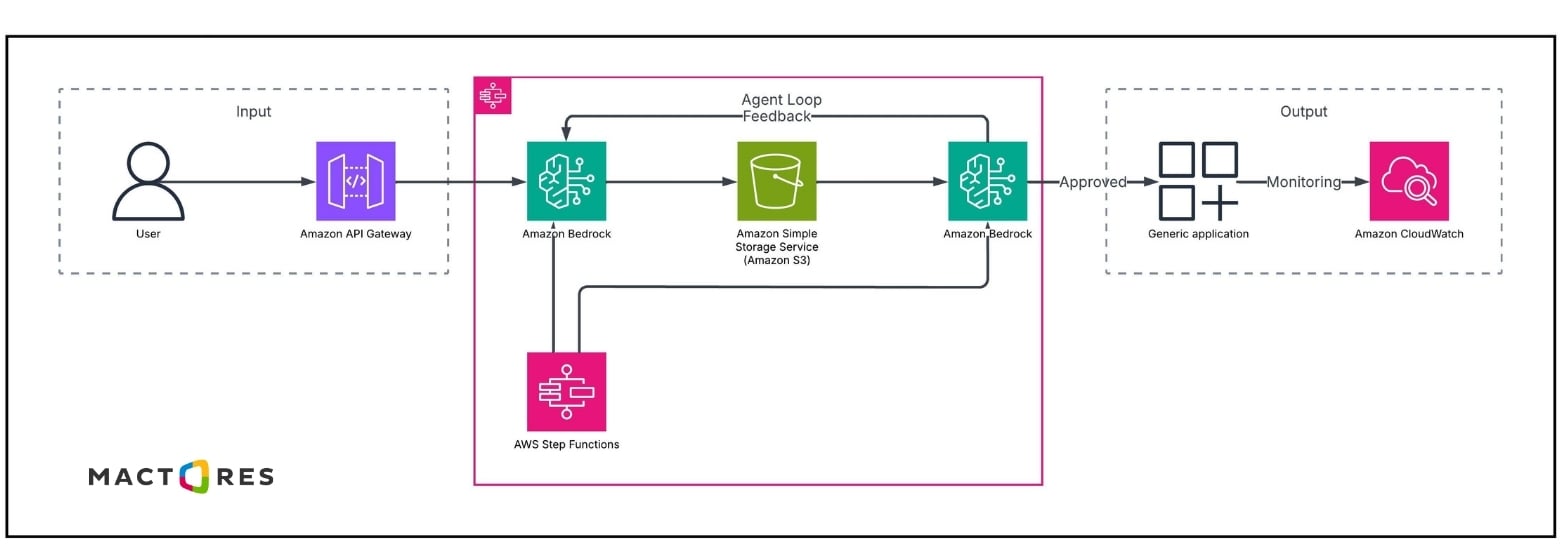
This separation ensures that evaluation is adversarial by design, not cooperative.
What the Critic Actually Evaluates (Concrete Criteria)
In production systems, critics should not rely on vague “quality” judgments. They evaluate against explicit, machine-checkable criteria, such as:
- Semantic equivalence: Does the output preserve business logic and intent?
- Behavioral correctness: Do edge cases produce expected outcomes?
- Performance characteristics: Are the complexity or execution plans materially different?
- Security posture: Are permissions, inputs, or data handling altered?
- Compliance constraints: Are regulatory or policy requirements violated?
By constraining the critic to these dimensions, enterprises reduce subjectivity and increase repeatability.
Why Separation Reduces Enterprise Risk
Generator–Critic architectures reduce risk in ways that reflection alone cannot:
- Decorrelation of failure modes: Different prompts, roles, or models reduce shared blind spots.
- Early detection of systemic issues: Problems surface before execution, not after impact.
- Controlled iteration: Fixes target-specific deficiencies instead of redoing entire tasks.
- Improved auditability: Critiques and revisions create explicit artifacts for review.
In effect, the critic acts as a governor, slowing or stopping unsafe behavior before it becomes irreversible.
Enterprise Example: Large-Scale Code Migration
Consider an enterprise migrating thousands of SQL queries across systems.
A single-agent approach:
- Produces syntactically valid queries
- Passes basic tests
- Fails under edge conditions months later
A Generator–Critic system:
- The generator performs migration
- Critic checks:
- Join semantics
- Null-handling differences
- Execution plan regressions
- Reviser fixes only the problematic constructs
This approach catches failures before deployment, dramatically reducing downstream incidents.
Generator–Critic as Enterprise Infrastructure
In mature deployments, Generator–Critic is not embedded inside prompts; it is implemented as system infrastructure:
- Critics implemented as separate services or policies
- Results logged for governance and audits
- Failures routed to humans or alternate workflows
- Criteria versioned alongside business logic
This elevates safety from a modeling concern to a platform capability.
Reducing Risk Through Problem Decomposition (Self-Ask)
Many agent failures happen before generation, critique, or execution. They happen at the moment an agent silently assumes it understands the problem.
In enterprise systems, this is one of the most dangerous failure modes: agents act confidently on underspecified, ambiguous, or incomplete tasks without ever surfacing what they don’t know.
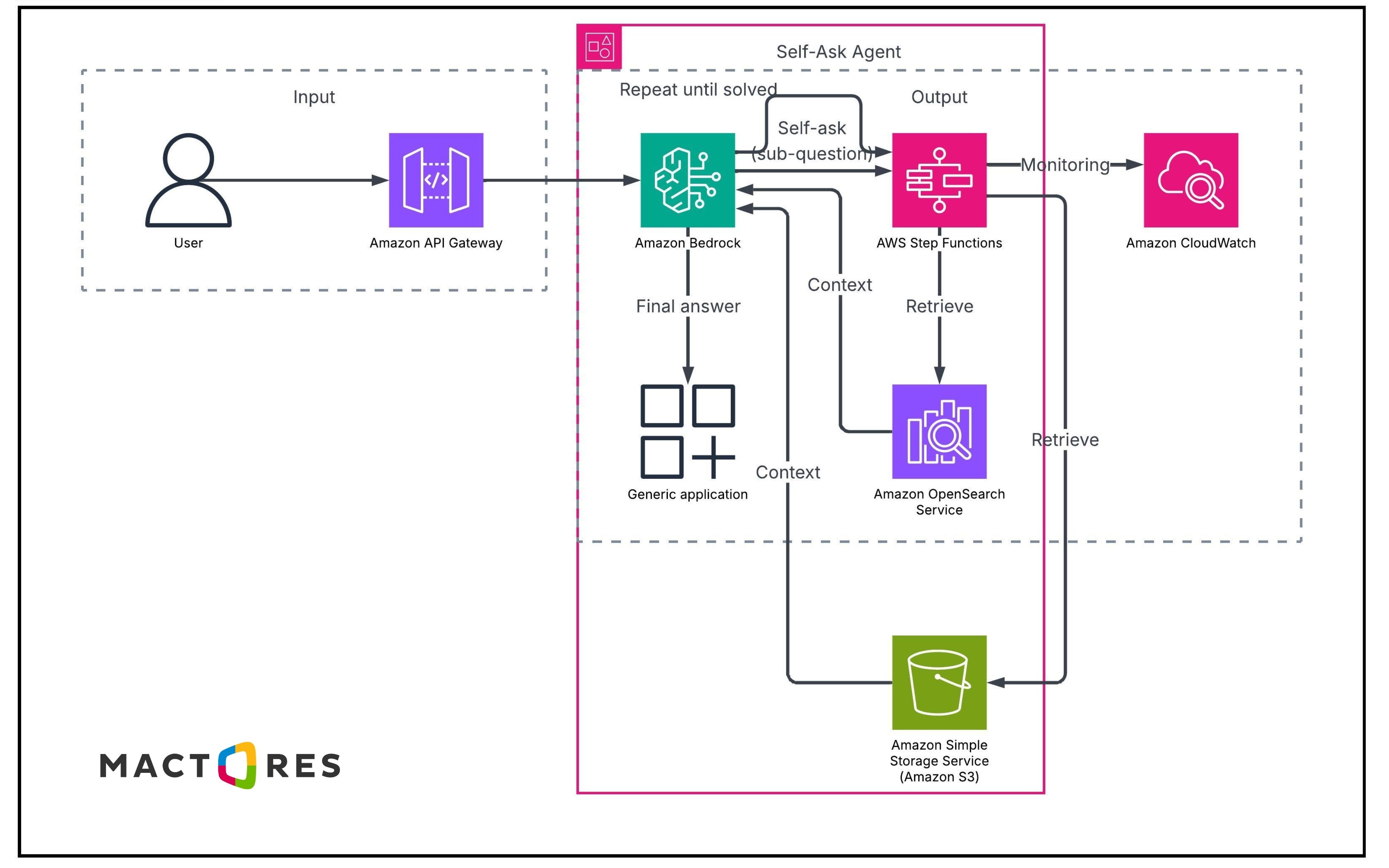
The Self-Ask pattern addresses this directly by forcing agents to identify missing information before attempting to solve the problem.
The Core Problem: Implicit Assumptions
By default, large language models are optimized to be helpful. When faced with a complex or vague request, they tend to:
- Infer intent instead of clarifying it
- Fill gaps with plausible assumptions
- Produce a complete-looking answer even when information is missing
For conversational use cases, this is often acceptable. For enterprise workflows, it is not.
Examples of unsafe assumptions include:
- Treating outdated data as current
- Assuming default configurations or schemas
- Guessing business rules that differ across teams
- Ignoring edge cases that aren’t explicitly mentioned
Once these assumptions enter the execution loop, downstream safety mechanisms have limited ability to correct them.
What the Self-Ask Pattern Changes
The Self-Ask pattern restructures the agent’s reasoning process:
Instead of asking: “How do I answer this?”
The agent first asks: “What do I need to know to answer this correctly?”
This introduces an explicit decomposition phase before any generation or action.
How Self-Ask Works in Practice
A Self-Ask-enabled agent follows a deliberate sequence:
Enterprise Scenarios Where Self-Ask Matters Most
Self-Ask is especially important for:
- Multi-system data reconciliation
- Compliance or regulatory analysis
- Architecture and migration planning
- Decision support and recommendations
- Incident analysis and root-cause investigations
In these contexts, a wrong assumption can invalidate an entire workflow, even if all subsequent steps are executed perfectly.
Why Reflection Alone Isn’t Enough for Production?
Reflection significantly improves agent correctness, but correctness alone is not enough in production environments. Enterprise AI systems are not judged solely by how often they are right; they are judged by what happens when they are wrong.
Reflection helps agents identify mistakes after an attempt. In many real-world workflows, that is already too late.
Production systems must assume that some errors cannot be safely corrected once execution begins.
The Limits of Autonomous Self-Correction
Autonomous self-correction breaks down in three critical scenarios.
First, some actions are irreversible.
Once an email is sent, a database migration is executed, or a deployment is pushed, the system cannot simply “retry” without consequences. Reflection may identify the mistake, but only after the impact has occurred.
Second, some decisions are inherently high-stakes.
Financial recommendations, legal interpretations, compliance assessments, and security-sensitive actions carry consequences that extend beyond technical correctness. Even a low probability of error can be unacceptable.
Third, agent confidence is not the same as certainty.
Agents can appear confident while operating on partial, outdated, or misinterpreted context. Reflection improves reasoning quality, but it cannot guarantee that the underlying assumptions are valid or complete.
In all three cases, allowing autonomous systems to proceed unchecked is a risk, not an optimization.
Enterprise Reality: Where Mistakes Matter
In enterprise deployments, agents are routinely trusted with actions such as:
- Sending customer or stakeholder communications
- Running data or schema migrations
- Deploying application code or infrastructure changes
- Generating financial, legal, or compliance recommendations
These actions are not isolated technical steps; they are organizational commitments. When something goes wrong, responsibility does not fall on the model; it falls on the enterprise.
This is the critical boundary where autonomous safety mechanisms must give way to explicit governance.
Reflection makes agents smarter.
Production systems require agents to be accountable.
That accountability cannot be automated away. It must be enforced through human-in-the-loop checkpoints that intercept high-impact decisions before execution, not after remediation becomes impossible.
In the next section, we’ll define where human intervention is mandatory and how to integrate it without slowing enterprise systems to a crawl.
Human-in-the-Loop: The Non-Negotiable Safety Layer
Human-in-the-loop (HITL) is often treated as a temporary crutch, something to be removed once agents “get better.” In enterprise systems, this framing is wrong. Human intervention is not a sign of immaturity; it is a deliberate safety boundary.
As agents gain autonomy, the role of humans shifts from manual execution to governance and risk control. The goal is not to review everything, but to intervene precisely where automation becomes unsafe.
Three Enterprise Rules for Human-in-the-Loop
.jpg?width=1563&height=838&name=human%20in%20loop%20(1).jpg)
Confidence-Aware Escalation
Not every agent action requires human review. If that were the case, automation would collapse under its own weight.
The key is confidence-aware escalation:
- Agents estimate confidence based on input completeness, retrieval quality, and critic feedback
- Predefined thresholds determine whether the agent proceeds, retries, or escalates
- Escalation becomes a structured outcome, not an exception
This ensures humans are involved only when necessary, and precisely when risk is highest.
Humans as Safety Governors, Not Bottlenecks
When implemented correctly, human-in-the-loop does not slow systems down; it speeds them up.
- Humans intervene strategically, not continuously
- Reviews are risk-based, not blanket approvals
- Incidents decrease, reducing downstream rework and outages
In mature systems, humans act as safety governors: setting boundaries, resolving ambiguity, and approving high-impact outcomes.
The result is not less automation, but automation that enterprises can trust.
Reliable Information Retrieval with Agentic RAG
Many enterprise agent failures are ultimately information failures. Agents reason correctly, follow policies, and execute steps as designed, but they do so using incomplete, outdated, or insufficient context.
Retrieval-Augmented Generation (RAG) was introduced to reduce AI hallucinations by grounding models in external data. However, most implementations stop at basic retrieval, which is not enough for production-grade safety.
Why Basic RAG Is Not Enough
Traditional RAG follows a simple pattern:
- Retrieve once
- Inject results into context
- Generate an answer
This approach assumes that the first retrieval is both relevant and sufficient. In enterprise environments, that assumption rarely holds.
Basic RAG systems typically suffer from:
- Single-shot retrieval: If the query is poorly framed, the retrieval is irrelevant, and the agent never knows.
- No verification of results: Retrieved documents are treated as authoritative, even when outdated or contradictory.
- No coverage guarantees: The agent has no way to tell whether critical information is missing.
As a result, agents produce confident outputs grounded in partial truth, which is often more dangerous than hallucination.
What Makes RAG “Agentic”
Agentic RAG treats retrieval as a reasoning process, not a lookup step.
Instead of retrieving once and moving on, the agent actively manages information gathering:
.jpg?width=1563&height=469&name=RAG%20(2).jpg)
This turns retrieval into a closed-loop control system rather than a best-effort fetch.
Safety Benefits of Agentic RAG
From a safety perspective, Agentic RAG provides measurable advantages:
- Reduced hallucinations: Agents are less likely to fabricate answers when retrieval gaps are explicit.
- Higher factual reliability: Cross-checking reduces reliance on stale or incorrect sources.
- Better handling of ambiguity: The agent can pause, refine, or escalate instead of guessing.
- Safer enterprise decision-making: Actions are based on verified, sufficient context, not assumptions.
In production systems, Agentic RAG acts as a safety layer for information flow, ensuring that decisions are made with the same rigor enterprises expect from human analysts.
Designing Layered Architectures for Enterprise AI Agents
One of the most common mistakes in enterprise AI adoption is treating safety patterns as isolated solutions. Teams experiment with reflection, add a critic agent, or bolt on retrieval, then move on. In practice, this leads to fragmented systems that behave well in narrow cases but fail under real-world complexity.
Enterprise-grade agent systems are not built from standalone techniques. They are built from layers of complementary capabilities that work together inside the execution loop.
These Patterns Are Modifiers, Not One-Offs
The patterns discussed so far are often misunderstood as discrete architectures. They are not.
- Reflection isn’t a system; it’s a capability that allows agents to learn from failure and correct themselves.
- Generator–Critic isn’t a workflow; it’s a role separation pattern that reduces correlated errors.
- Agentic RAG isn’t a feature; it’s a retrieval philosophy that treats information gathering as an active process.
Each pattern modifies how an agent behaves. None of them is sufficient on its own.
When applied in isolation, they improve local behavior. When composed, they enable system-level safety.
Composing Patterns in Real Systems
In production environments, these patterns are typically orchestrated through a coordinator or controller that assigns roles and enforces boundaries.
A common enterprise setup looks like this:
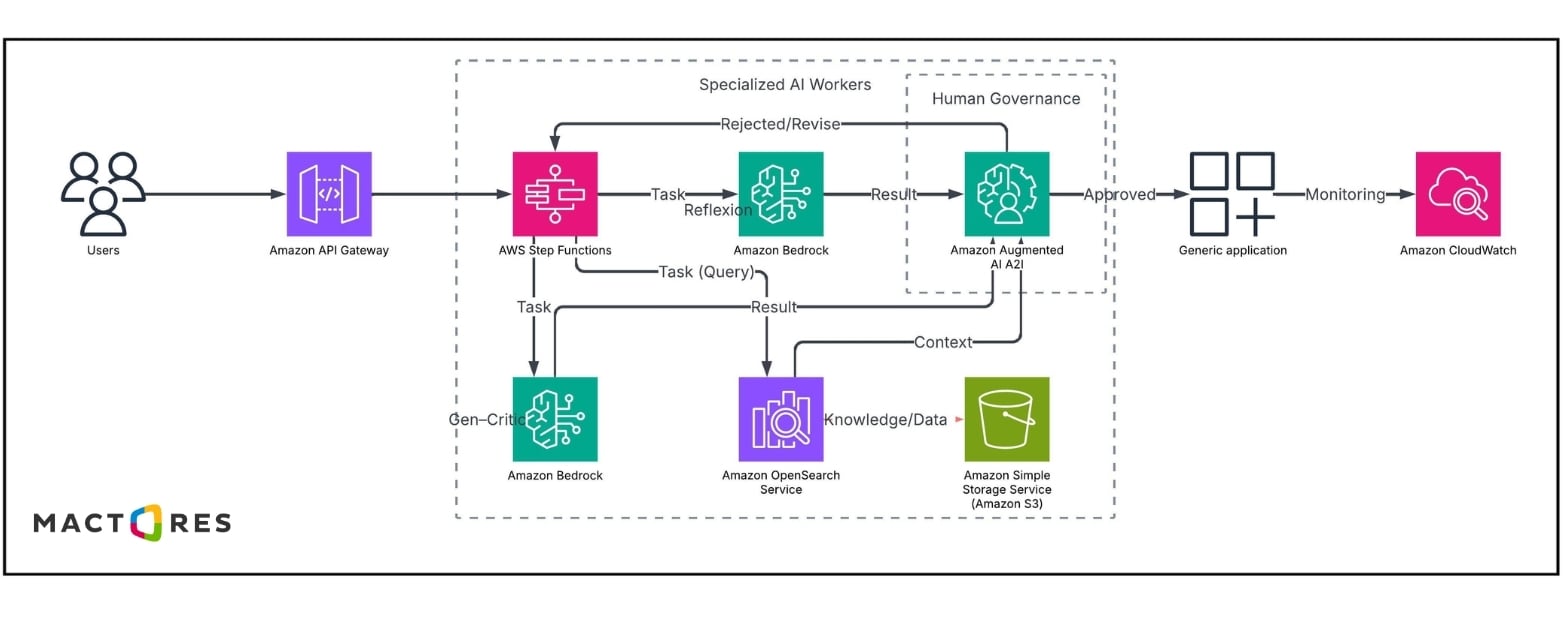
Each worker is optimized for its role, and safety is enforced through both automation and governance.
What “Enterprise-Grade” Actually Looks Like?
Enterprise-grade agent systems are often misunderstood as being more restrictive. In reality, they are more flexible and more reliable.
They are characterized by:
- Not fewer agents, but smarter ones
- Not more rules, but better feedback loops
- Not blind automation, but accountable autonomy
The goal is not to eliminate failure. It is to ensure that failures are detected early, corrected safely, and escalated when necessary.
When safety is treated as an architectural layer, not an afterthought, agents become systems enterprises can trust, scale, and defend.
Summing Up
AI agents are no longer experimental tools; they are becoming core enterprise infrastructure. But autonomy without safety is not innovation; it’s risk. Enterprise-grade systems are defined not by perfect first attempts, but by architectures that can reflect, evaluate, escalate, and recover when things go wrong. When safety is treated as a layered capability, spanning reflection, critique, intelligent retrieval, and human governance, agents move from “useful demos” to systems organizations can trust at scale.
The technology is ready. The architectural patterns are proven. What remains is a strategic choice. As AI agents move deeper into critical workflows, the real advantage will come from how systems are designed, not how fast they are deployed. Are you building agents that simply act, or architectures that know when action isn’t the right answer?
In the next article, we’ll move from architectural principles to concrete tooling with LangGraph vs CrewAI vs Bedrock Agents — The Definitive AI Agent Framework Comparison, examining how today’s leading frameworks differ in control, safety primitives, observability, and enterprise readiness.