.svg)
.svg)
.svg)
Most demand forecasting systems don’t fail because of poor models; they fail because the pipeline around the model doesn’t scale. In production, forecasting involves high-cardinality data (SKU × store × time), frequent updates, and external signals like promotions or seasonality. Static workflows, manual retraining, batch-heavy processing, and siloed data can’t keep up with this complexity.
As a result, forecasts become stale, pipelines break under load, and teams spend more time maintaining systems than improving accuracy. This is why forecasting needs to be treated as a data and systems problem, not just a modeling exercise. It requires distributed processing, automated retraining, and reliable orchestration across the pipeline.
In this blog, we’ll look at how to build such a system using Amazon EMR and machine learning, focusing on patterns that make forecasting autonomous and production-ready.
Problem Definition: Demand Forecasting in Practice
In real-world systems, demand forecasting is rarely a clean time-series problem. It operates under constraints that make both data and modeling significantly more complex.
At the data level, you’re dealing with high-cardinality series thousands (or millions) of SKU and location combinations. Many of these series are sparse, intermittent, or noisy, which limits the effectiveness of traditional statistical models.
There’s also a strong dependency on external signals. Promotions, pricing changes, holidays, and regional factors can all influence demand, but are often stored across different systems and arrive at different cadences.
From an operational standpoint, requirements vary:
- Some use cases tolerate batch forecasts (daily/weekly)
- Others require near real-time updates
- Data latency and freshness directly impact forecast accuracy
Another key challenge is concept drift, as demand patterns change over time, sometimes abruptly. Models trained on historical data can degrade quickly if retraining isn’t handled systematically.
Taken together, these constraints make it clear that forecasting isn’t just about choosing the right model; it’s about designing a system that can handle scale, variability, and continuous change.
From Models to Systems: What “Autonomous” Really Implies
“Autonomous forecasting” isn’t about replacing models; it’s about removing manual steps from the lifecycle around them.
In most setups, models are trained, evaluated, and deployed as separate, loosely connected steps. Over time, this leads to gaps: stale models, inconsistent data inputs, and limited visibility into performance.
An autonomous system closes these gaps by treating forecasting as a continuous pipeline:
- Data ingestion and feature generation run on a schedule (or trigger)
- Models are retrained automatically as new data arrives
- Predictions are evaluated against actuals
- Performance metrics feed back into the system
This requires a few core capabilities:
- Orchestration to manage dependencies and scheduling
- Monitoring for data drift and model degradation
- Versioning of datasets and models for reproducibility
There are trade-offs. More automation increases system complexity and computing cost. But without it, forecasting systems struggle to stay accurate and reliable at scale.
The goal isn’t full automation for its own sake; it’s building a system that can adapt continuously with minimal intervention.
Why Amazon EMR Fits This Workload?
At scale, the bottleneck in forecasting pipelines is rarely the model; it’s data processing and feature generation. This is where Amazon EMR becomes relevant.
EMR provides a distributed compute layer built on frameworks like Spark, which is well-suited for:
- Processing large, partitioned time-series datasets
- Generating features (lags, rolling windows) across millions of records
- Running parallel workloads for multiple SKU/location combinations
It integrates natively with S3, allowing you to separate storage and compute critical for building reusable data pipelines.
Compared to single-node setups, EMR handles:
- Horizontal scaling for large datasets
- Parallel execution of transformations and training jobs
- Better fault tolerance for long-running workloads
It’s also flexible; you can use it for:
- Batch feature engineering
- Distributed model training
- Preprocessing for downstream ML services
That said, EMR introduces trade-offs:
- Cluster provisioning and tuning require effort
- Costs can increase without proper auto-scaling and job optimization
In practice, EMR works best as the processing backbone of the pipeline, handling heavy data workloads while integrating with orchestration and storage layers in the broader system.
Reference Architecture: End-to-End Forecasting Pipeline
At a high level, an autonomous forecasting system is a multi-stage pipeline, where each layer is decoupled but tightly orchestrated.
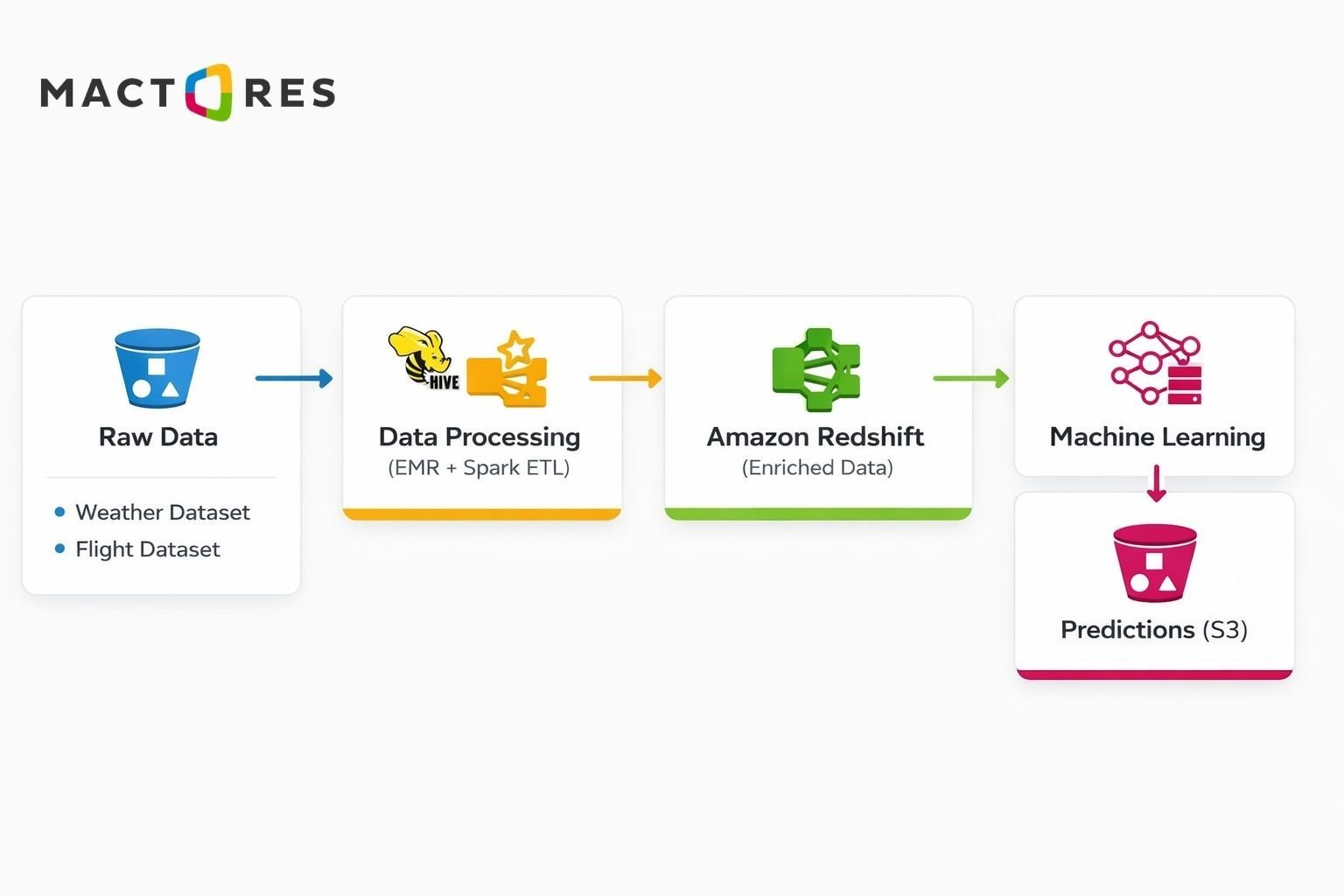
1. Ingestion Layer
- Batch ingestion from transactional systems (ERP, POS, logs)
- Optional streaming inputs for near real-time signals
- Data lands in a raw zone (typically S3)
2. Storage Layer
- Separation of:
- Raw data (immutable)
- Curated data (cleaned, structured)
- Partitioning by time, region, or entity for efficient access
3. Processing Layer (EMR)
- Spark jobs handle:
- Data cleaning and normalization
- Feature engineering (lags, rolling stats, seasonality features)
- Designed for distributed execution across large datasets
4. Modeling Layer
- Training pipelines operate on curated features
- Supports:
- Parallel model training across multiple time series
- Validation and evaluation workflows
- Outputs versioned models and forecast artifacts
5. Serving Layer
- Forecasts are written back to storage or downstream systems
- Used by:
- Inventory systems
- Planning dashboards
- APIs for consumption
6. Orchestration Layer (Cross-cutting)
- Tools like Step Functions or Airflow manage:
- Job dependencies
- Scheduling
- Failure handling
Data Engineering on EMR: Preparing Forecast-Ready Data
In most forecasting systems, data preparation is the most computationally intensive step. Getting this right has a bigger impact on accuracy than model choice.
Using Amazon EMR with Spark allows you to process large time-series datasets efficiently and consistently.
1. Data Preprocessing at Scale
- Missing values:
- Forward/backward fill for time-series continuity
- Interpolation where appropriate
- Outliers:
- Detection using statistical thresholds or rolling metrics
- Capping or removal, depending on business context
2. Feature Engineering Patterns
- Lag features: previous demand values (t-1, t-7, t-30)
- Rolling aggregates: moving averages, rolling sums
- Time-based features: day of week, month, seasonality flags
- Event signals: promotions, holidays, pricing changes
These features are typically generated using Spark window functions, which can operate across partitions efficiently.
3. Spark-Specific Considerations
- Partitioning: align with time or entity (e.g., SKU/store) to reduce shuffle
- Shuffles: minimize wide transformations to improve performance
- Caching: reuse intermediate datasets when pipelines are iterative
4. Storage Format
- Use columnar formats like Parquet for:
- Faster reads
- Better compression
- Efficient schema evolution
At scale, the goal is to build repeatable, optimized transformations that can run reliably as part of an automated pipeline, not one-off preprocessing scripts.
Model Selection and Training at Scale
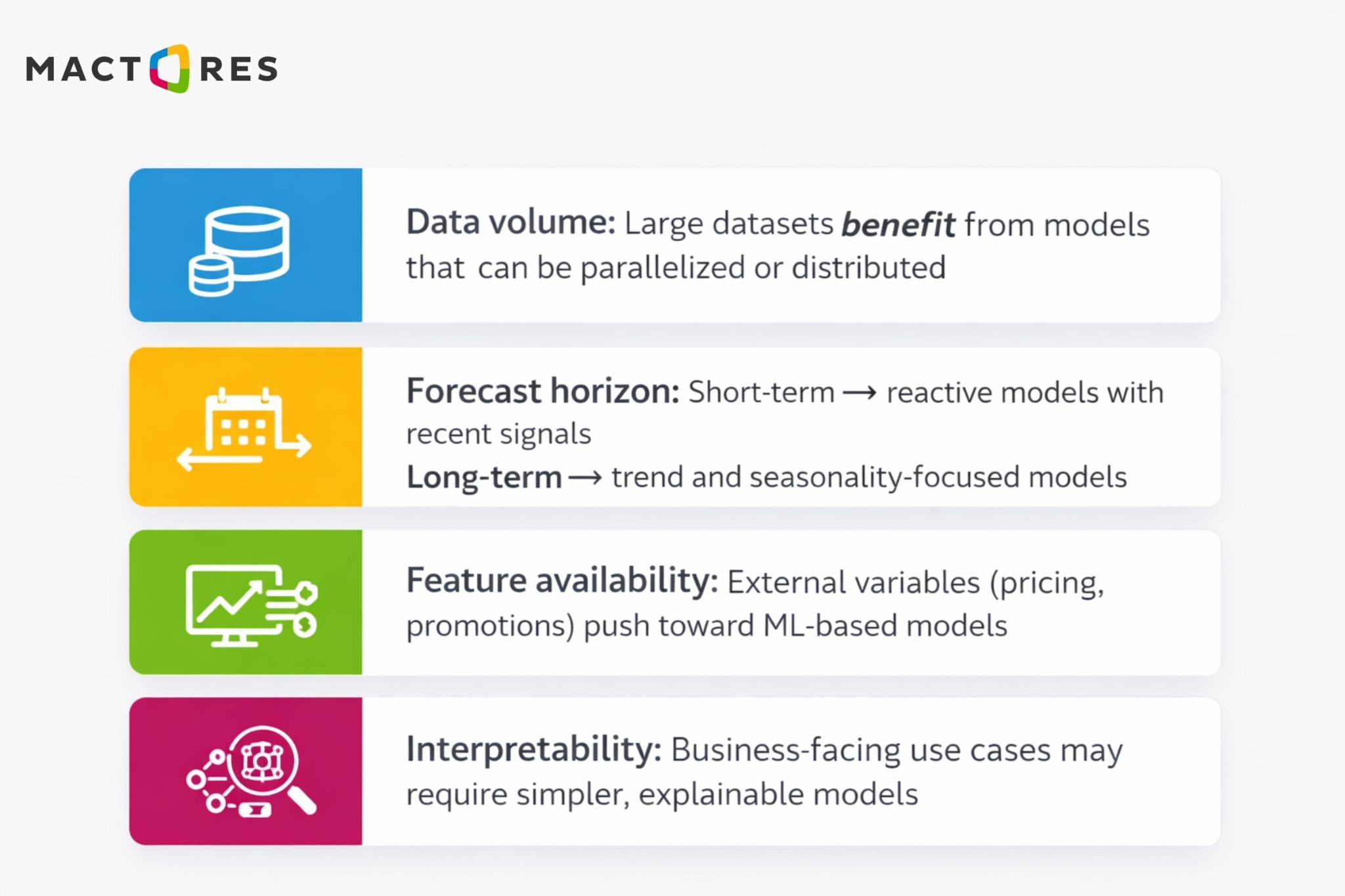
In production forecasting systems, model selection is rarely about finding a single “best” algorithm. Instead, it’s about choosing approaches that align with data characteristics, scale, and operational constraints and can be trained and retrained reliably.
Different datasets behave differently. Some time series are stable and predictable, while others are sparse, noisy, or heavily influenced by external factors. This variability often leads to a segmented or hybrid modeling strategy, rather than a one-size-fits-all approach.
A. How to Think About Model Selection?
B. Common Model Choices
- Statistical models (ARIMA/SARIMA):
Works well for stable, univariate series with clear seasonality - Machine learning models (e.g., XGBoost):
Handle multiple features and non-linear relationships effectively - Deep learning models (LSTM/RNN):
Useful for complex temporal dependencies, but requires more data and tuning
C. Training at Scale with Amazon EMR
EMR enables training workflows that go beyond single-machine limitations:
- Parallel training across thousands of SKU/location time series
- Distributed feature preparation using Spark
- Ability to integrate external ML libraries alongside Spark jobs
D. Hyperparameter Tuning and Evaluation
- Tuning strategies:
- Grid search (structured but expensive)
- Random search (more efficient at scale)
- Evaluation metrics:
- MAPE for relative error
- RMSE for sensitivity to large deviations
- Weighted evaluation:
Helps account for imbalance across high- and low-volume items
At this stage, the goal isn’t just model accuracy; it’s building a training process that is scalable, repeatable, and aligned with the overall pipeline.
Automating the Pipeline: Scheduling, Retraining, and Monitoring
Once the data and modeling layers are in place, the next step is turning them into a continuously running system. This is where most forecasting setups fall short: automation is either partial or brittle.
An autonomous pipeline ensures that data, models, and predictions stay up-to-date without manual intervention, while still providing visibility into performance.
1. Scheduling and Retraining
- Time-based triggers:
- Daily/weekly retraining for stable demand patterns
- Event-based triggers:
- Retrain when new data arrives, or thresholds are met
- Balance between:
- Frequent retraining (better accuracy)
- Compute cost and system load
2. Monitoring and Drift Detection
- Data drift: changes in input distributions (e.g., demand shifts)
- Model drift: degradation in prediction accuracy over time
- Track:
- Prediction vs actual error
- Feature distribution changes
3. Model Lifecycle Management
- Versioning of:
- Datasets
- Features
- Models
- Ability to:
- Roll back to previous models
- Reproduce past forecasts
4. Feedback Loops
- Incorporate actual demand data back into the pipeline
- Use it to:
- Update features
- Trigger retraining
- Enables continuous improvement without manual intervention
5. Failure Handling
- Retry mechanisms for failed jobs
- Data validation checks before training
- Alerts for pipeline or model issues
At this stage, forecasting becomes less of a periodic task and more of a self-sustaining system where orchestration, monitoring, and feedback loops keep the pipeline reliable and adaptive over time.
Performance and Cost Optimization on EMR
Running forecasting pipelines at scale on Amazon EMR requires careful balancing between performance and cost, especially as data volume and retraining frequency increase. Cluster sizing plays a key role. Compute-optimized instances are better suited for transformation-heavy workloads, while memory-optimized instances help with large aggregations and joins. Auto-scaling can prevent over-provisioning by adjusting resources based on workload demand, and spot instances can significantly reduce costs when workloads are fault-tolerant. On the processing side, minimizing data shuffles, optimizing joins, and aligning partitioning strategies with access patterns can improve job efficiency. Observability is equally important; tracking metrics, logs, and job performance through tools like CloudWatch helps identify bottlenecks early. Ultimately, efficient EMR usage comes down to building pipelines that are not just scalable, but also predictable in performance and controlled in cost.
Scaling Demand Forecasting with an EMR-Based Pipeline
A common scenario in large retail and supply chain environments involves forecasting demand across thousands of SKUs and multiple locations, where data is fragmented across transactional systems and updated at different intervals. In such setups, traditional pipelines struggle with scale, delayed retraining, and inconsistent feature generation, leading to stale forecasts and operational inefficiencies.
To address this, Mactores, as an Advanced AWS Partner, implemented a distributed forecasting pipeline built on Amazon EMR. The solution focused on centralizing data into S3, followed by large-scale feature engineering using Spark on EMR. Parallel model training was enabled across SKU-location combinations, allowing the system to process high-cardinality datasets efficiently. Orchestration was introduced to automate data ingestion, retraining cycles, and forecast generation, ensuring the pipeline remained continuously updated without manual intervention.
As a result, the organization was able to significantly reduce processing time for forecasting jobs, improve forecast granularity, and minimize stockouts and overstock scenarios. More importantly, the shift from a fragmented workflow to a production-grade, automated pipeline allowed forecasting to operate as a reliable, scalable capability rather than a periodic task.
Next Steps
If you’re looking to implement demand forecasting as an autonomous capability, the focus should be on incremental system design rather than a full-scale overhaul.
Start by identifying gaps in your current forecasting pipeline, especially around data consistency, feature engineering, and retraining. Establish a solid data foundation, then introduce distributed processing with Amazon EMR for scalability. Gradually add automation through scheduled retraining and monitoring for drift.
For teams operating in complex environments, working with experienced partners like Mactores can help accelerate this transition, particularly in designing production-grade architectures, optimizing EMR workloads, and aligning the system with business requirements.
The goal isn’t to build everything at once, but to evolve toward a pipeline that is scalable, observable, and continuously improving.