Patient, Care, Provider and Reporting Ontology: How Semantic Interoperability Gets Healthcare AI the Same Answer Twice

Key Takeaways
- Semantic interoperability means two systems agree on what the data means, not only on how it's formatted, and in healthcare it breaks down most often on four words: patient, care episode, provider and measure.
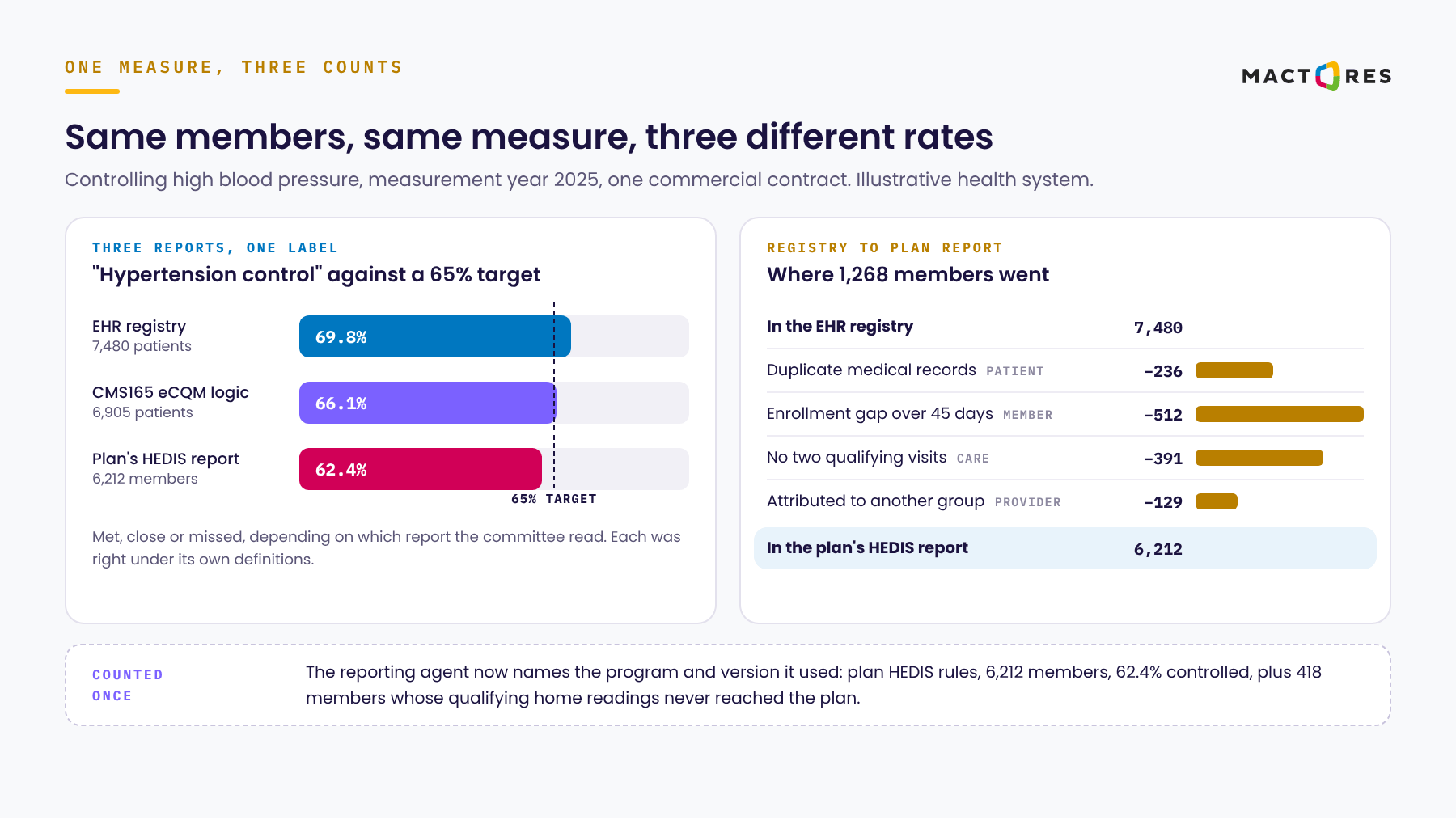
- The health system in this guide had three blood pressure control rates for the same contract, 69.8%, 66.1% and 62.4%, and each one was correct under its own definitions.
- FHIR standardizes how data moves and which codes it carries. Attribution, qualifying visits and which reading counts for which program are local decisions that need an owner.
- A patient, care, provider and reporting ontology writes those decisions down once, so a reporting agent computes a measure the same way every time and says which program's rules it used.
- PHI rules belong in the same model, so minimum necessary, care relationships and 42 CFR Part 2 records are checked on every agent query rather than after the answer.
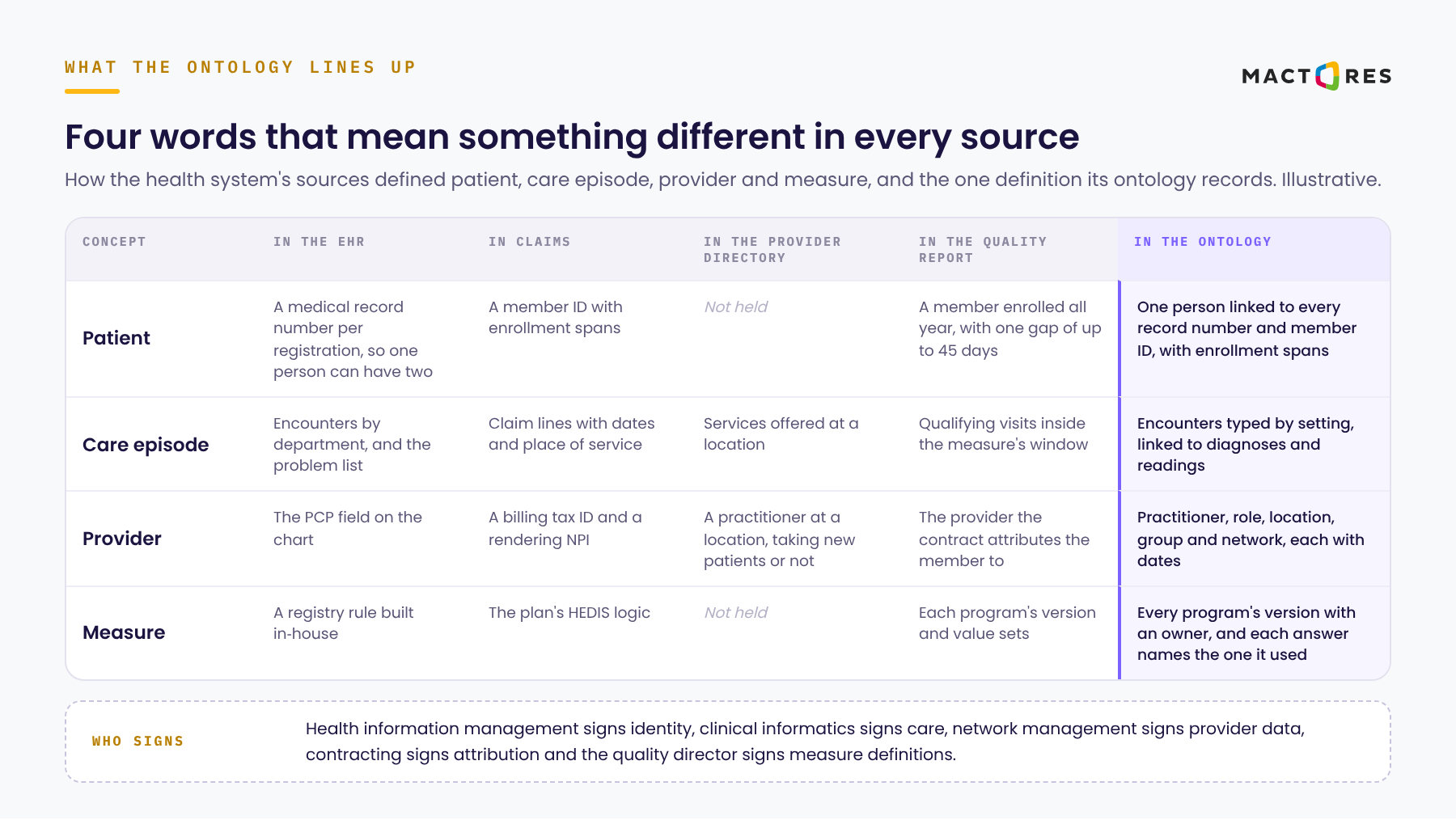
Most health systems can produce three different blood pressure control rates for the same patients, and every one of them can be correct. Semantic interoperability is supposed to prevent that. In practice, systems exchange data cleanly, in FHIR and with the right codes, and still disagree, because patient, care episode, provider and measure mean something different in the EHR, in claims, in the provider directory and in each quality program.
Our running example is a regional health system, made up but typical: four hospitals, about 60 primary care clinics on one EHR, an affiliated independent physician group on its own EHR, a Medicare ACO and value-based contracts with two commercial health plans. In March 2026 its quality committee met to review measurement year 2025 for the larger commercial contract, which set a 65% target for controlling high blood pressure. It had three numbers for the same members, and the meeting spent most of an hour on which one to believe.
Why Do Healthcare Reports Disagree on the Same Patient Count?
Because each report counts different people, using different visits, providers and readings, and calls the result by the same name. At the health system, all three rates for the commercial contract were labeled "hypertension control."
|
Report at the health system |
Who produced it |
Patients counted |
Controlled |
|---|---|---|---|
|
The EHR registry dashboard |
The population health team |
7,480 |
69.8% |
|
A calculation using the CMS165 eCQM logic |
The quality analytics team |
6,905 |
66.1% |
|
The plan's HEDIS report |
The health plan |
6,212 |
62.4% |
Against a 65% target, one report said the contract was met, one said it was close and one said it was missed. The AI assistant the quality team had started piloting made it worse. Asked the same question a week apart, it answered 68% and then 64%, because it wrote a fresh query each time and picked a different blood pressure table on the second run.
None of the three reports was wrong. The registry counted everyone with hypertension on the problem list and took the latest reading from any setting. The eCQM logic counted patients whose essential hypertension diagnosis started before or during the first six months of the year and who had a visit during it. The plan's HEDIS version required two outpatient or virtual visits with a hypertension diagnosis between January of the prior year and June 30, counted only members enrolled all year with no more than one gap of up to 45 days, and ignored readings taken in the emergency department.
When the team traced the 1,268 members between the registry and the plan's report, they fell into four groups: 236 people with two medical record numbers, 512 members with an enrollment gap longer than 45 days, 391 without two qualifying visits in the window, and 129 members the plan had attributed to a different provider group. Each group maps to one of four concepts, namely who the patient is, which care counts, which provider the patient belongs to and which measure definition applies, and those are what a healthcare ontology has to pin down.
What a Patient, Care, Provider and Reporting Ontology Contains
It contains the business meaning of those four concepts, the relationships between them and the rules that decide how they're counted, each with a named owner. At the health system, the first release covered only what the hypertension measure touched.
|
Part of the ontology |
What it held at the health system |
Who signed it |
|---|---|---|
|
Patient and member |
One person linked to EHR record numbers, plan member IDs and enrollment spans, with a merge rule for duplicates |
Health information management, with the plan's eligibility team |
|
Care |
Encounters typed as office, telephone, virtual, emergency or inpatient, diagnoses with onset dates, and readings with their setting and source |
Clinical informatics |
|
Provider |
Practitioners by NPI, groups by tax ID, locations, roles, affiliations with start dates and network participation by plan |
Network management |
|
Attribution |
Which patient belongs to which provider for each contract, with the method and the as-of date |
Value-based care contracting |
|
Reporting |
Each program's version of the measure, its value sets, measurement period, exclusions and which readings count |
The quality director |
The relationships carry most of the meaning. A blood pressure reading belongs to an encounter, the encounter has a setting, and each program decides whether that setting counts. An attribution belongs to a contract, which belongs to a plan, which sets its own method. Once those links exist, the populated graph becomes a clinical knowledge graph that agents can query, and the same episode definitions keep patient journey analytics consistent across clinics, hospitals and claims.
The ontology also records where each fact comes from. Enrollment spans came from the plan's eligibility file, encounter types from the EHR, affiliations from the credentialing system and attribution from the plan's monthly list. When two sources disagree, the ontology says which one wins for which question, which is how the 236 duplicate patients were merged once for every report rather than separately in each. It's the same modeling discipline as ontology in AI generally, applied to an industry with more identifiers and competing definitions than most.
Semantic Interoperability: Where FHIR Stops and Ontology Starts
FHIR stops at what the data is, and the ontology starts at what it means for your organization. HIMSS describes four levels of interoperability. Foundational interoperability lets systems connect, structural keeps the format and fields intact, semantic adds shared models and codes for, in HIMSS's words, "shared understanding and meaning to the user," and organizational covers governance, policy and legal agreements. FHIR resources and the terminology bindings in US Core cover structural interoperability and a large part of semantic.
Take one blood pressure reading. As a FHIR Observation it carries LOINC 85354-9 for the panel, 8480-6 for systolic and 8462-4 for diastolic, along with a value, a date and a link to the encounter. Any system can read it correctly. Whether it counts toward the plan's HEDIS rate depends on the encounter's setting and on whether it was taken on or after the member's second hypertension diagnosis, and neither rule lives in the Observation.
Attribution is the clearest case. The health plan sent its monthly list using the HL7 Da Vinci Member Attribution List guide, a FHIR Group of members with their attributed providers and coverage. The guide standardizes how the list is exchanged. It doesn't say how the plan decided who belongs to whom, and the plan's method, the plurality of primary care claims under a tax ID, differed from the PCP field the health system kept in its EHR.
|
Question at the health system |
What FHIR gives you |
What the ontology adds |
|---|---|---|
|
"Is this patient the same person as that member?" |
Patient and Coverage resources with their identifiers |
A rule for linking record numbers and member IDs, and who settles conflicts |
|
"Does this reading count for the plan's rate?" |
The Observation, its codes and its encounter |
Which settings and dates count under each program's version of the measure |
|
"Whose patient is this?" |
An attribution list in a standard format |
The contract's method, its as-of date and how it differs from the PCP field |
|
"Which version of the measure did we use?" |
Measure and MeasureReport resources |
The program, measure version and value set release behind each answer |
CMS's move to FHIR-based digital quality measures makes measure logic more portable, but it doesn't remove the local work. In February 2026 CMS put draft digital measure packages out for comment, 49 of them for eligible clinicians, and in a proposed rule for 2027 it asked for feedback on making FHIR-based reporting mandatory starting in 2030. Even then, someone at the health system still has to map its encounter types, identities and attribution onto what each measure expects.
Provider Data That AI Can Trust: Networks, Affiliations, Directories
Provider data that AI can trust has dates, sources and roles attached: who the practitioner is, where and under which tax ID they practice, which networks they're in for which plan, and when each of those last changed. Most provider data management today is built for directories and credentialing, and it rarely carries that history.
Directories have a long record of being wrong. In CMS's third review of Medicare Advantage online directories, 48.74% of provider locations listed had at least one inaccuracy, most often a provider who shouldn't have been listed at that location. The No Surprises Act now requires plans to verify directory information at least every 90 days, and Medicare Advantage plans have to publish their directories on Medicare Plan Finder starting with the 2027 open enrollment and attest each year that they're accurate.
At the health system, the 129 members attributed elsewhere traced back to provider data. The independent group joined the system's clinically integrated network on July 1, 2025, but kept billing under its own tax ID, and two of its physicians also saw patients one day a week at a system clinic under the system's tax ID. The plan attributed by tax ID while the EHR's PCP field named the physician, so both sides were looking at the same doctors and drawing different lines.
The ontology keeps practitioner, role, location, organization and network as separate records with effective dates, instead of one provider row. That lets an agent answer "Was this physician in the plan's network at the Elm Street clinic in March?" as of March, not as of today. The same identity problems show up in claims data, which is usually where our healthcare analytics on AWS work begins.
AI care coordination depends on the same facts. A care coordination agent that books a follow-up after an emergency visit needs the patient's attributed primary care practice under the current plan, whether that practice is taking new patients and which of its locations is in network. With a directory that's half right, the agent books patients at the wrong door, however well it writes the message.
Quality and Regulatory Reporting Agents That Give the Same Answer Twice
A reporting agent gives the same answer twice when it computes the measure from definitions it didn't write itself, and records which ones it used. After the ontology went in, the health system's quality assistant stopped writing fresh queries. It resolved each question to a program, a measure version, a population and a measurement period, then read results that had already been computed once, at patient level.
Asked about the commercial contract, it now answered with the plan's HEDIS rules by default: 6,212 members and 62.4% controlled, matching the plan's report. It also listed 418 members whose qualifying home readings, taken on digital devices and documented in the chart, had never reached the plan as supplemental data. The registry's 69.8% didn't disappear. It became an internal operational view, labeled as one, and the eCQM version stayed in the ACO's reporting, where its logic applies.
|
What the agent records with each answer |
For the commercial contract at the health system |
|---|---|
|
Program and measure |
HEDIS Controlling High Blood Pressure, measurement year 2025 |
|
Population |
Members in the plan's December 2025 attribution file, enrolled with no more than one 45-day gap |
|
Readings counted |
The most recent outpatient or home reading on or after the second hypertension diagnosis, none from emergency or inpatient stays |
|
Value sets |
The release published for measurement year 2025 |
|
Sources and versions |
EHR snapshot date, attribution file date and ontology version |
Asked again the next morning, it gave the same numbers, and they would change only if the data had moved. Every answer was stored with the measure version, the value set release, the attribution file's date and the ontology version, which is what the quality director asked for before she let the committee use it.
Quality reporting is already heavy work. A JAMA study of Johns Hopkins Hospital estimated that reporting on 162 quality metrics in 2018 took 108,478 person-hours, and an agent can take on part of that only if it counts the same way every time. The resolution path, a stored definition first, then a graph query and then document search, is how our context ontology for healthcare work handles measure questions for health systems and plans.
The agent drafts and explains, and it doesn't submit. The quality director signs every submission, and a clinician reviews anything that touches an individual patient's care. We've run agents on PHI that way before: the KlearTrust agentic claims platform reached production in 12 weeks, cleared about 80% of claims within the agent's authority and passed HIPAA and internal audit on its first review.
PHI and Access Rules Inside the Ontology
Access rules belong in the ontology because it already knows the relationships those rules depend on: who the patient is, who is on their care team, which program a report is for and which records carry extra protection. HIPAA's minimum necessary standard asks covered entities to limit most uses and disclosures of PHI to what the purpose needs, and an agent can only apply that if it knows both the purpose and the relationship.
At the health system, the quality assistant answered rate questions with counts, and showed member lists only to people on the care team or to quality staff assigned to the contract. A care coordinator asking for the 418 members with home readings saw the ones attributed to her clinics. A finance analyst asking the same question got the count.
Some records need more than role checks. Substance use disorder treatment records covered by 42 CFR Part 2 sit in their own class in the ontology with consent attached, and the updated Part 2 rule's compliance date was February 16, 2026. State laws add their own protected categories, such as HIV status and some mental health records, and the ontology tags those the same way, so a reporting agent can count a patient without revealing why the patient is in the count.
Our context ontology services start from one question your agents or reports get wrong, which for most health systems is a measure like this one. Within a week of the first working session, you get a diagnosis, a draft first-release scope and a target production date.