Ontology vs Taxonomy: Why AI Agents Need Relationships, Not Just Categories

Key Takeaways
- Ontology vs taxonomy comes down to relationships: a taxonomy sorts things into categories, while an ontology says how things relate and which rules apply to them.
- A taxonomy is enough when people or agents only need to find, filter or roll up, as in catalog navigation, search filters and document tagging.
- An AI agent needs an ontology when the answer depends on relationships and rules, such as compatibility, eligibility or what a customer is allowed to receive.
- The distributor in this guide shows the gap, where its agent suggested a respirator from the right category that the customer's crew couldn't legally wear.
- Your existing taxonomies aren't wasted. They usually become the backbone of the ontology, with relationships and rules added on top.
The ontology vs taxonomy question used to be a debate among librarians and information architects. AI agents have made it a practical one. An agent built on a taxonomy knows what category each thing belongs to. It doesn't know how those things relate, so it gives answers that are correctly categorized and still wrong.
Our example is an industrial safety supply distributor, made up but typical, selling to about 3,000 manufacturing, construction and utility customers. In 2026 it gave its customer service team an AI assistant built on its product catalog. The catalog was well organized. The assistant still recommended a respirator that a customer's crew wasn't allowed to wear, and that one order shows the difference better than any definition.
What Is a Taxonomy?
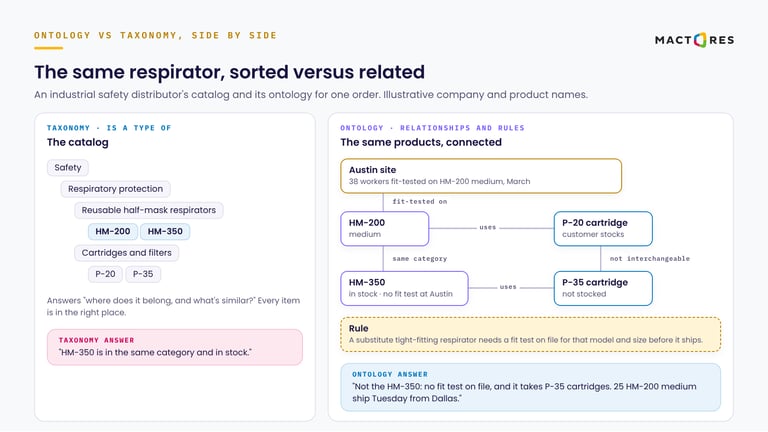
A taxonomy is a hierarchy of categories, where each item sits under a broader parent. The relationship is always the same kind: this is a type of that. The distributor's catalog put the HM-200 reusable half-mask respirator under reusable half-mask respirators, which sat under respiratory protection, which sat under safety. Charts of accounts, document libraries and product catalogs all work the same way.
Taxonomies are good at what they're built for. They make things findable, keep tagging consistent and let reports roll up from item to category. The W3C's SKOS standard was written for exactly this kind of structure, and it describes itself as a way to share thesauri, taxonomies and classification schemes rather than as a formal knowledge representation language. That difference turns out to matter.
What Is a Data Taxonomy?
A data taxonomy applies the same idea to data assets. It classifies tables, columns and documents by subject, such as customer, product or financial data, and by sensitivity, such as personal or restricted. The distributor's data catalog used one to mark which tables held customer contact details. It's an essential part of governed data, but it describes the data rather than the business the data is about.
What Is an Ontology?
An ontology is a formal model of the things in a domain, how they relate and the rules that govern them. It includes a class hierarchy, so it can contain a taxonomy, but it adds relationships of many kinds and the constraints that apply to them. The W3C's OWL 2 language is the usual standard, and it gives ontologies classes, properties, individuals and formally defined meaning.
In the distributor's case, the ontology said that a respirator uses specific cartridges, that a customer site has fit-test records for specific respirator models and sizes, and that a substitute respirator can't go to a crew that hasn't been fit-tested on it. Building an ontology in AI usually starts from a model-drafted proposal that the owners of each rule review and sign. For this comparison, the key point is that an ontology can say "uses," "is approved for" and "requires," while a taxonomy can only say "is a type of."
Ontology vs Taxonomy: The Differences That Matter for AI
They differ in structure, but the differences that matter for AI are about which questions each one can answer. The distributor's catalog and its ontology covered the same products and gave very different answers.
|
Taxonomy |
Ontology |
|
|---|---|---|
|
Structure |
A hierarchy, from broad categories down to items |
A network of classes, relationships and rules, which can include a hierarchy |
|
Relationship types |
One: "is a type of" |
Many: "uses," "is approved for," "requires," "replaces" |
|
Rules |
None beyond where things sit |
Constraints an agent must apply, such as "needs a fit test first" |
|
Typical standard |
SKOS, or simply a category table |
OWL, often with SHACL for validation |
|
What it answers |
"Where does this belong, and what's similar?" |
"Can this be used here, by these people, under these rules?" |
|
How an agent uses it |
To find and filter |
To reason about whether an answer or action is allowed |
|
Who maintains it |
Catalog, content or data teams |
Business owners for each rule, with the data team |
The row that matters most is rules. A taxonomy can tell an agent that two products are alike. It can't tell the agent when "alike" isn't good enough, and those are the cases where an agent's answer has consequences.
Ontology vs Taxonomy Examples, Side by Side
A construction customer ordered 40 HM-200 respirators in medium for a new site near Austin. The HM-200 medium was backordered for three weeks. The assistant, working from the catalog, found the HM-350 medium in the same category, in stock, and offered it as a substitute. The customer service rep accepted, and the order shipped.
The crew had been fit-tested on the HM-200. Under OSHA's respiratory protection standard, a worker using a tight-fitting respirator has to be fit-tested again whenever a different facepiece size, style, model or make is used. The HM-350 also took a different cartridge from the P-20 cartridges the customer had stocked. Forty respirators arrived that nobody on the site could wear until the safety manager arranged new fit tests.
|
What the rep needed to know |
What the taxonomy answered |
What the ontology answered (illustrative) |
|---|---|---|
|
Is there a similar respirator in stock? |
Yes, the HM-350 is in the same category |
Yes, but similar isn't the test for this customer |
|
Can this crew wear it? |
No answer, since fit tests aren't categories |
No. The Austin site has fit-tested 38 workers on the HM-200 medium only |
|
Will their cartridges fit? |
No answer |
No. The HM-350 uses P-35 cartridges, and the customer stocks P-20 |
|
What can we offer instead? |
Other items in the category |
25 HM-200 medium at the Dallas warehouse, shipping Tuesday, with the rest when the backorder clears |
Nothing in the taxonomy was wrong. Every product sat in the right place. The assistant simply had no way to know that a customer site, a fit-test record and a cartridge were related to the respirator it was recommending. Once the distributor added those relationships, along with a rule that substitutes for tight-fitting respirators need a matching fit test, the same question produced an answer the rep could send.
When Is a Taxonomy Enough, and When Does AI Need an Ontology?
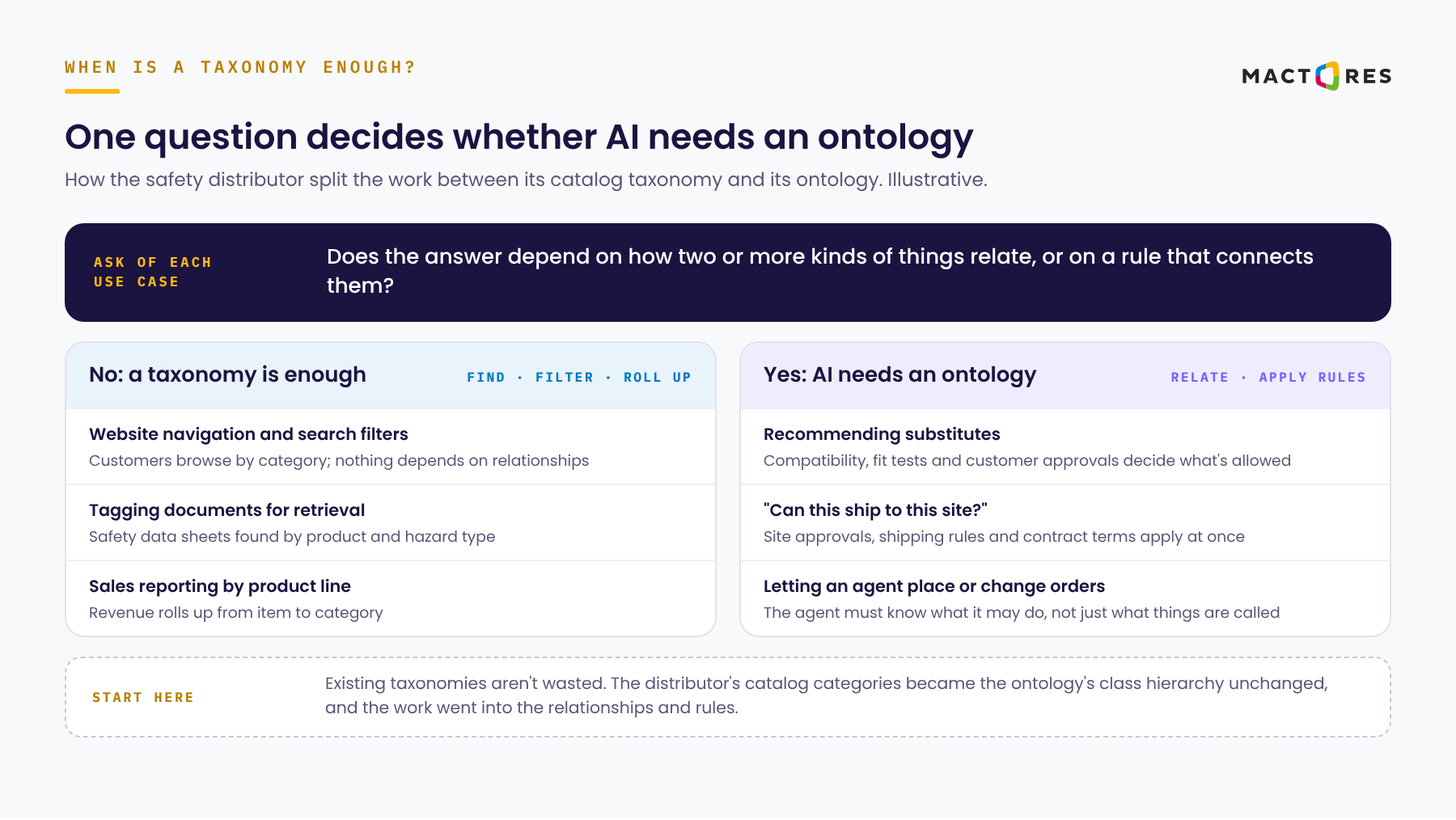
A taxonomy is enough when the job is finding, filtering or summarizing. An ontology is needed when the answer depends on how things relate or which rules apply. The distributor kept both, and used each where it fit.
|
Use at the distributor |
What it needed |
Why |
|---|---|---|
|
Website navigation and search filters |
Taxonomy |
Customers browse by category, and nothing depends on relationships |
|
Tagging documents for retrieval |
Taxonomy |
Safety data sheets only had to be found by product and hazard type |
|
Sales reporting by product line |
Taxonomy |
Revenue rolls up from item to category |
|
Recommending substitutes |
Ontology |
Compatibility, fit tests and approvals decide what's allowed |
|
Answering "can this ship to this site?" |
Ontology |
Shipping rules, site approvals and contract terms all apply at once |
|
Letting an agent place or change orders |
Ontology |
The agent has to know what it may do, not just what things are called |
The pattern is simple to apply. If the question is about one item and its category, a taxonomy will do. If it involves two or more kinds of things and a rule connecting them, a customer and a product, a part and a machine, a policy and a claim, the agent needs an ontology. Document retrieval sits in between. Tagging documents with a taxonomy makes retrieval-augmented generation more precise, but it won't stop an agent from combining two correct documents into a wrong answer.
Start from what you already have. The distributor's catalog categories became the class hierarchy of its ontology unchanged, and its data taxonomy told the team which governed tables held each fact. That AI-ready data foundation made the relationships quicker to model. The first release covered substitution and site eligibility for respiratory protection, the categories with the most consequential mistakes, and the same approach applies to parts and materials in our context ontology for manufacturing work.
Where the ontology lives depends on where your agents run. The main platforms now each offer one, from a Databricks ontology inside Genie to the Context Ontology Accelerator on AWS, and the modeling work is the same on all of them. Our context ontology services start from your existing taxonomies and one question your agent gets wrong. Within a week of the first working session, you get a diagnosis, a draft first-release scope and a target production date.