FinOps for AI: Funding the Program From the Envelope You Already Have

Key takeaways
- AI cost is now standard FinOps scope. 98 percent of FinOps practitioners manage AI spend, up from 31 percent two years ago, and about a third attribute more than a quarter of cloud spend to AI.
- Waste is rising again. Flexera’s 2026 report puts wasted cloud spend at 29 percent, the first increase in five years, with AI workloads named as a driver.
- Agentic workflows push inference cost up. Gartner projects inference cost per agentic workflow will rise more than fivefold through 2028.
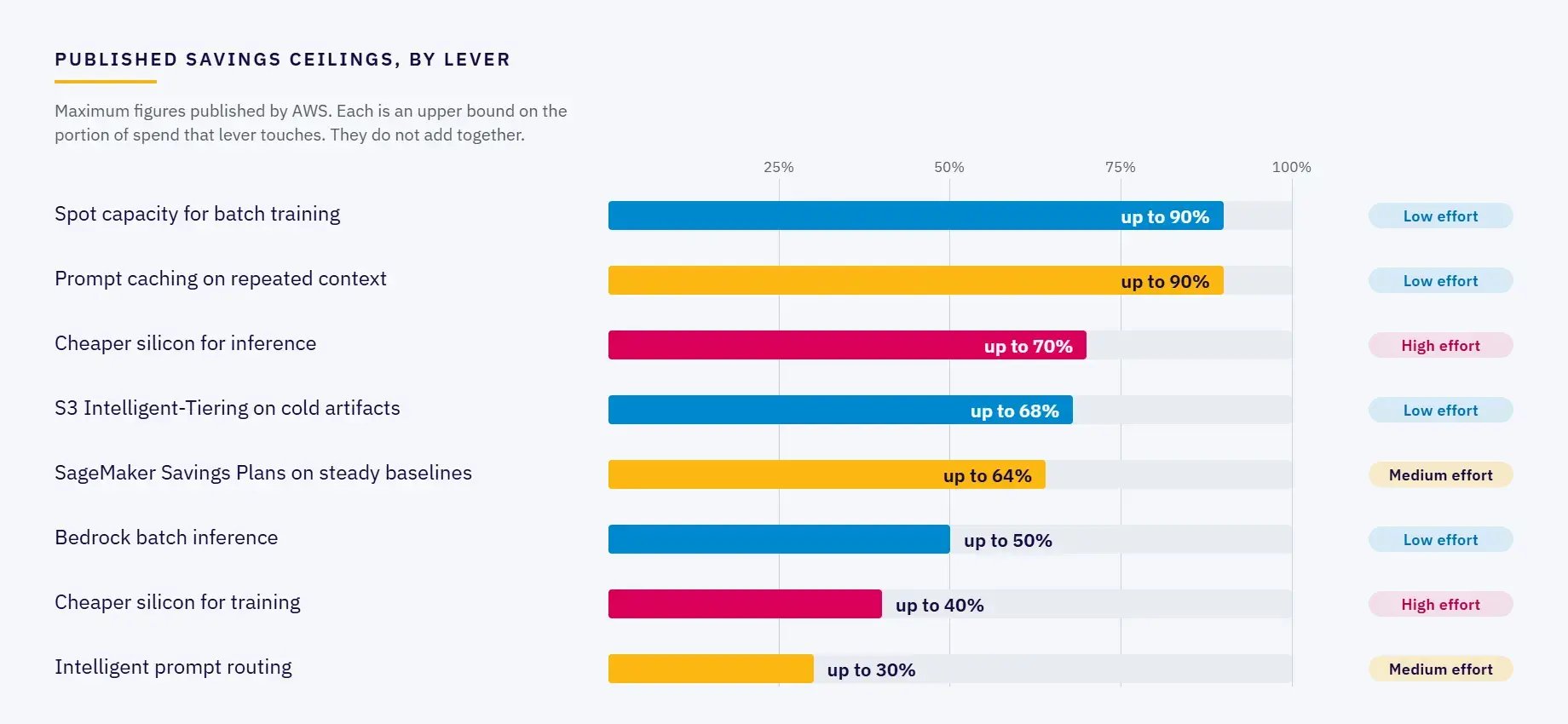
- Existing waste can fund new AI work. AWS publishes savings ceilings of up to 90 percent for Spot and prompt caching, 64 percent for SageMaker Savings Plans, 50 percent for Bedrock batch inference and 30 percent for Intelligent Prompt Routing.
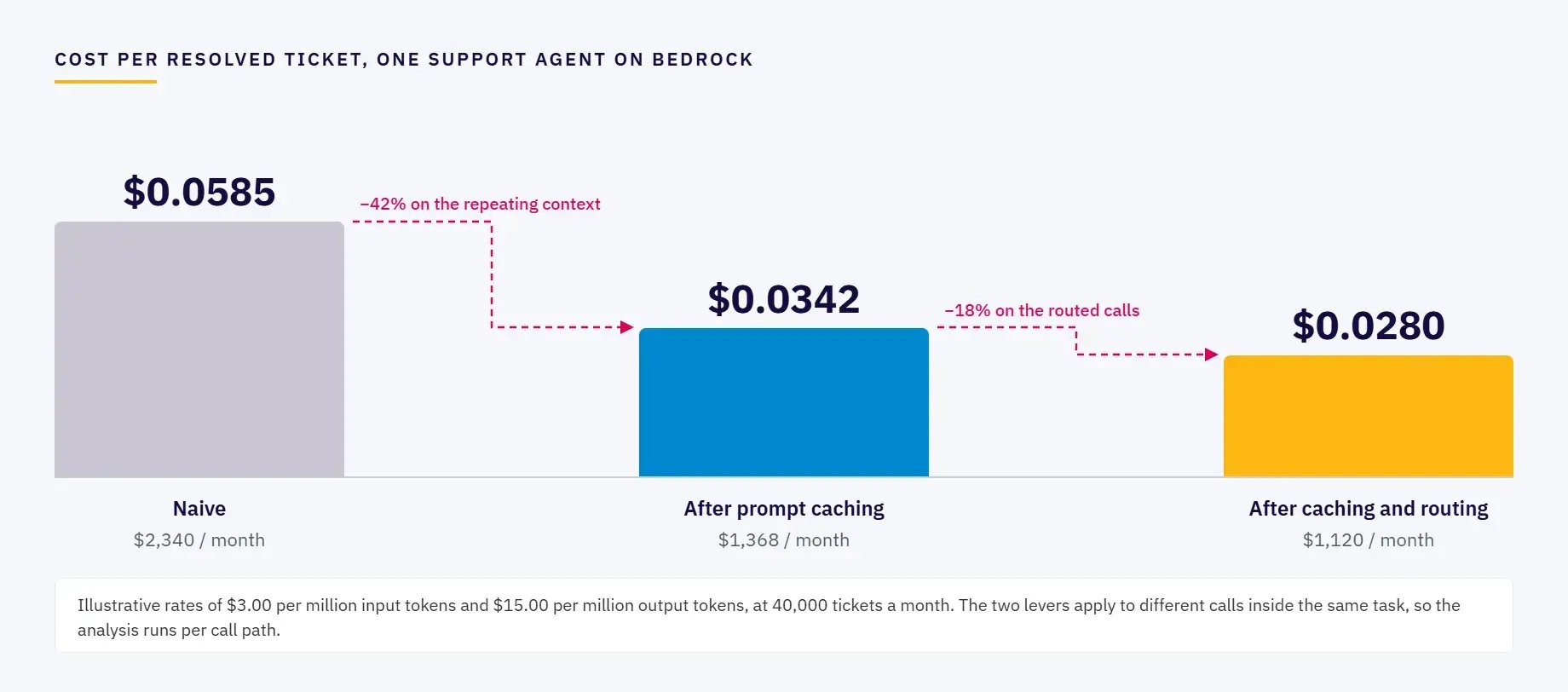
- Unit economics make savings visible. In the blog’s worked example, caching and routing cut cost per resolved ticket from $0.0585 to $0.0280, about $2,340 to $1,120 a month at 40,000 tickets.
Ninety-eight percent of organizations running FinOps now manage some form of AI cost. Two years ago that figure was 31%. The number comes from the State of FinOps 2026 research, the annual practitioner survey behind the FinOps Framework, and it is the clearest signal available that AI spend has stopped being a special case.
The reason is visible in any AWS bill carrying model workloads. A GPU training run that swings tenfold between quarters. An inference bill that moves with usage no forecast anticipated. A Bedrock endpoint someone spun up for a proof of concept in March, still billing in September.
That cost signature pulled FinOps out of the monthly billing review and into the executive risk conversation. For data and engineering leaders funding AI on AWS, the open question is no longer whether to run FinOps. Most already run some version of it.
The real question is whether that program extends to workloads that behave nothing like the rest of the environment, and whether it can pay for itself while doing so.
This blog covers what that extension requires: a working definition of FinOps for AI, the specific ways a traditional cost model breaks under training and inference, an operating model that covers experimentation and agents, the attribution mechanics that make model-level cost visible on AWS, and the levers that fund the next initiative from the existing bill.
What Is FinOps for AI?
FinOps is the operating discipline that brings financial accountability to variable, on-demand cloud spend. It unites engineering, finance, and business teams around shared, real-time cost data through a continuous cycle of informing, optimizing, and operating.
That definition, and the framework behind it, is maintained by the FinOps Foundation, the independent body that has published practitioner research on the discipline since 2019.
FinOps for AI is the same discipline scoped to workloads whose cost is driven by model behavior, not resource count. That means GPU and accelerator hours, tokens, managed model endpoints, vector storage, and increasingly, autonomous agents that decide for themselves how much inference a task requires.
Two properties of the base definition matter here. FinOps is a practice, not a tool, so a dashboard no more produces cost maturity than a ticketing system produces agility.
The second property is the one that settles the scope question. FinOps assumes usage-based, variable spend as its starting condition, which is exactly why AI infrastructure belongs inside it instead of sitting outside as a quarterly line item.
That scope question is now settled in practice as well as in theory. Alongside the 98% figure, the FinOps Foundation reports that roughly a third of organizations attribute more than a quarter of total cloud spend to AI. That is the threshold at which the conversation moves from the platform team to the CFO.
Why a Traditional Cost Model Breaks Under AI Workloads
Most FinOps programs were built around infrastructure that behaves predictably: virtual machines, managed databases, storage buckets. Cost moves gradually, correlates with business metrics already being tracked, and tolerates a monthly review. AI workloads violate every one of those assumptions.
The review cadence is wrong
A single training job can consume more accelerator hours in one sprint than a team’s entire baseline compute spend for the previous quarter. A monthly cost review catches that a month too late to change the outcome. Training and inference need visibility measured in hours, not billing cycles.
Waste moved rather than shrank
Flexera’s 2026 State of the Cloud Report, based on responses from 753 global cloud decision makers, found wasted cloud spend rose to 29% of cloud budgets. That was the first increase after five consecutive years of improvement, with AI workloads and newer PaaS services named as the drivers.
The waste did not disappear as FinOps programs matured. It relocated into infrastructure those programs were never built to see.
Unit economics stop translating
Cost per instance-hour says almost nothing about whether a model, an experiment, or an agent is earning its keep. Without a cost-per-token, cost-per-inference, or cost-per-training-run view, the cost data and the engineering decisions live in different spreadsheets and are reconciled by nobody.
Cost scales with model behavior, not just usage
Gartner’s research on agentic AI describes an inference paradox: cheaper tokens do not lower total spend, because each new capability tier consumes more of them.
Gartner projects that inference costs per agentic workflow will increase more than fivefold through 2028. It estimates that routing a task to an agentic reasoning model raises provider inference cost by at least five times against a simple chatbot-style call.
A forecasting model built on linear infrastructure growth has no mechanism for that kind of structural escalation.
Shadow AI widens the blind spot
Teams provision their own model API keys, stand up endpoints in unmonitored accounts, and run experiments outside the organizational units a FinOps program covers. The resulting spend is entirely real and entirely invisible until the invoice lands.
Account structure, covered further down, is the control that closes this gap. Policy alone does not.
A FinOps Operating Model for Training, Inference, and Agents
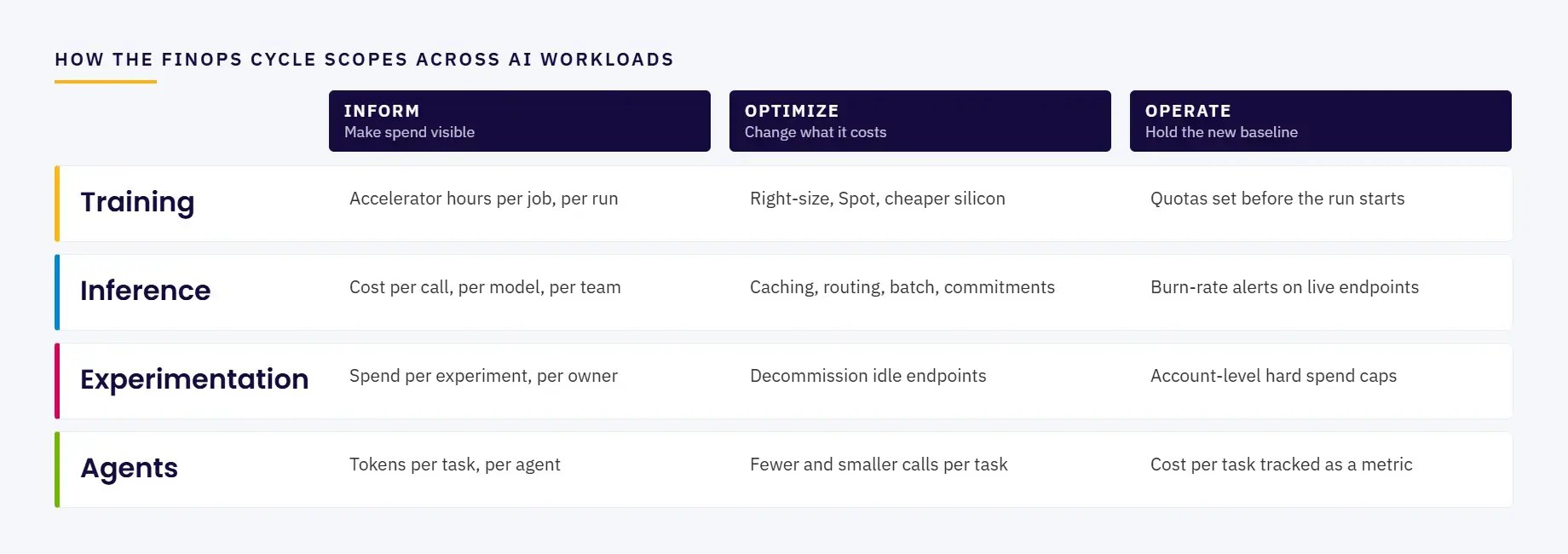
Extending FinOps to AI does not require a new framework. It is the same Inform, Optimize, Operate cycle, deliberately scoped across four workload types that behave differently: training, inference, experimentation, and agents.
People
AI-era cost governance needs roles a traditional cloud cost review never required. Machine learning engineers who can explain what drives a training job’s accelerator footprint. Platform engineers who own the accounts, quotas, and service limits.
It also needs a finance business partner fluent enough in the technical detail to translate accelerator hours and token counts into a budget line a CFO recognizes.
FinOps Foundation practitioner data shows most programs report into the CTO or CIO organization, with roughly six in ten running a centralized enablement model. That structure works for AI provided the machine learning and platform functions sit inside it and not alongside it.
Process
Three changes carry most of the weight.
Move from monthly to near-real-time visibility for training and inference, where spend can move materially within hours.
Attribute cost at the model, experiment, and agent level, not only by team or project. A review should be able to distinguish a production inference workload from an abandoned experiment still holding a SageMaker endpoint.
Set budgets and guardrails before a training run starts: hard quotas on accelerator instance types and counts, with alerts tied to burn rate instead of absolute spend.
Tooling
Native AWS cost tooling remains the foundation. Cost Explorer, Cost and Usage Reports, and Budgets cover the reporting layer.
AWS Compute Optimizer generates right-sizing and idle-resource recommendations across EC2, EBS, Lambda, RDS, and SageMaker. The base service carries no additional charge, with enhanced infrastructure metrics as a paid opt-in.
AWS Cost Anomaly Detection applies machine learning to spend patterns and alerts on anomalies with root cause analysis, free as part of Billing and Cost Management.
For architectural guidance, the Generative AI Lens of the AWS Well-Architected Framework sets out five cost focus areas: model selection, pricing mode, prompt design, vector store sizing, and agent design.
What changes is not the toolchain. It is what gets tagged and tracked inside it, which turns out to be harder on AI services than on infrastructure.
Cost Attribution for Bedrock and SageMaker: What Actually Works
Model-level attribution is where most AI cost programs stall. The mechanics differ from tagging an EC2 instance, and the difference is not obvious until a first attempt returns unallocated spend.
SageMaker attributes cleanly
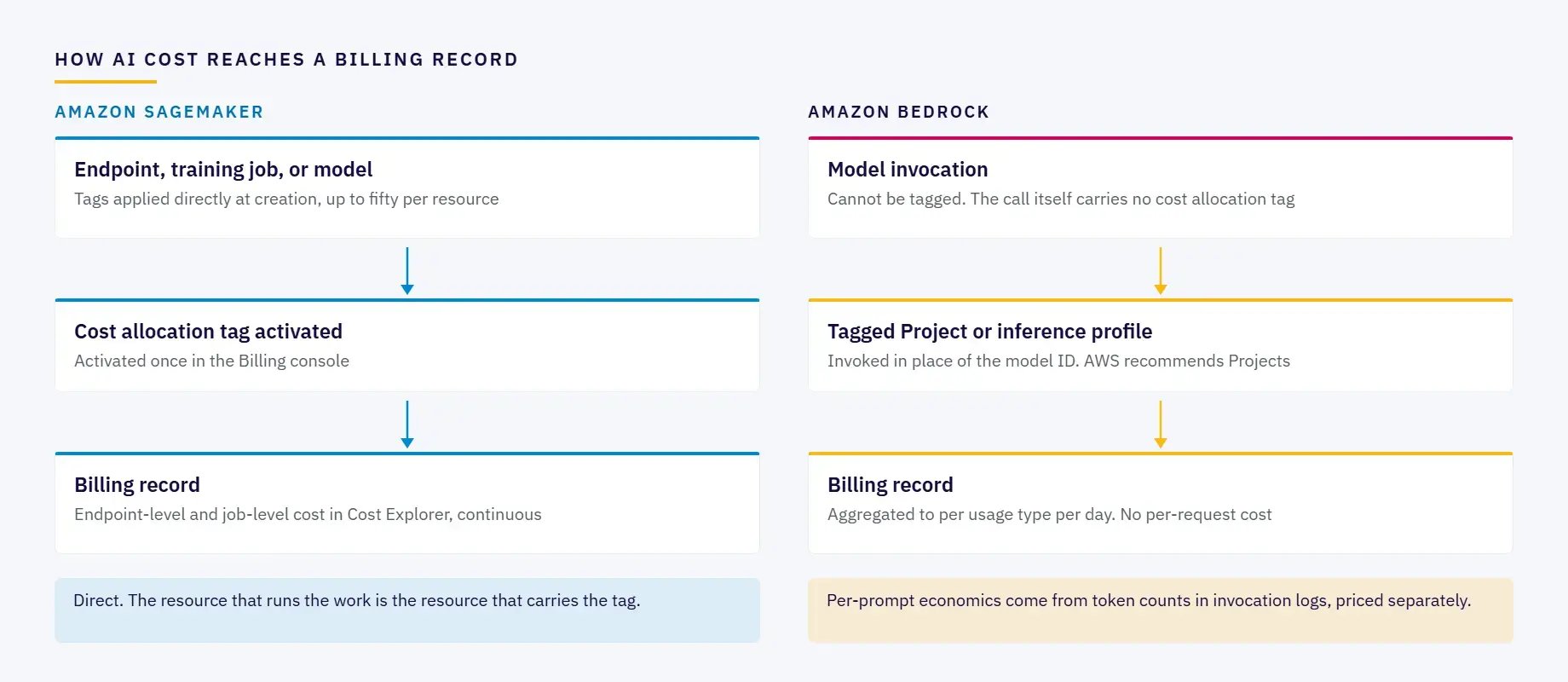
SageMaker resources accept tags natively. Endpoints, endpoint configurations, training jobs, and models all take a Tags parameter at creation, up to fifty per resource.
Once those tags are activated as cost allocation tags in the Billing console, endpoint-level and training-job-level cost falls out of Cost Explorer without further work.
The practical failure mode is not the mechanism. It is teams creating endpoints through notebooks and scripts that never set tags in the first place, which is an account-policy problem no tooling change fixes.
Bedrock attributes indirectly, through a resource
A raw model invocation cannot be tagged. Cost is attributed by invoking through a tagged resource, and AWS documents five distinct mechanisms with different API coverage.
Application inference profiles carry cost allocation tags and are used in place of a model ID in the call. Projects and workspaces attribute through project-level tags. IAM principal attribution assigns cost by calling identity. Per-request metadata tagging returns token counts in invocation logs, but never in billing records.
Four constraints shape how this gets designed, and each has cost consequences:
- Application inference profiles are model-specific and proliferate. AWS now recommends Projects for new work, because a profile per model per team multiplies quickly and becomes its own maintenance burden.
- Neither mechanism produces per-request cost. The finest available grain is per usage type per day. Per-prompt economics have to be derived from token counts in model invocation logs and priced separately.
- Application inference profiles are rejected by the Responses and Chat Completions APIs. A call naming a profile against those endpoints returns a 400 error, so an application built on them needs Projects instead.
- Cost allocation tags are not retroactive. Only spend incurred after activation is tagged, and activation takes up to 24 hours to appear.
That last constraint is worth escalating early. Every week without a tagging standard is a week of permanently unattributable AI spend, and no amount of later analysis recovers it.
Attribution quality is also bounded by the account and pipeline architecture underneath it. That is why data platform modernization on AWS tends to be a precondition for credible AI cost reporting, and not a parallel workstream.
An operational data lake rebuild at Synaptics illustrates the dependency. Replacing static partitioning with smart queues on one of the largest EDA clusters on AWS lifted throughput 40% and cut queue wait 75%. The same partitioning and account structure that produced those gains is what makes per-team compute cost legible.
Funding AI From the Envelope You Already Have
The most common reason a promising AI initiative stalls is not a shortage of ambition. It is a shortage of budget headroom, real or perceived.
Most AWS environments running AI workloads carry enough recoverable waste to fund the next initiative without a new budget request. The levers below are ordered by size of recovery against effort to implement.
Move the workload onto cheaper silicon
This is the largest lever available on AWS and the one most often skipped, because it gets filed as an engineering migration when it is a cost decision.
AWS states that Trn2 instances deliver 30% to 40% better price performance than GPU-based P5e and P5en instances for training. For inference, AWS puts Inf1 at up to 2.3 times higher throughput and up to 70% lower cost per inference against comparable EC2 instances.
The surrounding application tier matters too, since most AI systems still run orchestration, API, and preprocessing layers on general-purpose compute. AWS rates Graviton-based instances at up to 40% better price performance than comparable x86 instances.
Silicon migration carries real porting effort, which is precisely why it belongs on the modernization roadmap and not the cost-cutting checklist. The same sequencing logic that governs application and database modernization applies: move the workloads where the arithmetic is decisive, leave the rest.
Match the pricing mode to the workload’s shape
Commitment discounts and spot capacity are both underused and frequently misapplied.
SageMaker Savings Plans reduce cost by up to 64% against on-demand, which suits a steady-state inference baseline and suits a spiky, short-lived training schedule very badly. EC2 Spot Instances run at up to 90% off on-demand, which fits batch training and non-time-sensitive experimentation and does not fit production inference serving.
Most environments carrying waste here have the two reversed. Commitments get sized against a peak that experimentation created, and production inference then runs on demand.
Cut token cost before you cut capacity
On managed model inference, the largest savings come from how the model is called, not what it runs on.
Amazon Bedrock prices batch inference 50% below on-demand for supported models, which covers a surprising share of workloads that turn out to be latency-tolerant once someone asks the question directly.
Prompt caching in Bedrock can reduce cost by up to 90% and latency by up to 85% where a long system prompt or retrieved context repeats across calls. That describes most retrieval-augmented applications.
Intelligent Prompt Routing can reduce cost by up to 30% by sending each request to the smallest model that will answer it correctly.
One constraint is worth knowing before designing around these. Prompt caching is supported only on on-demand inference endpoints and is not available through the batch inference API. The two largest token-cost levers on Bedrock cannot be stacked on the same call path, so the decision is made per workload, not platform-wide.
Tier the storage AI leaves behind
Vector stores, embeddings, model checkpoints, and training datasets accumulate quickly. They are routinely left on the highest storage tier long after anyone reads them.
S3 Intelligent-Tiering moves objects automatically as access patterns change. AWS puts the saving at up to 40% when an object drops to the Infrequent Access tier after 30 days, and up to 68% at the Archive Instant Access tier after 90, with no retrieval charges between tiers.
This recovers real spend without touching a single compute decision, which makes it the easiest lever to run first while the harder ones are being scoped.
Decommission on a schedule
Idle SageMaker endpoints, orphaned EBS volumes left behind by terminated training instances, and forgotten Bedrock provisioned throughput are the purest form of waste in an AI environment. They are also the easiest to eliminate once someone owns the job.
The word doing the work in that sentence is schedule. Waste found during an annual cleanup has already cost a year.
None of this requires new tooling or a program stand-up. It requires clear ownership, accurate attribution, and a fixed cadence, which is what a scoped operating model provides.
A Worked Example: Cost per Resolved Ticket on Bedrock
Unit economics get argued for far more often than they get demonstrated. Here is the full derivation for a customer-support agent running on Amazon Bedrock.
Step 1: Establish the shape of one task
A single support resolution runs four model calls:
- Intent classification
- A retrieval-grounded answer
- A policy check
- A summary written to the case record
Together those calls consume:
|
Token type |
Volume per task |
|
Input tokens, total |
12,000 |
|
Of which repeat every call (system prompt plus retrieved policy context) |
9,000 |
|
Output tokens |
1,500 |
Step 2: Price the naive version
At an illustrative blended rate of $3.00 per million input tokens and $15.00 per million output tokens:
- Input: 12,000 x $3.00 / 1,000,000 = $0.0360
- Output: 1,500 x $15.00 / 1,000,000 = $0.0225
- Total: $0.0585 per resolved ticket
At 40,000 tickets a month, that is roughly $2,340.
Step 3: Apply prompt caching
Caching covers the 9,000 tokens that repeat on every call. At the 90% ceiling AWS documents for cached reads, those tokens cost $0.0027 instead of $0.027.
Cost per task falls to $0.0342.
Step 4: Apply intelligent routing
Routing sends the intent classification and policy check to a smaller model. At the 30% ceiling on the routed portion, cost per task lands near $0.028.
Step 5: Read the result
|
Stage |
Cost per ticket |
Monthly at 40,000 tickets |
|
Naive |
$0.0585 |
$2,340 |
|
After prompt caching |
$0.0342 |
$1,368 |
|
After caching and routing |
$0.0280 |
$1,120 |
The business now has a cost per resolved ticket instead of a cost per endpoint-hour.
Three caveats worth carrying forward
- The percentages are ceilings. AWS publishes maximums. A real environment should model the range and treat the ceiling as an upper bound, never a forecast.
- The levers apply to different calls in the same task. That is why the analysis runs per call path and not per application. Averaging across an application hides which call is expensive.
- None of it is calculable without attribution. Every figure above starts from token counts tied to a specific agent, which is the argument for getting attribution right before optimization starts.
Why agents raise the stakes
An agent decides at runtime how many calls a task requires. Cost per agent task is the only unit that survives that variability.
It is worth instrumenting from the first day a production AI agent on AWS handles real volume. A multi-agent customer experience platform delivered for Safaricom is a reference point for the scale at which per-task economics become an architecture constraint.
Architecture and Governance Patterns That Make Cost Visible
Cost visibility is an architectural outcome at least as much as a process outcome. Four patterns do most of the work.
Multi-account separation
Separating training, inference, and experimentation into distinct accounts or organizational units makes allocation close to automatic. It also lets guardrails be scoped to the risk profile of each workload type.
Service quotas, budget alerts, and service control policies can then differ across environments whose spend patterns have nothing in common, instead of being applied uniformly and tuned to the least sensitive of them.
Tagging as a control rather than a courtesy
A tagging standard capturing cost center, model or project identifier, environment, and owner is what makes model-level and agent-level attribution possible at all.
Enforce it at account and resource creation, not afterward. Given that cost allocation tags do not apply retroactively, enforcement timing is itself a cost decision.
Showback before chargeback
Showback, meaning visibility without billing, is the right starting point for most organizations. Chargeback becomes valuable once attribution is reliable enough that teams trust the numbers they are shown.
Moving to chargeback before that trust exists generates disputes about data quality instead of changes in behavior, and those disputes are expensive to unwind.
Guardrails ahead of after-the-fact review
Hard quotas on accelerator instance counts, alerts tied to burn-rate anomalies instead of static thresholds, and account-level spend caps on experimentation environments catch runaway cost while it is still small.
The alternative is a retrospective finding, which describes the problem without controlling it.
Regulated environments raise the bar again, because cost attribution and audit evidence draw on the same tagging and lineage. A HIPAA-aligned agentic claims platform built on Amazon Bedrock for KlearTrust is a case in point: the account structure and audit trail that satisfied a HIPAA review are the same structures that make per-model cost reportable.
Traditional FinOps vs. FinOps for AI
|
Dimension |
Traditional FinOps |
FinOps for AI |
|
Primary cost drivers |
Compute instances, managed databases, storage, network egress |
Accelerator hours, tokens, model API calls, vector storage |
|
Review cadence |
Monthly or quarterly |
Near-real-time for training and inference |
|
Unit economics |
Cost per instance-hour or per resource |
Cost per token, per inference, per training run, per agent task |
|
Attribution mechanism |
Resource tags applied directly |
Tagged profiles, projects, and endpoints invoked on behalf of the model |
|
Attribution grain |
Resource-level, continuous |
Per usage type per day, with token detail in invocation logs |
|
Forecasting basis |
Historical trend, largely linear |
Tied to usage, model complexity, and reasoning depth |
|
Common waste sources |
Idle or oversized instances, unattached storage |
Idle accelerator capacity, forgotten endpoints, abandoned experiments |
|
Governance model |
Budgets, approvals, periodic audits |
Quotas and burn-rate alerts set before spend occurs |
Outcomes to Expect
A scoped FinOps for AI program should produce results that survive a board question within a quarter or two.
- Cost predictability. Forecasts carrying defined variance bands, instead of a single number already wrong by the time the invoice arrives.
- Initiatives that get funded instead of stalling. New AI work paid for from recovered waste inside the existing envelope, without waiting on a budget cycle.
- Defensible unit economics. A cost-per-inference and cost-per-agent-task figure that engineering, finance, and product all work from, derived from token counts and priced, never estimated.
- Faster, safer experimentation. Guardrails that let teams run experiments without a standing fear of runaway bills, and without anyone babysitting an account.
- An audit trail that holds. Tagging, attribution, and approval records that answer where the AI budget went, in the form an audit committee expects to receive it.
- Durable executive trust. A cost story consistent enough that the next AI budget request is evaluated on merit, instead of being read as a repeat of an unexplained overage.
Those outcomes follow from ownership and cadence more than from tooling. That is why they tend to arrive faster under a fixed-date, fixed-fee delivery model with signed acceptance at each phase than under an open-ended optimization effort.
The broader sequencing question, which workloads to modernize in what order, is covered across the major delivery pillars.