Application Modernization: The Decision, the Sequence, and the Cost

Key takeaways
- System age is a weak readiness signal. Rising change latency, a one-engineer dependency, and a renewal bigger than the rebuild say far more.
- The binding constraint picks the disposition. A data-centre exit points to rehost and a licensing renewal to replatform, decided system by system.
- The database usually holds more business logic than the code. That is why the application and the schema belong in one assessment.
- Three artifacts decide whether a cutover lands. A written cutover criterion, a rehearsed rollback, and a dated retirement for the legacy system.
- Application modernization estimates slip in discovery, not the build. A separately paid assessment whose outputs you keep makes that risk visible early.
- Four measures hold up in front of a board. Change latency, change failure rate, reallocated run cost, and the constraint the program cleared.
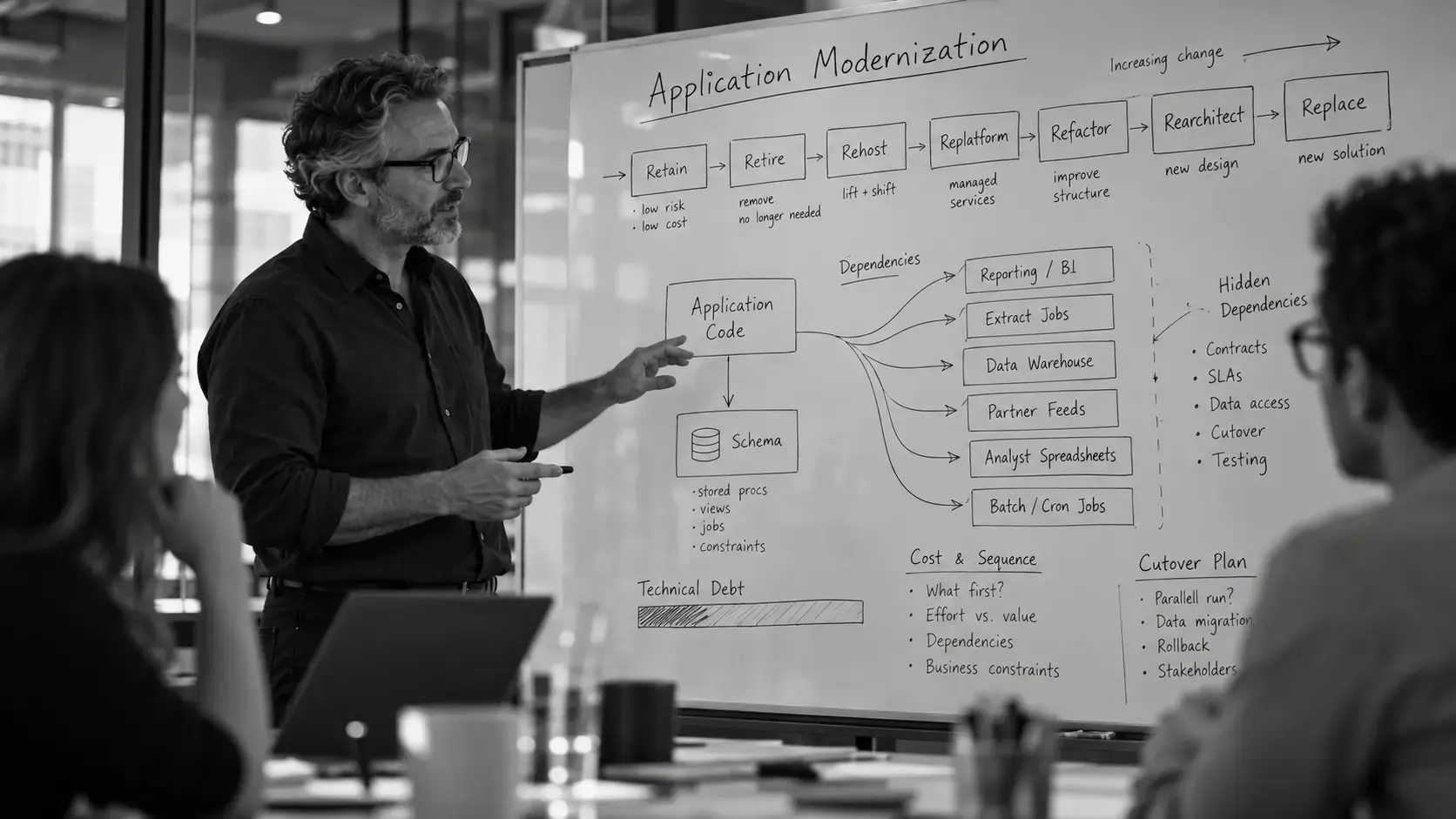
Application modernization is the work of changing what a system runs on without changing what the business depends on it for. That sentence is simple to write and hard to execute, which is why most programs fail on sequencing rather than on technology. The engineering is usually solvable. The decision about which systems to touch, in what order, against which constraint, and with what evidence at cutover is where multi-year overruns begin.
This guide is vendor-neutral. It carries no product recommendation, no platform preference, and no maturity-model pyramid. It covers the questions an application owner has to answer before signing anything, the trade-offs sitting behind each answer, and the failure modes that surface eighteen months later, once nobody remembers why a choice was made.
What application modernization actually means
The term has been stretched to cover everything from a hosting change to a full rewrite, which is precisely why budgets attached to it are so hard to defend. A narrower working definition helps. Modernization is any change to a production system’s runtime, data layer, or architecture that reduces the cost of the next change.
The test is forward-looking. Moving a monolith to a cloud VM and leaving it untouched is a hosting change, and it lowers a facilities line and nothing else. Splitting that monolith’s billing logic into a service with its own schema and its own deploy pipeline counts as modernization, because the next change to billing no longer requires a full-system regression cycle.
What often gets billed as modernization
|
Work item |
What it actually is |
Does it lower the cost of the next change? |
|---|---|---|
|
Lift-and-shift to cloud VMs |
Infrastructure migration |
No. The same code runs on someone else’s hardware. |
|
Version upgrade of a database engine |
Maintenance |
Rarely. It buys a support window rather than flexibility. |
|
Wrapping a legacy system in an API |
Integration |
Partially. Access improves while the core stays intact. |
|
Replacing a custom system with SaaS |
Portfolio change |
Yes, provided the process bends to the product. |
|
Refactoring into services with independent data |
Modernization |
Yes. |
|
Re-architecting around an event or streaming model |
Modernization |
Yes, at the highest cost and the highest risk. |
Naming the work honestly matters for a practical reason. A CFO who approves modernization and receives an infrastructure migration will decline the second phase. Most stalled programs stalled exactly there.
The five signals a system is genuinely ready
Age is a weak proxy for application modernization urgency. Systems written in 2004 that are well tested, well documented, and rarely changed can sit safely for another decade. Systems written in 2019 that nobody will touch without the one engineer who understands them cannot. The reliable signals are behavioral.
Signal 1: Change latency is rising while change volume stays flat
The same class of change takes longer each year. This is the single most reliable indicator, because it measures accumulated coupling directly instead of inferring it from an architecture diagram.
Signal 2: One person is required for any material change
A single engineer, or a small group, has to be in the room before anything significant ships. Treat this as a line on the risk register with a named owner and a mitigation date attached to it.
Signal 3: The renewal is larger than the rebuild
Licensing, extended support, and specialist maintenance accumulate on a system that delivers no competitive differentiation. Once the run cost of standing still approaches the cost of moving, the decision becomes arithmetic.
Signal 4: The system blocks a program that is already funded
Analytics, AI, a partner integration, or a new compliance regime cannot proceed until the legacy system changes. The board has already approved that spend, and the legacy system now stands between the approval and the delivery.
Signal 5: Compliance evidence has to be reassembled after the fact
Audit responses require someone to reconstruct what happened from logs and memory. The architecture is failing a governance requirement, and every new regulation compounds the failure.
How to read the signals together
One signal on its own usually argues for containment. Freeze the interface, stop investing, and plan a window for later. Three or more argues for scheduling the work. Five argues for scheduling it inside this fiscal year.
Seven dispositions, and how to choose between them
Most application modernization conversations collapse into a binary of migrate or rewrite. The useful frame applies a disposition per system across the portfolio. A typical estate ends up running four or five different dispositions in parallel, and that is the correct outcome.
The disposition matrix
|
Disposition |
What you do |
Best fit |
Typical risk |
What it costs you later |
|---|---|---|---|---|
|
Retain |
Leave it in place and freeze investment |
Stable, low-change systems that block nothing |
Low today, rising each year |
The cost is deferred, and it still arrives |
|
Retire |
Decommission and migrate the residual data |
Overlapping systems and dead features |
Low, provided actual usage is understood |
Nothing, if the usage analysis was right |
|
Rehost |
Move the runtime with no code change |
A data-centre exit under a hard deadline |
Low technically, high strategically |
The full cost of the real work, later |
|
Replatform |
Move and swap components such as the database engine, app server, or runtime |
Licensing pressure and managed-service targets |
Moderate, because behavioral differences surface under load |
Some architectural debt survives |
|
Refactor |
Restructure code and data in place |
A sound domain model inside poor structure |
Moderate, with a long parallel-run window |
The least residual debt per unit of spend |
|
Rearchitect |
Build a new architecture for the same capability |
Systems acting as a permanent constraint |
High, because scope tends to expand |
Nothing if it lands, everything if it stalls |
|
Replace |
Buy a product and retire the custom system |
Capabilities that carry no differentiation |
Moderate to high, driven by process change |
Configuration debt and vendor dependency |
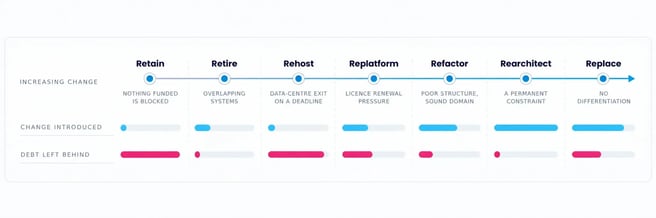
Two rules govern the table.
Rule 1: Choose against the binding constraint
If the binding constraint is a data-centre lease expiring in nine months, rehost is the right answer even when it is the least satisfying one. If the constraint is a licensing renewal, replatform is right. If the constraint is a funded AI program that cannot read the data, rearchitecting the data layer comes first and the application layer waits. The common failure is choosing the disposition that matches the ambition, then meeting the constraint mid-flight.
Rule 2: Sequenced dispositions need a trigger in writing
“Rehost now, refactor in year two” becomes a real plan once year two has a named owner, a budget line, and a written trigger condition. Without all three it is a rehost with a story attached, and the second phase quietly disappears. Ask for the trigger condition in writing before approving phase one.
The database is the dependency most programs under-scope
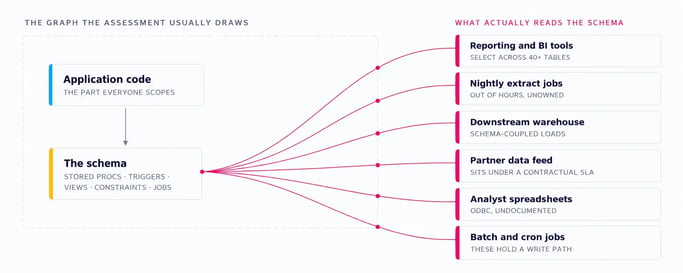
Application modernization plans are usually written by application people, and the database arrives late in the analysis as an implementation detail. In most legacy estates the data layer holds more business logic than the application code does, spread across stored procedures, triggers, constraints, scheduled jobs, and views that some quarterly report has depended on for a decade. Three consequences follow, and each one turns into schedule slip when it surfaces during build instead of during assessment.
Behavior hides where a code search cannot reach it
Transaction isolation, cursor semantics, collation and sort order, null handling, implicit type conversion, and date arithmetic all behave differently between database engines, and they differ in ways that throw no errors. They simply return different answers. A test suite written against the application will pass while the numbers quietly change underneath it.
The blast radius extends past the application boundary
Reporting tools, extract jobs, downstream warehouses, partner feeds, and spreadsheets on somebody’s laptop all read the schema directly. The application’s dependency graph and the schema’s dependency graph are two different graphs, and only one of them usually gets drawn.
Cutover risk concentrates in the data
Rolling back an application is a deployment operation. Rolling back data after hours of production writes is a reconciliation project with a timeline of its own. That asymmetry is the reason cutover planning should start at the data path and work outward from there.
What this means in practice
Assess the application and the database together, in one pass, against one dependency graph. Splitting them into two workstreams under two owners is the most reliable way to produce a plan that is internally consistent and externally wrong. Mactores scopes both layers as a single engagement for exactly that reason, and the assessment produces a single graph covering the application and the schema together.
Sequencing is the part that decides whether it lands
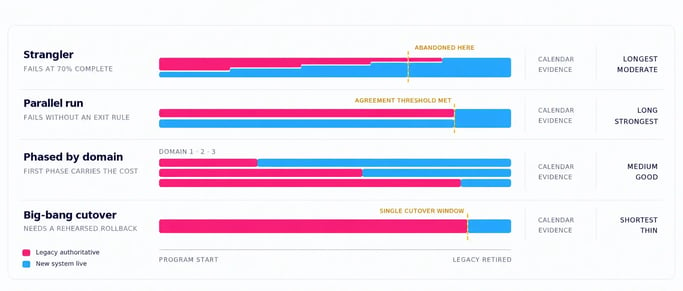
Once the disposition is set, sequencing decides the outcome of an application modernization program more than tooling does. Four patterns cover nearly all production work.
Strangler
Route traffic through a facade, move capability behind it incrementally, and retire the original once the last route is redirected. It carries the lowest risk and the longest calendar. It is also the pattern most often abandoned around seventy percent complete, which leaves two systems, two on-call rotations, and a permanent operating cost. If you choose it, name the retirement date at the start and defend it.
Parallel run
Both systems process real production traffic, outputs are compared continuously, and the legacy system stays authoritative until agreement holds at a defined threshold. This produces the strongest evidence available for regulated or financially material workloads, and it is also the most expensive pattern to operate. Parallel runs fail when nobody defines the exit criterion, so they run indefinitely and quietly become the plan.
Phased cutover by domain
Move one bounded domain completely, including its code, its data, and its consumers, then move the next. The pattern requires clean domain boundaries, which is exactly what legacy systems lack, so the first phase absorbs a disproportionate share of the cost while those boundaries get established.
Big-bang cutover
Everything moves in a single window. The pattern is correct more often than its reputation suggests, specifically when the system is small, when a parallel run is genuinely infeasible, or when partial states cannot be reconciled. It requires a rollback that has been rehearsed against production-like data and volume. A rollback that exists only as a document has never been tested.
Three artifacts to confirm before build starts
Whatever the pattern, ask whether these three exist.
- A written cutover criterion. “When testing is complete” will not do. State the threshold: reconciliation variance under a defined tolerance across a defined period, with a named person who signs.
- A rehearsed rollback. Execute it at least once against production-like data and volume, and record the result. An untested rollback plan functions as a control only on paper.
- A retirement date for the legacy system. Write it into the plan with a budget line that disappears on that date. Systems kept running for safety tend to keep running forever, and the savings case never arrives.
What application modernization costs, and why the estimate slips
Application modernization estimates fail predictably. The build is estimable. The discovery is not, because the unknown is by definition unscoped, and the commercial model decides who absorbs that gap.
How the commercial models compare
|
Model |
Who carries discovery risk |
Best fit |
Failure mode |
|---|---|---|---|
|
Time and materials |
The customer |
Genuinely exploratory work |
A change-order spiral, with the incentive misaligned against finishing |
|
Fixed-fee, fixed-date |
The vendor |
Well-bounded scope after a real assessment |
Scope defended narrowly, and ambiguity turns into dispute |
|
Outcome-based |
Shared |
A single measurable business metric |
Attribution arguments over what actually moved the metric |
|
In-house |
The customer |
Deep domain knowledge and available capacity |
Opportunity cost, because the product roadmap stops |
Three structural points hold regardless of the model you choose.
Pay for assessment separately and own the output
A discovery sprint that produces a dependency graph, a disposition recommendation per system, and a cutover risk register is worth buying on its own. Contract it so that you keep the artifacts whether or not the same firm does the build. A vendor who declines to sell assessment as a standalone deliverable is selling a sales instrument.
A fixed fee means little without overage terms
A fixed fee with unlimited change orders is time and materials with a cover page. Ask one direct question: what happens to the fee if the date slips for reasons inside the vendor’s control? The answer separates a delivery commitment from a pricing format.
Budget the run cost of the transition
Parallel runs, dual licensing, two on-call rotations, and duplicated infrastructure cost real money for the whole transition period. Programs that omit this line discover it in month four and cut the parallel run short, which is the moment risk actually enters the system.
How to measure it so the result survives board scrutiny
Application modernization is easy to declare done and hard to prove valuable. Four measures hold up under scrutiny, because each one has a baseline that predates the program.
Change latency
Median time from committed change to production, for a defined class of change. Capture the baseline before the program starts. It expresses the definition at the top of this piece more cleanly than any other number available.
Change failure rate
The percentage of changes that require remediation. A program that improves speed while degrading this number has relocated the cost instead of removing it.
Reallocated run cost
Licensing, maintenance, and specialist support that stopped, with the receiving budget line named. Savings without a stated destination will not survive a finance review.
Constraint cleared
The funded program that could not proceed, and the date it actually started. This measure is binary, dated, and the one executives remember a year later.
What to leave out of the report
Lines of code migrated, services created, and percentage complete all measure activity. Every one of them can rise while the four measures above get worse.
What changed in 2026
Two things have shifted in application modernization, and both are worth stating carefully, because the market currently overstates both.
Automation has absorbed the analysis layer
Dependency mapping, call-graph construction, dead-code identification, test generation, and parallel-run instrumentation are mechanical tasks, and agent tooling now completes them faster and more thoroughly than an analyst team does.
That genuinely changes the unit economics of assessment, and it compresses the phase that used to consume the most calendar time. The judgment layer has not moved. Which disposition fits which system, where a domain boundary belongs, how to sequence a cutover against business risk, and when the evidence is sufficient to sign all remain human decisions. Any tool claiming to automate that layer is describing a roadmap.
The AI program now prices the cost of waiting
For most organizations, the binding constraint on putting AI into real operations sits in the systems of record, which cannot be read, grounded against, or written to safely. Model access stopped being the bottleneck some time ago. This moves modernization out of the infrastructure budget and into the capital-allocation conversation, which changes who approves it and on what timeline. It also raises the standard, because a modernization that delivers a cloud-hosted version of the same opacity has not cleared the constraint.
How to evaluate an application modernization partner
Five questions, each with a wrong answer that is easy to spot.
1. Who runs the assessment, and do they run the build?
A firm that scopes the work and then hands it to a separate delivery organization has no incentive to scope honestly. Ask whether the people in the assessment sessions will be the people in the room at cutover.
2. What happens to the fee if the date slips?
Every firm commits to a date, so the commitment on its own tells you nothing. Ask who pays when the date moves.
3. What does acceptance look like in writing?
You want a named artifact, a named signer, and a defined criterion for each phase exit. “Sign-off on completion of the phase” fails all three tests.
4. Show me a cutover that went wrong
Any firm with production history has one. How they answer tells you how they behave under pressure, which is the thing you most need to know.
5. Who runs the system the day after?
If the answer is a managed-service agreement, you have replaced one dependency with another. The target state has your team owning a system they can change themselves.
The short version
Application modernization is a sequencing problem wearing a technology costume. Diagnose the system by its behavior and treat age as a weak proxy. Choose the disposition that answers your binding constraint.
Scope the database in the same pass as the application. Write the cutover criterion, rehearse the rollback, and put a retirement date on the legacy system. Measure change latency, change failure rate, reallocated cost, and the constraint you cleared. Ask the vendor who pays when the date moves.
Do those things and the engineering, which was always the solvable part, stays solvable.