Amazon Bedrock in Production: What Decides If Agents Ship


Key takeaways
- Four model properties set the cost curve: tool-calling reliability, output token verbosity, p95 latency across chained calls, and instruction adherence as the context window fills.
- Four purchasing modes shape the architecture: on-demand, cross-region inference profiles, provisioned throughput, and batch inference at 50 percent of on-demand pricing for selected models. Inference profiles and provisioned throughput cannot be used together.
- Guardrails cover the language layer only. Permission to act belongs in the tool implementation and the IAM role the agent assumes.
- Six evaluation layers gate every release: retrieval recall, tool-call validity, task completion, grounding, cost per completed task at p50 and p95, and safety. Every consequential action should carry a complete trace, with 100 percent coverage as the target.
Teams choose it because the security review is shorter and the model catalogue is broad. Teams then discover that picking Amazon Bedrock resolves roughly a fifth of the decisions that stand between a working prototype and something on call at three in the morning.
What follows is an account of the remaining four fifths: which components carry weight in production, where the cost curve bends, how the guardrail and retrieval pieces fit a real control model, and which constraints are structural rather than configurable.
What does Amazon Bedrock actually hand you on day one?
Three things arrive immediately, and the value of each is easy to over-read.
-
A single inference surface across model families. The Converse API normalises message formats, system prompts, tool definitions and streaming across models from several providers, which makes swapping a model a configuration change instead of a rewrite. The abstraction is real but partial. Tool-calling reliability, instruction adherence and reasoning behaviour vary sharply between families, so a swap that compiles is not a swap that behaves.
-
An AWS-native security posture. Calls authenticate through IAM, traffic can stay on PrivateLink, keys are managed in KMS, and the audit trail lands in CloudTrail. For a regulated enterprise this collapses weeks of review, and it is the single most common reason the platform gets selected.
-
No inference capacity to manage. Nothing to size, patch or scale until the point where throughput commitments enter the picture, which is a real threshold and is covered further down.
What does not arrive is an agent. The orchestration, the tool contracts, the evaluation harness and the operational model remain engineering work regardless of which managed service sits underneath.
Which Amazon Bedrock components matter once agents leave the pilot?
The service surface is wide, and most of it is irrelevant to a first production agent. These are the pieces that carry weight, and the production concern each one answers.
AgentCore reached general availability in October 2025, which matters for planning: the managed runtime, gateway, identity, memory and observability pieces are now supportable choices rather than preview bets, and the build-versus-adopt conversation has changed accordingly.
The honest framing for a first agent is that Runtime, Gateway, Identity and Observability remove genuine undifferentiated work. Memory and Knowledge Bases deserve a harder look, because both encode opinions that your data may not share.
Each piece also has a characteristic way of being misread. The Converse API gets treated as behavioural parity when it only delivers interface parity. Teams build a bespoke orchestrator before testing whether Runtime already fits. Gateway gets adopted as an integration shortcut when its real value is the authorisation boundary it imposes. Identity gets bypassed in favour of one broad role covering every action the agent can take.
Memory gets switched on before anyone has written a retention and deletion policy. Observability defaults get accepted as an audit trail when they are an operations dashboard. Knowledge Bases get pointed at messy enterprise documents on the assumption that the defaults will hold. Guardrails get mistaken for the authorisation model. And Model Evaluation gets run once during selection and never wired into the release path.
02
How should a model be selected on Amazon Bedrock without repricing the system later?
Model choice sets the cost curve, and the cost curve is what kills agent programmes at scale rather than at pilot. Four properties matter more than benchmark position.
- Tool-calling reliability under pressure. Measure how often the model emits well-formed, schema-valid tool arguments across a few hundred real tasks, including malformed and adversarial inputs. A model two points behind on a reasoning benchmark but materially better at producing valid arguments will finish more tasks with fewer retries, and retries are where agent budgets go.
- Output token verbosity. Two models with identical input pricing can differ by a wide margin in tokens emitted per step. Across a twelve-step loop that difference compounds into the dominant line on the bill.
- Latency distribution rather than median. Agent loops multiply latency by step count. A model with a good median and a heavy tail produces an unusable p95 once four calls are chained.
- Context handling as the window fills. Instruction adherence degrades differently across families as context grows. Test at the context size the agent will actually reach at step ten, not at step one.
Pin the model version explicitly and treat a version change as a code change that must clear the evaluation suite. Provider versions move, and behaviour drift traced to an unpinned model has cost more than one team a fortnight of debugging that found nothing in their own code.
What does Amazon Bedrock cost at production volume?
AWS exposes four purchasing modes, and choosing between them is an architecture decision rather than a procurement one.
| Mode | what it buys | Fits | Structural Contstaint |
|---|---|---|---|
|
On-demand |
Per-token pricing, no commitment | Variable traffic, early production | Subject to account-level throughput quotas |
| Cross-region inference profiles |
Capacity spread across regions on the on-demand path |
Spiky traffic that would otherwise throttle | Does not combine with provisioned throughput, and routes requests across regions |
| Provisioned throughput | Reserved tokens per minute for a committed term |
Predictable, high-importance traffic |
A commitment, and incompatible with inference profiles |
| Batch inference |
Asynchronous processing, priced at 50 percent of on-demand for selected models |
Backfills, evaluation runs, bulk enrichment |
Not an interactive path |
Two of those rows contain the constraint that reshapes architectures. Cross-region inference profiles and provisioned throughput are mutually exclusive, so the question of whether traffic can leave a region has to be answered before capacity strategy is chosen rather than after. A team that commits to provisioned throughput and later needs burst headroom discovers that the obvious mechanism is unavailable to them.
Prompt caching is the lever most teams reach for last and should reach for first. Agent loops resend a stable prefix of system prompt, tool definitions and instructions on every step, and caching that prefix converts the most repetitive part of the bill into a fraction of its former cost.
Extracting the benefit requires discipline: the cached prefix has to be byte-stable, so anything dynamic belongs after it, and a timestamp injected into a system prompt will quietly destroy the hit rate.
The number to manage is cost per completed task, tracked as a distribution. Agent costs are long-tailed, and a small population of pathological tasks that loop before failing routinely accounts for a disproportionate share of spend. A mean will hide that completely.
Where do Amazon Bedrock Guardrails belong in an agent’s control model?
Guardrails apply content filters, topic denial, sensitive-data handling and contextual grounding checks to model inputs and outputs, independently of the model in use. They are genuinely useful and they sit in one specific layer.
Read the two bands carefully. Guardrails inspect language. Authorisation governs consequence. A configuration that blocks a model from discussing refunds does nothing to stop a tool call that issues one, because the two operate at different layers on different inputs.
Permission to act belongs in the tool implementation and in the IAM role the agent assumes, and it should hold even if every instruction the model receives has been subverted.
Grounding checks deserve separate attention. They compare a response against supplied context and score faithfulness, which makes them a useful last line of defence and a poor substitute for retrieval that returned the right passages in the first place.
03
Should retrieval run on Bedrock Knowledge Bases or your own pipeline?
Knowledge Bases handle ingestion, chunking, embedding, vector storage and retrieval as a managed path, which removes real work. The decision turns on how much of your corpus behaves the way the defaults assume.
| factor | Knowledge Bases fit well | Build the pipeline |
|---|---|---|
| Document structure | Reasonably clean text with consistent formatting | Dense tables, scanned originals, structure-carrying layouts |
| Chunking | Default strategies produce sensible passages | Boundaries must follow domain structure such as clauses or procedure steps |
| Entitlements | Access is uniform across the corpus | Per-document permissions that must constrain the query itself |
| Freshness | Scheduled synchronisation is acceptable | Minutes-level currency driven by change data capture |
| Retrieval strategy | Managed hybrid retrieval performs adequately | Custom ranking, domain rerankers, query rewriting |
| Deletion | Standard removal on resync | Verified deletion across index, cache and derived artefacts |
The determining factor is usually the entitlement column. Where users are entitled to different subsets of the corpus, authorisation has to constrain the candidate set inside the query rather than trim results afterwards, since filtering after retrieval lets forbidden passages consume the result budget and collapses recall for the least privileged users.
A pattern worth considering is a managed start with an exit. Begin on Knowledge Bases to reach a working system quickly, instrument recall against a labelled task set from the outset, and treat a persistent recall ceiling as the signal to take ownership of the pipeline. The measurement is what makes that decision evidence-based rather than architectural preference.
04
How do agents on Amazon Bedrock reach systems that were never designed for them?
AgentCore Gateway exposes existing APIs and MCP servers as agent tools with IAM authorisation attached, which solves the connection problem cleanly when a usable interface already exists. The difficulty in most enterprises is that it does not.
The systems holding the process an agent needs frequently offer no transactional API, carry an access model designed for a reporting tool a decade ago, and keep their business rules inside stored procedures nobody currently employed has read. Three routes exist, with materially different risks.
- Read via change data capture. Stream changes from the source into a queryable store and let the agent read current state without touching the system of record. Low risk, and it addresses only half the problem.
- Write via a service façade. Stand up a service that owns the process rules and presents an idempotent, typed contract for the Gateway to publish, so the rules live somewhere readable instead of inside a trigger. That is substantial engineering, and it is the only route on this list that survives a control review.
- Screen-level automation. Driving a terminal or browser session is brittle enough that it belongs in a plan as a dated interim measure rather than a destination.
Recognising which of these applies changes the shape of the programme. Where a legacy estate stands between the agent and the work, the critical path runs through application and database modernisation with an agentic outcome attached, and scoping it as a Bedrock project guarantees the expensive discovery lands in the phase with the least budget left.
How is data residency maintained on Amazon Bedrock?
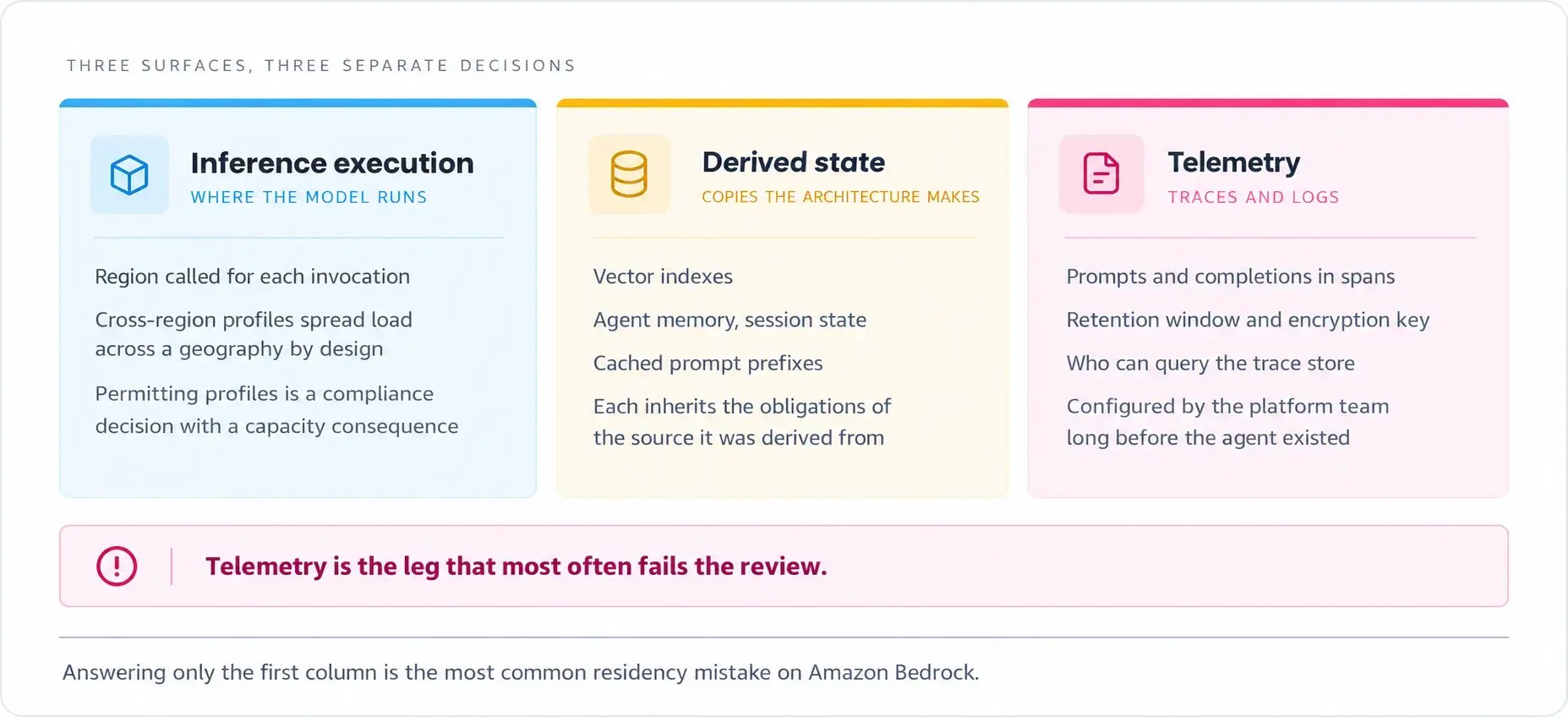
Three separate questions decide residency, and teams routinely answer the first and assume the rest.
-
Where inference executes. Model invocation happens in the region targeted. Cross-region inference profiles improve availability by distributing requests across regions in a geography, which is exactly the behaviour a strict residency commitment forbids.
Deciding whether profiles are permitted is a compliance decision with a direct capacity consequence, since the alternative path to headroom is a throughput commitment.
-
Where the derived state persists. Vector indexes, agent memory, session state and cached prefixes are copies of the source data and inherit its obligations. Managed memory in particular deserves an explicit retention and deletion answer before adoption rather than after.
-
Where telemetry lands. Traces and logs containing prompts and completions hold the same sensitive content the agent processed. Observability data flows to CloudWatch, and the retention window, the encryption key and the list of people who can query it are all part of the residency posture.
This is the leg that most often fails a review, because the platform team configured the observability stack long before the agent programme existed.
What does observability look like for an Amazon Bedrock agent?
AgentCore Observability emits OTEL-compatible telemetry into CloudWatch, covering session counts, latency, duration, token usage and error rates, with a GenAI observability view for AgentCore resources. That is a solid operational baseline and a partial audit trail.
The gap is intent. Platform metrics answer how the system behaved. A reviewer asks what evidence the agent used and on what basis it acted, which requires span attributes the application has to emit: the task identifier, the step index, the tool invoked, a hash of the arguments, identifiers for every retrieved passage, the authorisation decision, and the reason the loop terminated.
Emit those synchronously at decision time and the audit conversation becomes a query. Reconstruct them later from platform logs and it becomes an archaeology project with a deadline.
Four alerts earn their place in the first week of production: token spend per task crossing a threshold, step-budget exhaustion rate rising, tool error rate by tool, and escalation volume moving in either direction. A falling escalation rate alongside rising complaints is the signature of an agent that has become confidently wrong.